
Traditional Balinese Massage in Melbourne: What to Expect
What makes a massage feel right depends on more than its name. If you’re considering traditional balinese massage melbourne, it’s reasonable to want a clear picture before booking, especially if you’re unsure how the style differs from other massage options or whether it suits your preferences.
Traditional Balinese massage is a massage tradition associated with Bali, Indonesia, and is distinct from Chinese Medicine. This guide explains what the style’s name can tell you, how to compare massage descriptions, and what to think about when planning a session. Zhong Centre offers Traditional Balinese Massage at its St Kilda clinic at 306a to 310 St Kilda Road. The clinic has wheelchair-friendly entrances and treatment rooms that accommodate mobility challenges. On-site parking availability may vary, and nearby street parking is subject to local restrictions.
Key Takeaways
- Traditional Balinese massage is associated with Bali, Indonesia. The name refers to a cultural style, while your experience depends on the individual session.
- Descriptions of traditional balinese massage melbourne can vary. Read them as a guide to the service rather than a promise of a particular technique or pressure.
- Compare massage styles by the experience and pressure you prefer, not by labels alone.
- Before your appointment, consider what feels comfortable and share relevant health information or pressure preferences.
- Zhong Centre offers Traditional Balinese Massage at its St Kilda clinic. Use the practical details in this guide to plan your visit.
Traditional Balinese massage in Melbourne: what the name means
An unfamiliar massage name can make choosing a Melbourne service feel uncertain. Does “traditional” describe a set sequence, a particular technique or the style’s cultural roots? Start by separating the tradition’s name from what you personally want from a session.
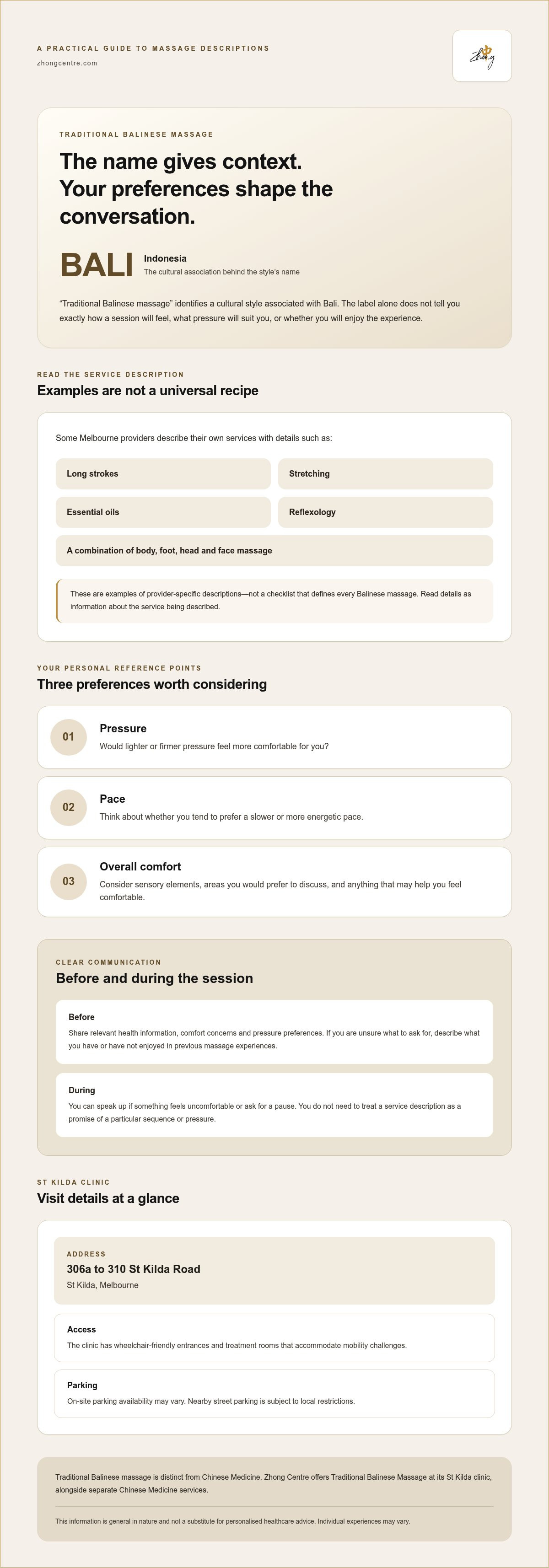
Traditional Balinese massage is associated with Bali, Indonesia. The name identifies a cultural style, but it doesn’t predict exactly how a session will feel or what pressure will suit you. If you’re considering traditional balinese massage melbourne, this distinction helps you understand what the label can tell you and what to consider for yourself.
Where the Balinese massage tradition comes from
Balinese massage is associated with Bali, an Indonesian island with its own cultural and healing traditions. General accounts describe it as shaped by a mix of influences, rather than as one fixed technique. The Balinese massage overview offers background on the tradition and its influences. It’s a broad introduction, not a definitive account of every local practice.
That context matters when you’re reading about a massage style. A service described as Balinese draws on a cultural tradition, but the label alone doesn’t give you a personal guide to pressure or comfort. Approaches can differ between settings. Respectful language recognises the tradition’s cultural association without reducing it to a single standardised routine.
What the term does, and does not, tell you
The words “Balinese massage” tell you the cultural style associated with the service. They don’t predict how much pressure you’ll prefer, how the pace will feel to you or whether you’ll enjoy the experience. Those are personal considerations, so don’t assume the name tells you whether the massage will suit you.
Nor should a traditional label be taken as a promise of relaxation or a health improvement. People’s preferences and experiences differ. When deciding whether to book, consider what you find comfortable, and think about how you’ll communicate if you want a pause or a change during the session.
It’s also useful to keep the cultural label distinct from Chinese Medicine. A massage tradition associated with Bali is not automatically a Chinese Medicine technique. Zhong Centre offers Traditional Balinese Massage at its St Kilda clinic, alongside Chinese Medicine services such as acupuncture and consultations. These are distinct offerings, so compare them according to what you’re looking for rather than assuming they involve the same approach. The next step is to consider how massage descriptions and your own preferences can help you decide whether this style appeals to you.
Balinese massage techniques and the experience: what descriptions can tell you
Massage descriptions can sound precise while still leaving room for individual experience. Some explain a service through specific manual approaches; others use broader wording. Read those details as information about the service being described, not as a definition of every Balinese massage.
A treatment label can point to a tradition, but it can’t guarantee a uniform session. For anyone considering traditional balinese massage melbourne, it’s more useful to read service information carefully and reflect on personal comfort than to assume every session follows the same sequence or uses the same pressure.
How to read descriptions of massage techniques
Some Melbourne providers describe their own services using terms such as long strokes, stretching, essential oils, reflexology, or a combination of body, foot, head and face massage. These are examples of provider-specific descriptions, not a checklist that defines the entire Balinese tradition. A list on one clinic’s page describes that service. It isn’t a universal guide to what the style involves.
Zhong Centre offers Traditional Balinese Massage. When considering any massage, focus on the information about that service and your own preferences rather than assuming every provider follows the same approach. For example, if you have a particular preference about pressure or pace, identify it before your appointment so you can communicate it clearly.
Why individual preferences matter
Before the session, share comfort concerns, areas you’d prefer to discuss and relevant health information. You can also speak up if something feels uncomfortable during the massage. Clear communication gives the practitioner useful information, and you can ask for a pause if you need one.
A useful service description gives you a starting point for deciding whether a massage sounds appealing. Then use your own preferences to guide what you communicate about pressure, pace and comfort. This is more helpful than treating a list of techniques as a universal recipe.
If you’re considering a visit, Zhong Centre’s booking information can help you plan. Before your appointment, think through any comfort needs and relevant health information you’d like to share.
Traditional Balinese massage versus other styles: find your best fit
The same applies to traditional balinese massage melbourne. “Traditional” refers to a style and cultural association. The label doesn’t guarantee a particular technique, pressure level or therapeutic result, and it can’t tell you exactly how a session will feel.
| Style label | Intended experience described | Pressure preference to consider | What to look for in the service description |
|---|---|---|---|
| Balinese massage | A massage associated with the Balinese tradition. The details can differ between providers. | Don’t assume pressure from the name. Consider what feels comfortable for you. | Look for the provider’s own description rather than assuming every service uses the same methods. |
| Relaxation massage | The label commonly signals a focus on a calming massage experience, but descriptions vary. | Check whether the wording gives you a sense of the intended pressure and pace. | Read the clinic’s explanation; the label alone doesn’t set a universal format. |
| Deep-tissue massage | A separate style description that may indicate a focus on firmer or more targeted pressure, depending on the provider. | Consider whether you’re comfortable with the pressure described. Don’t assume it will suit you. | Check how the provider explains the approach. Deep-tissue wording isn’t a feature you should automatically attribute to Balinese massage. |
Balinese massage and relaxation massage: compare the description
If you’re drawn to a quieter, gentler-feeling experience, pay attention to the words a provider uses to describe pace, pressure and overall approach. “Relaxation” is a service label, not a promise about how you’ll feel. Zhong Centre offers Traditional Balinese Massage. The comparison here is a way to help you read massage labels, not a suggestion that Balinese and relaxation massage are interchangeable.
Balinese massage and deep-tissue massage: compare expectations
Deep-tissue wording describes a separate massage category. It shouldn’t be read as an automatic part of Balinese massage, and the Balinese label alone doesn’t tell you whether the pressure will feel light or firm. If pressure or pace matters to you, communicate your preference and any comfort concerns before the session. Suitability and individual experience vary.
Keep the cultural tradition distinct from Chinese Medicine, too. They are separate traditions, even where general descriptions discuss historical influences between healing systems. If you’re weighing massage against a Chinese Medicine service, compare what each service involves and which approach fits your preferences.
Getting ready for a Balinese massage in Melbourne
A little preparation can make it easier to focus on what matters: comfort, preferences and the practical details of getting to your appointment. You don’t need to arrive with a perfect script. A few clear points can help you communicate and make an informed decision about your visit.
What to consider before your appointment
Before you arrive, consider your preferences around pressure, pace and sensory experience. For example, you might prefer lighter pressure or feel more comfortable knowing you can speak up if something doesn’t feel right. These are personal preferences, not a way to predict how you’ll feel afterwards.
Share relevant health information and comfort concerns before the massage. If you have an individual health concern or are unsure whether massage is suitable for you, speak with a qualified health professional. For clothing, eating or aftercare, follow the appointment information rather than assuming a general rule applies to every massage.
A simple preparation sequence can keep things straightforward:
- Think about pressure, pace and any areas you’d prefer to discuss.
- Make a note of relevant health information or questions you want to raise.
- Review practical visit details so you can plan your trip to St Kilda.
Planning a visit to Zhong Centre in St Kilda
Zhong Centre offers Traditional Balinese Massage at 306a to 310 St Kilda Road, St Kilda, VIC 3182. The clinic has wheelchair-friendly entrances, and treatment rooms accommodate mobility challenges. Keep these access details in mind as you organise your visit.
On-site parking availability may vary. Nearby street parking is subject to local restrictions, so check the signs and restrictions when planning where to park. The clinic’s frequently asked questions page can also help with practical visit planning.
For traditional balinese massage melbourne, choosing a service starts with more than recognising the style name. Consider whether the approach appeals to you, think through what you’d like to communicate about comfort, and plan your trip in a way that suits your access needs. Zhong Centre’s St Kilda clinic is accessible to people travelling from across Melbourne, including Elwood, Bayside, Armadale, Toorak, Windsor, Prahran, St Kilda East, Melbourne East, Elsternwick, Port Melbourne, Albert Park, Caulfield, Malvern, Chadstone, Balaclava and Ripponlea.
If you’re ready to plan a visit, you can book Traditional Balinese Massage at Zhong Centre.
Book traditional Balinese massage at Zhong Centre in St Kilda
If the style seems like a possible fit, review the booking information and decide whether you’d like to proceed. Zhong Centre offers Traditional Balinese Massage. The service name identifies the cultural style, but it doesn’t promise a particular technique, sequence, pressure or outcome.
What is confirmed about the local clinic
Zhong Centre’s St Kilda clinic is at 306a to 310 St Kilda Road, St Kilda, VIC 3182, and Traditional Balinese Massage is offered at this location. Keep your expectations focused on what matters to your decision: whether the service appeals and whether the clinic’s location and access arrangements suit your visit.
Take the next step at your own pace
Choosing traditional balinese massage melbourne is a personal decision. Consider whether the style aligns with your preferences, and note any comfort concerns or relevant health information you may want to discuss. If you have questions about your health circumstances, consider seeking advice from a qualified health professional.
Review the booking information and choose an appointment option that suits you. Book Traditional Balinese Massage at Zhong Centre when you’re ready.
Choose your next step with confidence
Choosing traditional balinese massage melbourne doesn’t require you to know every detail of the tradition. Focus on what matters to you: whether the style appeals, what you’d like to communicate about comfort, and whether the practical arrangements suit your visit.
Zhong Centre offers Traditional Balinese Massage at its St Kilda clinic. Wheelchair-friendly entrances and treatment rooms that accommodate mobility challenges are part of the clinic’s access arrangements. The service name doesn’t guarantee a particular technique or result, so keep your expectations grounded and your preferences clear.
If the offering feels like a suitable option for you, take the next step at your own pace. Book a Traditional Balinese Massage at Zhong Centre and review the booking information as you plan your visit.
Frequently Asked Questions
Is traditional Balinese massage suitable for everyone?
No. Whether it’s suitable depends on your individual circumstances, health history and comfort preferences. If you have an injury, a health condition or concerns about pressure, consider getting advice from an appropriately qualified health professional before booking. Think about what you’d be comfortable communicating during the session, too. Personalised advice can help you decide whether massage is an appropriate option for you.
Can I ask for lighter pressure during a Balinese massage?
Yes. You can communicate that lighter pressure is your preference or ask for a pause if you feel uncomfortable. You might say, “Could you use less pressure here?” or explain that you’re sensitive in a particular area. Clear, timely communication helps the practitioner understand your comfort concerns. If you remain uncomfortable, you can ask to stop the session.
What should I wear to a traditional Balinese massage?
Clothing and draping practices vary between providers, so there isn’t one rule to assume for every appointment. Choose comfortable clothing for travelling to the clinic, then follow any service-specific instructions in your appointment information. If you’re unsure what to expect, review the clinic’s practical information before you go.
Is traditional Balinese massage appropriate during pregnancy?
Pregnancy can change what feels comfortable and what you need to consider before massage. Discuss your plans with your maternity-care professional before booking, particularly if you have questions about your individual circumstances. If you’re considering traditional balinese massage melbourne while pregnant, include relevant health information and comfort concerns in your decision. This answer doesn’t establish that a particular massage technique is suitable during pregnancy.
What should I do if I feel discomfort during a massage?
Speak up promptly and describe what feels uncomfortable, such as pressure in one area or a position that doesn’t feel right. You can ask for a pause or stop the session if you don’t feel comfortable continuing. You don’t need to wait until the end to raise a concern. Clear communication is a practical way to make your preference known.
Can massage replace care from a doctor or other health professional?
No. Massage shouldn’t be used as a substitute for diagnosis, medical advice or care from an appropriately qualified health professional. If you have symptoms that are new, persistent or concerning, seek personalised advice rather than relying on massage to assess them. Massage doesn’t diagnose or replace medical care.
This information is general in nature and not a substitute for personalised healthcare advice. Individual experiences may vary.