
TCM Lifestyle Advice for Fertility: Practical Habits to Support Your Journey
What if supporting your fertility journey didn’t mean adding a dozen new rules to your day? Conflicting advice can make every meal, workout and bedtime feel like a decision you might get wrong. TCM lifestyle advice for fertility offers a different lens: practical ideas informed by Traditional Chinese Medicine, considered in the context of your individual needs and preferences.
The key is personalisation, not a one-size-fits-all checklist. In Traditional Chinese Medicine, practitioners may consider everyday habits as part of a broader picture of wellbeing. That perspective is distinct from biomedical explanations, and it shouldn’t replace medical fertility assessment or care. You can explore complementary support while keeping your fertility healthcare team informed.
In this article, you’ll find manageable ways to think about food, movement, rest and stress through a TCM lens, without turning daily life into another source of pressure. We’ll also look at why individual advice matters and how to assess suggestions before acting on them. At Zhong Centre in St Kilda, a personalised TCM consultation can provide space to discuss lifestyle questions in context.
Key Takeaways
- Understand TCM lifestyle advice for fertility as a traditional framework for discussing wellbeing, not a biomedical diagnosis or fertility prescription.
- Explore food, sleep, movement and stress care as flexible topics to discuss, rather than rules you must follow.
- Weigh fertility advice by asking whether it’s practical, appropriately sourced and compatible with your wider healthcare.
- Build a manageable routine by choosing one priority, keeping it realistic and reviewing how it fits your circumstances.
- A personalised TCM consultation at Zhong Centre, 306a-310 St Kilda Road, St Kilda, can help put lifestyle questions in context. The clinic has wheelchair-friendly entrances and treatment rooms that accommodate mobility challenges. All Aesthetic Acupuncture appointments always include a full Chinese Medicine diagnostic treatment.
What does TCM lifestyle advice for fertility mean?
Fertility advice can quickly become a pile of rules. TCM lifestyle advice for fertility takes a different approach: it draws on Traditional Chinese Medicine to explore everyday habits and wellbeing in the context of the person, rather than prescribing a universal routine.
In plain terms, TCM lifestyle guidance is traditional, individualised advice about habits and wellbeing; it is not medical fertility care, a biomedical explanation of conception or a guarantee of pregnancy. It may offer topics to reflect on, but general lifestyle ideas can’t establish the cause of fertility concerns or replace an assessment.
How does Traditional Chinese Medicine view fertility and wellbeing?
Traditional Chinese Medicine uses concepts such as balance, Yin and Yang, Qi and Blood to interpret health within its own traditional framework. These concepts aren’t biomedical diagnoses or established physiological mechanisms. The Traditional Chinese Medicine tradition includes a range of theories and practices, and its language should be understood on those terms, not as a substitute for clinical explanations.
A practitioner may ask about your broader health, daily routine and circumstances before discussing whether any lifestyle ideas feel relevant. That conversation doesn’t mean a particular TCM pattern applies to you. Avoid self-diagnosing from an online checklist. The same general suggestion may not suit everyone, and your needs may change over time.
Where does lifestyle advice fit alongside fertility care?
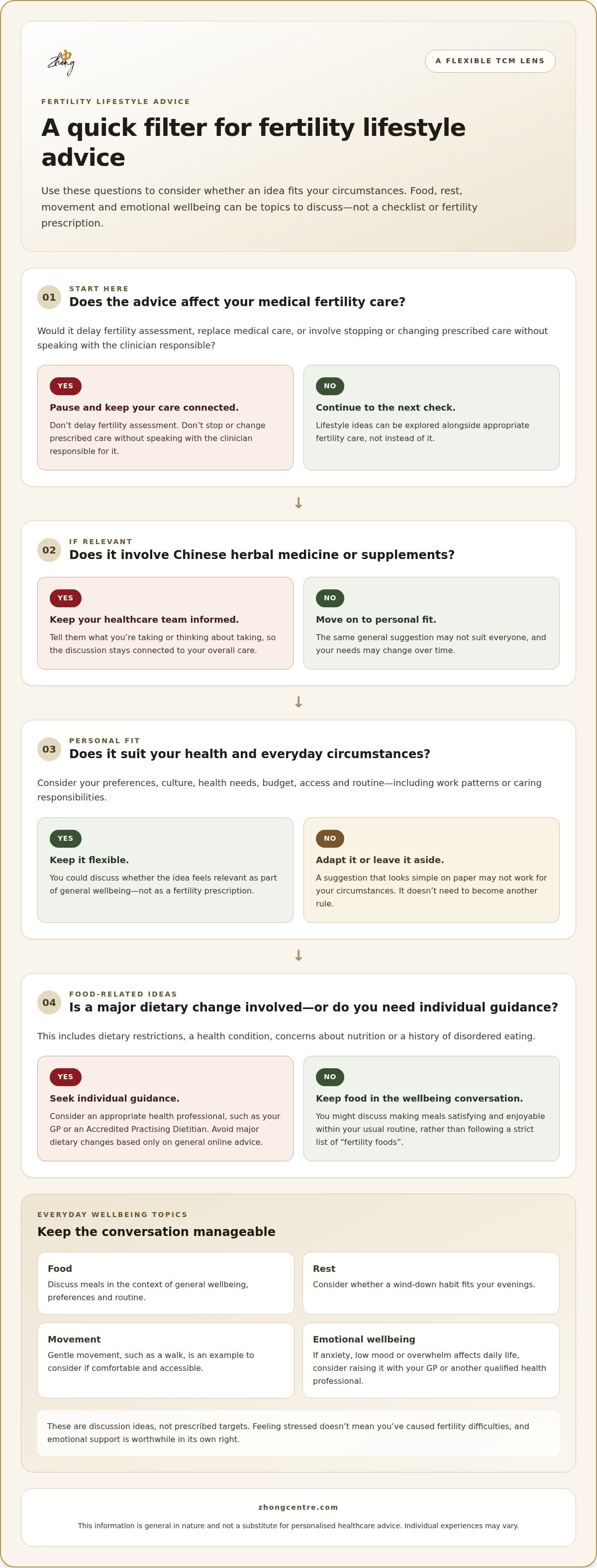
Lifestyle suggestions are optional areas to discuss alongside appropriate fertility care. You might explore whether a manageable change to a daily routine feels supportive while continuing conversations with your GP or fertility specialist. A TCM perspective can sit beside medical care, not replace it.
Don’t delay fertility assessment to try general lifestyle advice, and don’t stop or change prescribed care without speaking with the clinician responsible for it. If you’re considering Chinese herbal medicine or supplements, tell your healthcare team what you’re taking or thinking about taking. This helps keep the discussion connected to your overall care.
A personalised TCM consultation can give you space to raise questions and consider advice in context. Zhong Centre offers TCM consultations and fertility support at 306a-310 St Kilda Road, St Kilda, VIC 3182. The clinic has wheelchair-friendly entrances and treatment rooms that accommodate mobility challenges. All Aesthetic Acupuncture appointments always include a full Chinese Medicine diagnostic treatment.
Which everyday habits can you discuss through a TCM fertility lens?
Food, sleep, movement and emotional wellbeing can all be conversation starters in a TCM consultation. They’re not a fertility checklist, and there’s no single routine that suits everyone. TCM lifestyle advice for fertility is most useful when it stays flexible, respects your circumstances and doesn’t turn everyday choices into another source of pressure.
Food, rest, movement and stress care are four everyday wellbeing areas you can discuss through a TCM lens, without treating them as ways to improve conception rates. Your preferences, culture, health needs, budget and access all matter. A suggestion that looks simple on paper may not work with shift work, caring responsibilities, dietary requirements or what’s realistically available to you.
How can you approach food without rigid fertility rules?
Think about meals as part of general wellbeing, not as fertility care. You might discuss how to make meals satisfying and enjoyable within your usual routine, rather than following a strict list of “fertility foods”. No single ingredient can be labelled a fertility cure, and a food described in traditional terms shouldn’t automatically be considered suitable or unsuitable for everyone.
For example, a practical conversation could focus on adapting meals to your preferences, culture and schedule. If you have dietary restrictions, a health condition, concerns about nutrition or a history of disordered eating, seek individual guidance from an appropriate health professional, such as your GP or an Accredited Practising Dietitian. Avoid major dietary changes based only on general online advice.
How do sleep, movement and emotional wellbeing fit in?
Trying to conceive or attending fertility appointments can be emotionally demanding. Feeling stressed doesn’t mean you’ve caused fertility difficulties, and you shouldn’t be made responsible for controlling every feeling. If anxiety, low mood or overwhelm is affecting daily life, consider raising it with your GP or another qualified health professional. Emotional support is worthwhile in its own right, not a test of whether you’re doing fertility “well”.
To keep these conversations grounded, ask: “Does this idea suit my health and routine?”, “Is it being offered as general wellbeing guidance or as a claim about conception?” and “Could it conflict with advice I’m already following?” You don’t need to overhaul your day. Start with an area you’re comfortable discussing and leave out suggestions that feel restrictive, inaccessible or at odds with your care.
If you’d like to explore how lifestyle questions fit your circumstances, a personalised TCM consultation can provide space to discuss them in context.
How can you assess TCM fertility advice without rigid rules?
Advice can sound convincing and still be a poor fit for your life. A strict routine may offer a sense of certainty, but it can add pressure, cost or impractical demands without establishing what’s right for your health. Flexible changes leave room to adapt. Neither approach can control fertility outcomes, and there’s no perfect routine you must follow to deserve support.
Traditional Chinese Medicine recommendations sit within a traditional framework. That’s different from a claim supported by clinical research. Ask what kind of advice you’re hearing, what it’s based on and whether it’s being presented as a personal perspective, a general wellbeing idea or a proven medical effect. Clear distinctions help you make an informed choice without dismissing the tradition or overstating what it can show.
What makes a lifestyle suggestion realistic and useful?
A useful suggestion should take your preferences, resources and existing health needs seriously. Before trying it, consider whether it’s affordable, accessible and manageable alongside work, family life and current care. A small adjustment you can comfortably maintain may be more practical than a long list of rules. If your routine varies, that isn’t a personal failure or proof you’ve undermined your fertility.
Use these questions when advice feels confusing:
- Is this a traditional TCM recommendation, or is someone making a clinical research claim?
- Is the source clear, and does it explain uncertainty or limitations?
- Does the suggestion fit my health needs, preferences and circumstances?
- Could it conflict with prescribed medicines, fertility care or advice from my healthcare team?
Be especially wary of messages that promise a particular fertility outcome if you follow a “perfect” diet, routine or mindset. Fertility is not a measure of how well you’ve followed lifestyle advice. A suggestion should be something you can consider, not another standard to judge yourself against.
How should you handle herbs or conflicting fertility advice?
Don’t start herbal medicines or supplements based only on a general article, social media post or another person’s recommendation. Products can have side effects or interact with medicines. Healthdirect Australia’s guidance on complementary medicines recommends discussing their use with a health professional. This is particularly relevant if you’re taking prescribed medicines or receiving fertility care.
Good advice makes space for questions. It should help you weigh your options, not insist that one rigid plan is the only path.
How can you build a manageable TCM-informed fertility routine?
A routine doesn’t need to be elaborate to be worth considering. Start with one area you genuinely want to explore, make the idea fit your current life, then review whether it feels practical. That keeps TCM lifestyle advice for fertility from becoming another demanding checklist. It’s a way to organise wellbeing choices, not a method for controlling conception or measuring your chances.
How do you choose a first step that suits your life?
Pick a routine area that matters to you, rather than the one that sounds most impressive. You might prepare a meal you enjoy when it suits your schedule, or set aside a quiet moment during a part of the day that already has some breathing room. Keep the first version small enough to adapt around work, family, health needs and energy levels. Missed days happen. They don’t invalidate the rest of your routine.
Use this table as a planning prompt, not a prescription. The examples are starting points to adapt or leave aside according to your circumstances.
| Habit area | Your personal reason | A practical version | Review prompt |
|---|---|---|---|
| Meals | I’d like mealtimes to feel less rushed. | Prepare one familiar meal when it fits my week. | Was this enjoyable and workable? |
| Rest | I want a calmer transition into the evening. | Set aside a quiet moment in a way that suits my home. | Did this feel comfortable, or like another task? |
| Movement | I’d like to make space for movement I enjoy. | Choose an accessible activity that feels appropriate for me. | Did it fit my energy and health needs? |
| Emotional wellbeing | I want time to check in with myself. | Make a brief pause for reflection or a supportive conversation. | Would I choose to do this again? |
How can you review your routine without turning it into pressure?
Review the experience, not conception as a pass-or-fail result. Ask whether the habit felt comfortable, practical and supportive of your general wellbeing. If it added stress, cost or strain, you can adapt it, pause it or decide it isn’t right for you. A routine should respond to your life, not demand that your life bend around it.
Chinese Medicine offers a broader traditional framework for discussing wellbeing. A practitioner can help you consider how general lifestyle questions fit within that perspective, without treating a routine as a fertility guarantee. At Zhong Centre, a personalised TCM consultation can provide space to discuss your questions alongside the fertility care you’re receiving. Share relevant changes with your GP or fertility specialist, and don’t alter prescribed care based on a lifestyle plan.
If you’d like to discuss fertility acupuncture in a TCM context, a consultation can help you explore whether that approach fits your circumstances.
What can a Melbourne TCM fertility consultation add to your plan?
Trying to sort useful lifestyle ideas from conflicting advice can feel like a job in itself. A TCM consultation offers a place to discuss your questions in context, including how Traditional Chinese Medicine perspectives and fertility support might sit alongside your existing care. It doesn’t predict or guarantee conception, and it isn’t a substitute for fertility assessment or medical care.
What can you bring to a personalised fertility discussion?
Bring the questions that matter to you. You might want to talk through a routine you’re considering, what feels manageable in your day, or how complementary support could fit with fertility care. There’s no need to arrive with a perfect plan. The purpose is to have a considered conversation, not to assume a particular consultation will diagnose or resolve a fertility concern.
It can also help to share relevant medicines, supplements and details of fertility care you’re receiving. That gives the practitioners involved a clearer picture to discuss and helps keep complementary support in view alongside your wider healthcare. Continue working with your GP or fertility specialist, and don’t change prescribed care based on general lifestyle suggestions.
- Write down the questions you’d like to cover.
- Note any routine changes you’re considering and what makes them appealing or difficult.
- Bring relevant information about medicines, supplements and current fertility care.
This kind of preparation can keep the conversation focused on your circumstances and preferences. TCM lifestyle advice for fertility should be individualised, considered and complementary to appropriate medical care, not a new set of rules to follow at all costs.
How can Melbourne readers take a low-pressure next step?
Zhong Centre offers TCM consultations and fertility support at 306a-310 St Kilda Road, St Kilda, VIC 3182. The clinic is a local option for people in Melbourne and nearby areas, including Elwood, Bayside, Armadale, Toorak, Windsor, Prahran, St Kilda East, Melbourne East, Elsternwick, Port Melbourne, Albert Park, Caulfield, Malvern, Chadstone, Balaclava and Ripponlea. Wheelchair-friendly entrances and treatment rooms accommodate mobility challenges.
If a personalised conversation feels useful, you can book a TCM consultation at a pace that suits you. It’s an optional way to explore your questions while keeping your GP or fertility specialist involved in your care.
This information is general in nature and not a substitute for personalised healthcare advice. Individual experiences may vary.
Take a thoughtful next step
Your fertility journey doesn’t need another set of rules. Let TCM lifestyle advice for fertility be a way to explore questions about wellbeing, not a measure of how well you’re managing or a promise of a particular outcome. Keep your medical fertility care in view, and choose complementary support only if it feels relevant to you.
At Zhong Centre, Dr Tahya, Dr Abbie and Dr Matt are AHPRA-registered acupuncturists. A TCM consultation offers space to discuss what you’re considering and how it may fit alongside your wider care. You can bring questions, share relevant health information and take the conversation at a pace that feels comfortable.
If you’d like to explore this approach, book a TCM consultation in St Kilda. A considered next step can start with a conversation, and you can decide what feels right from there.
This information is general in nature and not a substitute for personalised healthcare advice. Individual experiences may vary.
Frequently Asked Questions
Can TCM lifestyle advice improve fertility?
TCM lifestyle advice can’t tell you your individual fertility outlook. It may help you identify wellbeing topics or questions you’d like to raise, but it isn’t a way to assess factors such as ovulation, sperm health or reproductive anatomy. A GP or fertility specialist can discuss which clinical assessments may be relevant to your circumstances. Use traditional guidance as a perspective for reflection, not as a measure of fertility potential.
Can I use TCM lifestyle advice while having IVF or other fertility treatment?
Before adding a complementary service or product during IVF, tell your fertility clinic what you’re considering and when. Ask whether any timing considerations apply to your medication schedule or planned procedures. Keeping a current list of appointments, medicines and supplements can make those conversations clearer. If the clinic gives you instructions, follow them and raise questions directly with the team responsible for your fertility care.
Should I avoid cold foods when trying to conceive?
You don’t need to remove chilled foods as a blanket step when trying to conceive. If you prefer cooked or warm meals, choose them because they suit your appetite, comfort or routine, not because avoiding cold foods is a proven fertility requirement. Be cautious about advice that leads you to skip meals or cut out whole food groups. For dietary restrictions or nutrition questions, an Accredited Practising Dietitian can offer individual guidance.
Are Chinese herbs safe to take for fertility?
Safety depends on the specific product and your circumstances, so don’t rely on a general label such as “natural”. If you’re discussing an herbal product, have its name, ingredient list, dose and source available, and mention other medicines or supplements you use. Healthdirect Australia’s complementary medicines guidance also advises discussing these products with a health professional. Don’t change prescribed medicines without advice from the clinician who prescribed them.
Does stress cause infertility?
Stress levels alone can’t identify the reason someone is having difficulty conceiving. You also don’t need to make feeling calm another fertility task or blame yourself for being worried. If distress is affecting work, relationships or your ability to attend appointments, tell your GP or fertility clinic what’s happening. You can ask about emotional support options for coping with the experience, regardless of whether stress is related to fertility.
When should I seek medical advice about fertility?
Speak with your GP when you have a fertility concern, rather than waiting until you’ve completed a lifestyle plan. Mention absent or very irregular periods, persistent pelvic pain, a known reproductive health condition, or other symptoms that concern you. Bring relevant health information and a list of medicines or supplements. Your GP can discuss whether assessment or referral is appropriate. If you’re already receiving fertility care, raise new concerns with your care team.
This information is general in nature and not a substitute for personalised healthcare advice. Individual experiences may vary.