
TCM clinic in Bayside for acupuncture and personalised care
The best TCM clinic in Bayside is one where a qualified Traditional Chinese Medicine practitioner listens to your concerns and tailors care to your needs. That matters whether you’re exploring acupuncture for the first time or seeking support for ongoing wellbeing. Good care starts with a conversation, not a one-size-fits-all plan.
Choosing a clinic can feel overwhelming when you’re comparing practitioners, treatment approaches and what happens at a first consultation. Look for clear explanations, a comfortable setting and a plan that reflects your health priorities.
This guide explains acupuncture, what to expect at an initial consultation and how a practitioner’s experience can inform personalised care. You’ll also find practical guidance on location and booking, so you can consider whether a Bayside TCM clinic suits your needs.
Key Takeaways
- Acupuncture uses fine needles at specific points, and your concerns and health priorities help shape the approach.
- Practitioner training, registration and experience in your area of concern are useful factors when assessing a clinic.
- A first consultation is a chance to discuss your health background and goals before considering a personalised care plan.
- Understanding a clinic’s location and consulting hours can help you plan appointments around your routine.
- Learn what to expect from the booking process and how Zhong Centre’s Cosmetic Acupuncture and related services may suit your interests.
Acupuncture
If you’re looking for the best TCM clinic in Bayside for your needs, start by understanding what acupuncture involves. It uses fine needles at specific points and draws on a practice with more than 5,000 years of history. A useful appointment begins with your health concerns, relevant medical care and questions about the session.
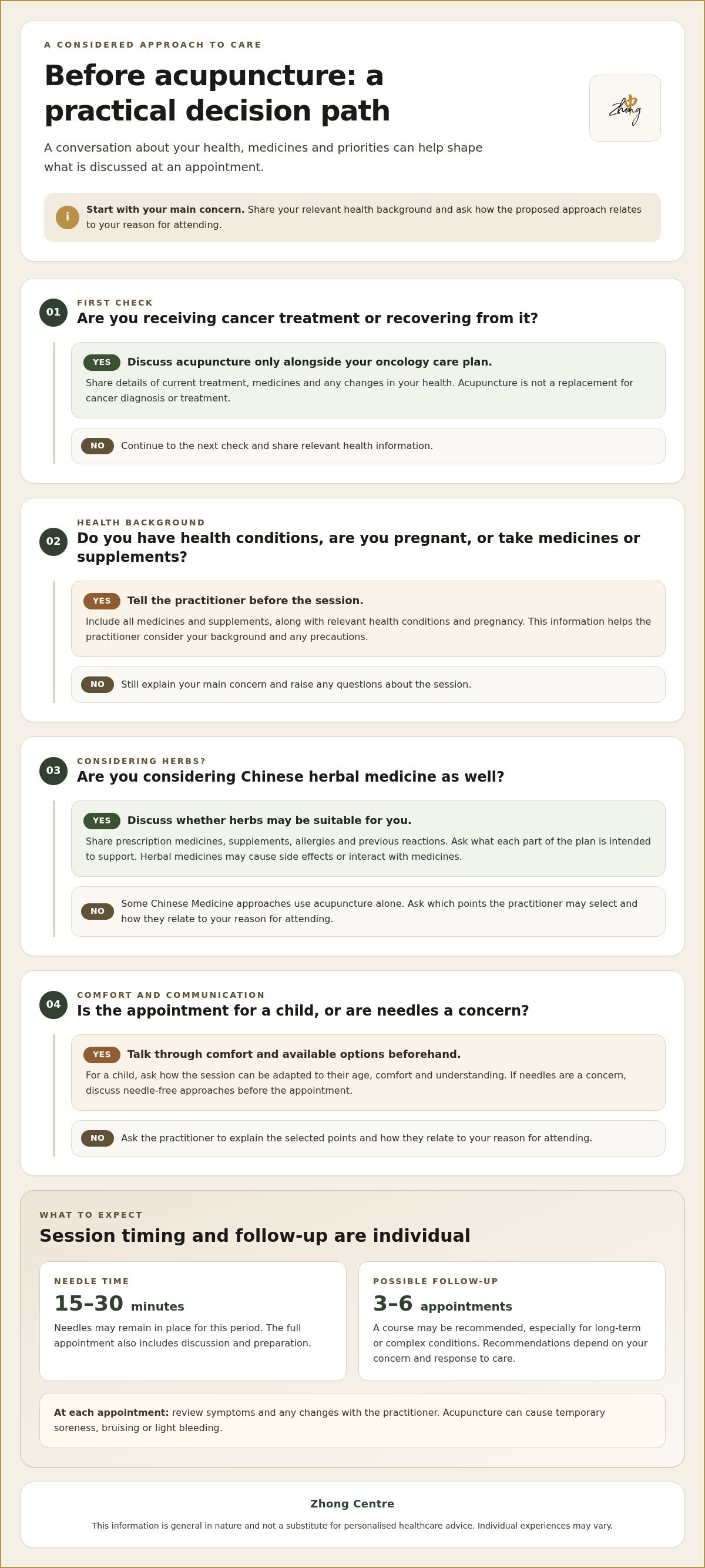
Acupuncture can cause temporary soreness, bruising or light bleeding. Herbal medicines may cause side effects or interact with medicines. Before treatment, tell the practitioner about your health conditions, pregnancy and all medicines or supplements you take.
Acupuncture with Chinese herbal medicine
Some Chinese Medicine approaches combine acupuncture with Chinese herbal medicine, while others use acupuncture alone. The practitioner considers your concerns and health background when discussing whether herbs may be suitable. Herbal medicine is prescribed individually in line with a person’s constitution. Share information about prescription medicines, supplements, allergies and previous reactions, and ask what each part of the plan is intended to support.
Acupuncture involves inserting fine needles at selected acupoints. In Traditional Chinese Medicine, these points relate to the flow of Qi, a concept used to understand patterns of health and wellbeing. Your practitioner can explain which points they select and how they relate to your reason for attending. For example, if you’re seeking support with pain, discuss the affected area, how it feels and which activities aggravate it.
Treatment duration and follow-up care
During a session, needles may remain in place for 15-30 minutes. The full appointment also includes time for discussion and preparation, so ask how it’s structured. Follow-up recommendations depend on your concern and response to care. A course of three to six follow-up treatments may be recommended, especially for long-term or complex conditions. Review symptoms and any changes with the practitioner at each appointment.
If you’re receiving cancer treatment or recovering from it, consider acupuncture only alongside the care plan set by your oncology team. Share details of current treatment, medicines and changes in your health before booking. Acupuncture may be discussed as supportive care, not as a replacement for cancer diagnosis or treatment. This helps the practitioner consider whether acupuncture is appropriate and what precautions may apply.
For a child, ask how the practitioner adapts the session to their age, comfort and understanding. If needles are a concern, discuss needle-free approaches before the appointment. The practitioner can explain available options and how the child’s health history informs the plan. A parent or carer can share relevant medicines, allergies and medical care, then help the child ask questions in their own words.
When comparing options for the best TCM clinic in Bayside, consider whether the practitioner explains acupuncture, herbal medicine and follow-up in language you understand. A clear conversation helps you prepare questions and decide whether the proposed approach fits your priorities.
Practitioner qualifications and experience
Start with the practitioner, not the clinic’s marketing language. AHPRA registers individual practitioners, not clinic names. Zhong Centre’s Dr Tahya, Dr Abbie and Dr Matt are AHPRA-registered acupuncturists. Registration is one useful check; training and experience relevant to your concern add important context.
Other experience details can show how a practitioner’s background fits your needs. Christine Lee has practised as a registered Chinese Medicine practitioner since 2008 and completed a Bachelor of Applied Science in Chinese Medicine and Human Biology at RMIT. Dr May Mei graduated with a Master of Applied Science (Acupuncture) from RMIT in 2007 and is registered with the Chinese Medicine Board of Australia. These examples show why it’s worth reading beyond a job title.
Which Bayside TCM clinics are registered with AHPRA? AHPRA registration applies to practitioners, not clinics. Zhong Centre’s Dr Tahya, Dr Abbie and Dr Matt are AHPRA-registered acupuncturists. Check the individual practitioner’s registration and area of practice rather than assuming a clinic’s name indicates registration.
Which Bayside TCM clinics accept private health insurance rebates? Chinese Medicine isn’t covered by Medicare in Australia, although you may be eligible to claim costs from a private health fund. Private health insurance rebates are available for services at Zhong Centre; your fund and level of cover determine your eligibility.
Practitioners may have areas of interest such as pain, fertility, menopause, stress or digestive concerns. Match their stated experience to your reason for booking. For example, if you’re seeking fertility support, ask about the practitioner’s Chinese Medicine training and relevant clinical interests. Discuss how herbal medicine, acupuncture or other care may fit your health background.
Clinic listings for Bayside and nearby suburbs can help you compare location, practitioner profiles and appointment details. Read profiles for qualifications, registration and relevant experience, then consider whether the stated focus matches your needs. Massage experience, for example, is distinct from acupuncture registration, so assess each qualification in relation to the care you’re seeking.
What are patients’ reviews and ratings for Bayside TCM clinics? Ratings vary between platforms and over time, so read written feedback for specific details about communication, appointment arrangements and explanations of care. Treat reviews as personal accounts, not evidence that you’ll have the same experience. Compare recurring themes instead of relying on a single star score.
Before booking, write down your main concern and any questions about practitioner experience or herbal medicine. That gives you a practical starting point for the appointment. If you’re ready to arrange a consultation, use the online appointment booking page.
First consultation and personalised treatment plans
A first consultation gives the practitioner a starting point for understanding your symptoms, priorities and health background. Before attending, note when the concern began, what changes it and how it affects daily activities. For example, if you want to discuss sleep, record your usual routine and any recent changes. Bring a current list of medicines and supplements, plus relevant care plans or test information.
The practitioner may ask about previous diagnoses, family history, digestion, sleep, stress and other aspects of wellbeing. They may also ask what you hope to address and what care you’ve already tried. Answer as clearly as you can, including details that seem unrelated. This information informs the discussion, but doesn’t promise a particular result. Ask how the practitioner uses it to develop a treatment plan.
A personalised plan should explain its proposed steps clearly. Ask which therapy is being considered, what it is intended to support, how progress will be reviewed and when the plan might be revisited. If acupuncture is suggested, ask which points the practitioner plans to use and why. If other approaches are discussed, ask how they relate to your symptoms and health goals. Raise any concerns before deciding whether to proceed.
For psoriasis, distinguish supportive care from medical diagnosis and dermatology management. Share your diagnosis, affected areas, symptom pattern and prescribed medicines with the practitioner. Ask how the proposed approach fits alongside your existing care and whether the practitioner has experience discussing psoriasis. Don’t stop or change prescribed treatment based on a complementary therapy appointment. A clear plan should identify what the practitioner will address and when to contact your usual healthcare professional about changing symptoms.
Before leaving, agree on practical next steps. Ask what to expect after the session, what changes to observe and how to report them at follow-up. You could track symptom timing, sleep or activity in a short diary. This gives you and the practitioner specific information to review, rather than relying on memory. If the plan includes follow-up appointments, ask what would prompt a review or adjustment.
Use the consultation to check that the plan reflects your preferences, health history and other care. Patients should feel able to ask questions, pause a discussion or decline a proposed step. A natural approach still needs clear reasoning. If you’re ready to discuss your health priorities, you can book a consultation appointment.
Clinic location and trading hours
For Bayside residents, a clinic’s address and appointment times affect how easily visits fit around work, study and family commitments. Compare the location with your usual starting point, such as home or work in Melbourne. Consider the whole trip, not just the distance on a map. A nearby clinic may be less practical if appointment times clash with your routine.
Use the clinic’s published address to map a sample journey before choosing an appointment. Check the route from home, work or your usual public transport stop. If you drive, look into parking near the address. If you use public transport, review the route and walking distance. This helps you judge whether attending is manageable.
Appointment times matter if you’re considering follow-up care for an ongoing concern. Compare the available times with your weekly commitments, including work shifts, caring responsibilities and travel. For example, consider whether an appointment would require taking leave or arranging transport. A realistic schedule can help you plan complementary care without adding avoidable pressure to your day.
Check the clinic’s published appointment information for the days and times available for consultations. Don’t assume general opening hours are the same as practitioner consultation hours. A Chinese Medicine practitioner may consult at particular times within the clinic’s broader schedule. Use the listed appointment options to find a time that suits your needs.
Location can shape your experience before you enter the consultation room. Consider whether the route is straightforward, whether you can arrive without rushing and whether the setting works for your circumstances. If you’re travelling after work, for instance, a route with fewer transfers may be easier. If you’re attending with a support person, plan the trip together.
For a wellness appointment, consider what happens around the session as well as during it. Allow time to travel, arrive and leave without rushing to your next commitment. If you’re managing fatigue or discomfort, compare the effort involved in reaching each clinic. A convenient location and workable appointment times are practical factors, alongside practitioner qualifications and the care discussed during your consultation.
Before choosing a clinic, compare its Bayside location, available appointment times and your typical travel route. Consider the specific time you’re booking, not just general opening hours. This helps you assess whether Traditional Chinese Medicine can fit your routine, especially if you’re considering regular visits as part of broader health or wellness support.
Consulting hours and appointment booking
Use the booking page to compare available appointment times with your weekly schedule. Choose a time that allows for travel, arrival and any discussion after your session. If you work shifts or have caring responsibilities, note the days and times you can attend before booking. A realistic routine makes it easier to plan care without rushing between commitments.
Before booking, identify the appointment type that matches your needs. If you’re considering acupuncture, note questions about needles. If you want to ask about herbal medicine, prepare a current list of medicines and supplements. Clear questions help focus the booking on the care you want to discuss, rather than choosing a session without understanding its purpose.
Read the appointment details carefully, including the listed practitioner, location and consultation time. Clinic opening hours and practitioner consultation hours may differ, so use the appointment options shown for the service you want. If you’re arranging a visit around work in Melbourne, compare the appointment time with your travel plan and allow enough time to arrive without feeling hurried.
Prepare a short note before confirming your appointment. Include your main concern, relevant health history and practical needs, such as bringing a support person. If you have emotional or holistic health concerns, write down the topics you want to raise. A brief list can help you explain what matters and remember questions about the approach or next steps.
After choosing a time, keep the booking details somewhere easy to find. Add the appointment to your calendar and note the clinic address. If the booking page provides instructions or policies, read them before attending. This preparation helps you arrive ready to discuss your health priorities and understand how the appointment will proceed.
For ongoing natural health support, consider how future appointments might fit your routine. Don’t assume every session will follow the same schedule; plans depend on the care discussed with the practitioner. If you’re considering acupuncture, herbal medicine or another holistic approach, use the consultation to clarify possible follow-up and how progress will be reviewed.
When you’re ready to choose a time, book your TCM appointment online. Bring your questions, relevant health information and a clear sense of what you’d like to discuss. That gives the appointment a practical starting point, whether your focus is physical, emotional or broader wellness support.
Zhong Centre: Cosmetic Acupuncture
Zhong Centre may suit you if you’re exploring Cosmetic Acupuncture for facial care. Fine needles are used on the face and body, with treatment tailored to concerns such as fine lines and skin tone. A consultation can help you understand what the service involves and whether it aligns with your priorities.
Options include Facial Rejuvenation Acupuncture and Gua Sha Facial, as well as a TCM Consultation to discuss broader health questions. These approaches involve different techniques, so ask what each session entails before deciding. Ask about the session, possible risks and how your health history informs the discussion before deciding.
If you’re considering these services, contact Zhong Centre in St Kilda to discuss your next step.
Choose a care approach that feels right for you
Choosing the best TCM clinic in Bayside is about more than finding a convenient appointment. It’s an opportunity to consider what kind of care fits your priorities. If you’re interested in facial-focused support, Zhong Centre offers Cosmetic Acupuncture and Facial Rejuvenation Acupuncture. A TCM Consultation gives you space to discuss your questions and the approach that may suit your needs.
You don’t need to arrive with every answer. Bring the concern you want to discuss, share relevant health information and ask what each proposed step involves. Clear communication helps you make an informed decision about whether to proceed, pause or explore another approach.
If you’d like to take that next step, book an appointment with Zhong Centre. Start with a conversation, and choose a path that feels considered and comfortable for you.
This information is general in nature and not a substitute for personalised healthcare advice. Individual experiences may vary.
Frequently Asked Questions
What are the highest-rated traditional Chinese medicine clinics in Bayside, Melbourne?
Star ratings alone can’t identify the right clinic for every person, and review scores may differ between platforms. Compare the detail behind the ratings: comments about communication, appointment arrangements and how care is explained. Zhong Centre is in St Kilda, within Melbourne’s Bayside area. Use reviews as individual opinions, not as evidence that your experience or health outcomes will match someone else’s.
What treatments do Bayside TCM clinics offer, including acupuncture and herbal medicine?
Zhong Centre offers acupuncture, TCM consultations and Herbal Medicine Prescription. Acupuncture uses fine needles at selected points, while Chinese herbal medicine is prescribed individually in line with a person’s constitution. The clinic also offers Cosmetic Acupuncture, Facial Rejuvenation Acupuncture, Gua Sha Facial and Cupping Therapy. A consultation can help you discuss which approach relates to your health priorities.
Where are Bayside TCM clinics located, and what are their opening hours?
Zhong Centre’s clinic is at 306a-310 St Kilda Road, St Kilda, VIC 3182. Bayside is broad, so consider your route from suburbs such as Elwood, Elsternwick or Caulfield when planning a visit. Opening hours and practitioner consulting times are different details; use the clinic’s appointment booking information to plan around a consultation time, rather than assuming general trading hours indicate appointment availability.
How can I choose a qualified and reputable TCM practitioner in Australia?
Check a practitioner’s registration and area of practice, then compare their training and experience with your reason for seeking care. AHPRA registers practitioners, not clinics. Read practitioner profiles for relevant experience and clear explanations of proposed care. Reviews can offer context about communication, but they can’t predict your individual experience.
Do Bayside TCM clinics require a referral or offer first-visit consultations?
Zhong Centre offers a TCM Consultation as a starting point for discussing your health concerns and care options. Referral requirements can differ by clinic, appointment type or payment pathway, so follow the instructions for the consultation you’re booking. If you already have a GP referral or relevant medical notes, bring them. A list of medicines and supplements can also help inform the discussion.
This information is general in nature and not a substitute for personalised healthcare advice. Individual experiences may vary.