
Safe Skincare During Pregnancy in Australia: An Ingredient-by-Ingredient Checklist
What if “pregnancy-safe” on the label isn’t the whole story? Working out safe skincare during pregnancy Australia can feel like decoding conflicting advice, especially when your skin is changing and familiar products no longer feel like an obvious fit.
It makes sense to look beyond a reassuring label. Product names and broad claims don’t always explain the ingredients, concentration or directions for use. “Natural” wording isn’t a personal safety assessment either. A practical review of your routine can help you identify questions to take to a GP, midwife or pharmacist without turning every product into a source of worry.
This guide offers an ingredient-by-ingredient checklist to help you review labels, understand the Australian context and identify ingredients worth discussing with a health professional. It covers commonly queried ingredients, routine changes to consider and situations where individual advice matters more than general online guidance.
Key Takeaways
- For safe skincare during pregnancy australia, look beyond broad product labels and consider ingredients alongside how and where you use them.
- Make a product list that includes active ingredients, frequency of use and application area. Note whether your skin is broken or irritated, so a health professional can give more relevant advice.
- Use the ingredient comparison to organise common skincare questions into choices to keep, pause or discuss with an appropriate professional.
- Record your current routine before making changes. Where appropriate, changing one product at a time can make it easier to track your skin’s response.
- Zhong Centre offers Traditional Chinese Medicine consultations and pregnancy support in Melbourne for broader wellbeing conversations. Take product-specific skincare questions to an appropriate healthcare professional.
Safe skincare during pregnancy in Australia: why labels need a closer look
Pregnancy can change how your skin feels and responds, so a familiar product may prompt fresh questions. Pregnancy-conscious skincare means checking the ingredients, how you use a product and your personal circumstances, rather than relying on a broad label. The context matters: Pregnancy involves individual health considerations that a general product label can’t account for.
The ingredient, concentration, amount used, frequency and application area are useful details to include when asking about a product. Whether your skin is intact or broken may also be relevant to a health professional’s assessment. These details don’t establish how much of an ingredient enters the body or what that means for an individual pregnancy. Formulation and personal circumstances matter too.
What does a pregnancy-friendly skincare label actually tell you?
“Pregnancy-friendly” is product positioning, not an individual safety assessment. Treat it as a prompt to read further, not a guarantee that a product suits every pregnancy, skin type or concern. Marketing language may not tell you the concentration of an active ingredient, how often to use the product or whether evidence applies to your pattern of use.
Check the complete ingredient list and directions. Then separate two questions: what is the product claiming, and what is known about the specific ingredient in the way you plan to use it? “Natural” or “organic” wording doesn’t answer either question on its own. If a key detail is unclear, take the product or a clear photo of its ingredients to a qualified health professional.
How Australian product regulation fits into your skincare check
Australian regulation distinguishes products by their ingredients, intended purpose and claims. The Therapeutic Goods Administration (TGA) regulates therapeutic goods, while the Australian Industrial Chemicals Introduction Scheme (AICIS) regulates the introduction of most industrial chemicals, including cosmetic ingredients, rather than assessing finished cosmetics for pregnancy suitability. Cosmetic and therapeutic claims can lead to different regulatory pathways. A product’s category alone doesn’t establish whether it’s appropriate for you during pregnancy.
For example, a moisturiser marketed for general skin care may follow a different regulatory pathway from a product making a therapeutic claim, such as one claiming to address acne or provide sun protection. The distinction depends on the product and its claims, so don’t assume every sunscreen or acne product falls into one category. TGA and AICIS guidance can clarify their respective roles, but individual circumstances still matter.
How to assess skincare ingredients and exposure during pregnancy
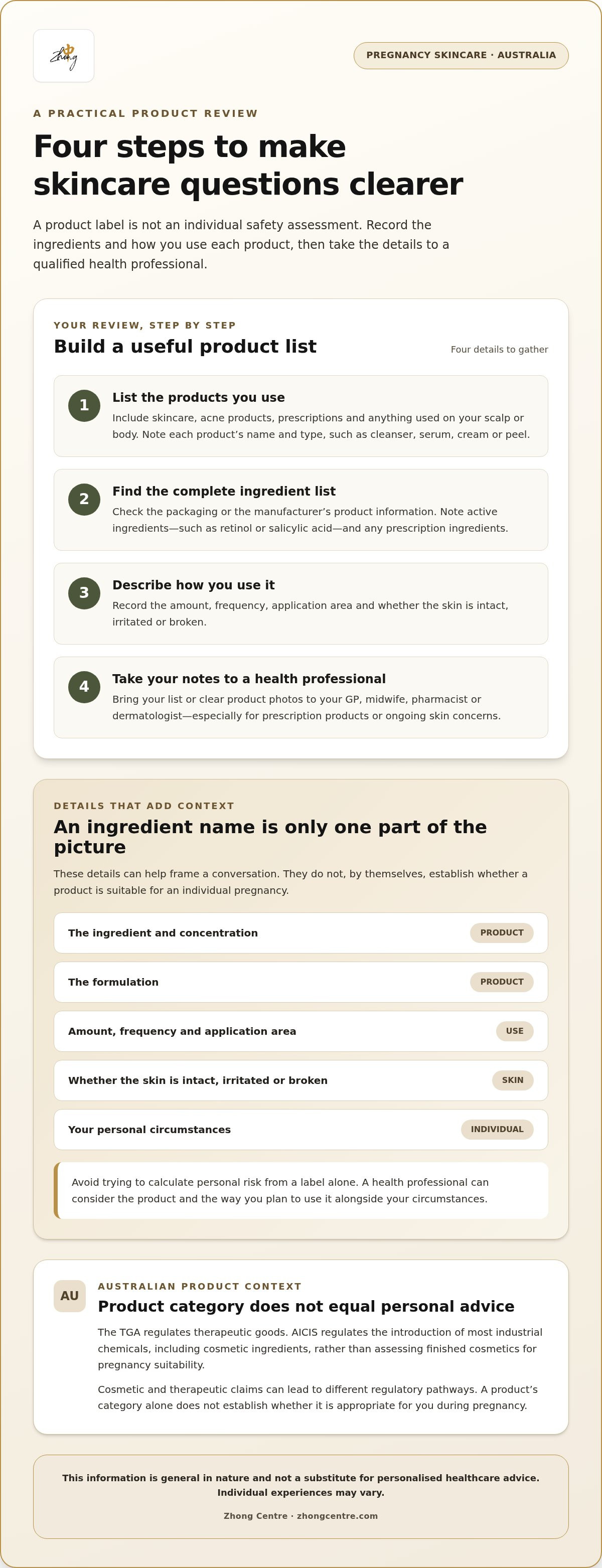
A useful safe skincare during pregnancy australia check is a small evidence-gathering exercise, not a hunt for alarming-sounding words. Start with the product and the way you actually use it. Those details give your healthcare professional a clearer picture than an ingredient name in isolation.
- List your products. Include skincare, acne products, prescriptions and anything used on your scalp or body. Record the product name and type, such as cleanser, serum, cream or peel.
- Find the full ingredient list. Check the packaging or the manufacturer’s product information. Note active ingredients, including familiar names such as retinol or salicylic acid, as well as prescription ingredients.
- Describe your use. Write down how much you apply, how often and the size and location of the area. Note whether the skin is intact, irritated or broken.
- Take questions to a health professional. Bring the list or product photos to your GP, midwife, pharmacist or dermatologist, especially for prescription products or ongoing skin concerns.
These details help frame a discussion; they don’t prove that an ingredient is suitable or unsuitable. A product applied over a small area differs from one used frequently across a larger area, and broken skin may affect absorption. The ingredient, concentration and formulation matter too. Avoid trying to calculate your personal risk from a label alone.
Read the full ingredient list, not just the front label
Front-of-pack terms such as “gentle” or “pregnancy-friendly” don’t show the complete formula or explain the evidence behind a claim. Look for the ingredient list on the container or manufacturer’s product page, then identify the product type and any highlighted actives. Record the directions and how often you actually use the product. An unfamiliar chemical name isn’t proof of harm; it’s a prompt to check reliable information or ask a qualified professional.
Which ingredient questions deserve individual advice?
Retinoids are a common question. Oral retinoids are associated with serious risks in pregnancy, while evidence about topical retinoid exposure is more limited. A 2015 systematic review and meta-analysis by Kaplan and colleagues found no significant increase in major congenital malformations after inadvertent topical retinoid exposure, but its authors said the evidence was not strong enough to support use during pregnancy. As a precaution, topical retinoids are commonly avoided. Discuss any use or exposure with your healthcare professional. Read the review in the British Journal of Dermatology.
Other questions, including acne actives, exfoliants and prescription products, also depend on the specific ingredient, concentration, formulation and pattern of use. Don’t stop prescribed skincare without discussing it with the prescriber. For broader wellbeing during pregnancy, Zhong Centre offers Traditional Chinese Medicine consultations and pregnancy support. Product-specific skincare advice is a separate conversation for an appropriate healthcare professional.
Compare common skincare choices in Australia: keep, pause or ask
Use “keep”, “pause” and “ask” as prompts for a conversation, not universal medical instructions. Evidence varies between ingredients, and advice can depend on the formula, strength, application area and frequency, as well as your health history. Use this comparison to review your routine and prepare questions, not as a personal safety ruling.
Active ingredients for acne, pigmentation and exfoliation
| Ingredient or product type | Evidence status | Sensible next step |
|---|---|---|
| Topical retinoids, such as retinol or tretinoin | Precautionary avoidance is commonly advised; pregnancy-specific evidence for topical use is limited. A systematic review and meta-analysis of topical retinoid exposure discusses the limits of the available evidence. | Pause or ask about use during pregnancy. Discuss prescription products and any exposure with your healthcare professional. |
| Hydroquinone | Pregnancy-specific data are limited. A review of skincare ingredients in pregnancy notes substantial skin absorption and recommends caution until more data are available. | Ask before using products for pigmentation concerns. See the Canadian Family Physician review. |
| Salicylic acid and other exfoliating acids | A pregnancy skincare review describes limited-area topical salicylic acid use as low risk, while advising caution with large areas or high concentrations. Evidence for other acids and specific products can differ. | Ask about high-strength products, peels or frequent leave-on use. Share the label and directions; the review of skincare products in pregnancy gives context. |
| Other acne actives, including benzoyl peroxide or azelaic acid | A clinical review considers these options in pregnancy, but evidence and recommendations vary by ingredient and formulation. | Ask a pharmacist, GP or dermatologist, particularly about prescription-strength products or persistent concerns. See the review of acne care during pregnancy. |
Moisturisers, sunscreen and simpler routine options
A basic routine can include gentle cleansing, a moisturiser you already tolerate and sun protection suited to your skin. That doesn’t make every formulation suitable for everyone. Check the ingredients and seek advice if a product causes irritation or contains an active you’re unsure about. When considering professional skin treatments or specialised beauty services alongside a simplified daily routine, studios such as glowandshinebyshifali.com.au offer tailored options to support your complexion gently.
Cancer Council Australia recommends broad-spectrum sunscreen as part of sun protection, alongside shade, clothing and a hat. Follow the product directions and current Australian guidance. Don’t assume that “mineral” or “chemical” alone determines suitability during pregnancy. A sunscreen making therapeutic claims may follow a different regulatory pathway from a general cosmetic.
Decision principle: use “keep, pause or ask” to guide a product-specific discussion, weighing the ingredient, evidence and actual pattern of use rather than relying on a blanket label.
A practical pregnancy skincare checklist for your Australian routine
A clear record can make a skincare conversation more useful and less overwhelming. Before changing your routine, write down what you use and how you use it. You’ll have a practical reference for reviewing your routine and something concrete to share with a healthcare professional if an ingredient raises questions.
Review your routine without changing everything at once
Start with an inventory, not a bin. Include daily skincare, occasional masks or peels, acne products and prescribed preparations. For each one, note its purpose, ingredients, application area and frequency. Mark anything you’re unsure about for discussion rather than trying to assess it from a product name alone. If your routine also extends to professional cosmetic procedures or skin therapies, resources from clinical providers such as Aleksandra Aesthetic Studio can offer insight into how aesthetic treatments are evaluated and adapted for individual skin needs.
- Product and type: record the name and whether it’s a cleanser, moisturiser, serum, sunscreen, exfoliant or prescription product.
- Ingredients to discuss: copy the full list, then highlight active ingredients or names you’ve been advised to ask about.
- Use pattern: note how much you apply, how often and whether it goes on a small area or a larger part of your body.
- Skin context: record any irritation, broken skin or changes you’ve noticed, along with when they began.
If a change seems appropriate after getting advice, changing one non-prescribed product at a time may make it easier to notice whether your skin responds differently. That’s a way to keep track, not a medical rule. Don’t stop or alter a prescribed product without discussing the decision with the person who prescribed it. If your routine includes several products you’re concerned about, ask how to prioritise them rather than making multiple changes at once.
When a pharmacist, GP or maternity-care professional can help
Ask a pharmacist, GP, midwife or other maternity-care professional about a specific ingredient, prescription product or persistent skin concern. Bring the packaging or a clear photo of the complete ingredient list, along with notes on how and where you use it. Include any prescribed medicines or products used for a diagnosed skin condition. If you experience a significant reaction or discomfort, seek prompt medical advice. For severe symptoms such as difficulty breathing, seek emergency care.
Product questions and broader pregnancy wellbeing are separate conversations. Zhong Centre offers pregnancy support and Traditional Chinese Medicine consultations for broader wellbeing. If you’d like to discuss this kind of support, you can book a pregnancy support consultation. For decisions about skincare ingredients or product suitability, speak with an appropriate healthcare professional.
Pregnancy skincare and personalised support in Melbourne
Skincare questions and pregnancy wellbeing can overlap, but they’re not the same conversation. If you’re weighing safe skincare during pregnancy australia, take ingredient-specific questions to a GP, pharmacist, dermatologist or maternity-care professional. Zhong Centre offers Traditional Chinese Medicine consultations and pregnancy support in Melbourne for broader wellbeing conversations.
Zhong Centre is based in Melbourne and supports people from St Kilda, Elwood, Bayside, Armadale, Toorak, Windsor, Prahran, St Kilda East, Melbourne East, Elsternwick, Port Melbourne, Albert Park, Caulfield, Malvern, Chadstone, Balaclava and Ripponlea.
What a Traditional Chinese Medicine consultation can contribute
A consultation can make room for your questions, health context and wellbeing priorities during pregnancy. You can explain what’s on your mind and discuss what support may be relevant to your circumstances. If you’re preparing for a broader wellbeing conversation, consider what you’d like support with, what questions you want answered and whether there’s relevant health information you’d like to share. You don’t need to arrive with a perfect plan. Any next steps should reflect your individual situation.
Choose your next step with confidence
For a product-specific question, speak with an appropriate healthcare professional and bring the product packaging or ingredient list. If you’re experiencing a skin concern that persists, is worsening or is causing significant discomfort, seek personalised medical advice rather than relying on a general online checklist. If you have a reaction, follow the guidance in the previous section about seeking timely help. General guidance can help you frame a question, but it can’t replace an assessment of your circumstances.
For broader pregnancy wellbeing, Zhong Centre’s Traditional Chinese Medicine consultations provide a whole-person setting to discuss your circumstances. This support can sit alongside your maternity care and medical advice. If it feels relevant, you’re welcome to book a Traditional Chinese Medicine consultation.
Product labels and general information can’t determine whether a specific skincare product is suitable for you during pregnancy. Discuss that decision with an appropriate healthcare professional, and use broader wellbeing support for the questions it’s designed to address.
Make your next skincare decision a considered one
Pregnancy can bring new questions, but you don’t need to decode every label alone. Use this safe skincare during pregnancy australia checklist as a starting point, then take ingredient-specific concerns to your GP, pharmacist, dermatologist or maternity-care professional. The right next step depends on the product, how you use it and your individual circumstances.
If broader pregnancy wellbeing is also on your mind, Zhong Centre is a Melbourne clinic offering Traditional Chinese Medicine consultations and pregnancy support. A consultation provides space for a wider wellbeing conversation. For product-specific skincare advice, speak with an appropriate healthcare professional.
When you’re ready to explore broader support, book a Zhong Centre consultation. Take things at a pace that feels right, with clear questions and personalised advice guiding your choices.
Frequently Asked Questions
Can pregnancy make your skin more sensitive?
Yes, skin can feel different during pregnancy, including becoming drier, itchier or more reactive. That doesn’t automatically mean a product is harmful. If a product stings or causes a rash, stop using it and seek advice if symptoms persist or worsen. Intense or widespread itching, particularly on your palms or soles, is worth raising promptly with your maternity-care professional. DermNet’s overview of pregnancy-related skin changes provides further context.
What should I do if I used a product before realising I was pregnant?
Don’t panic, but make a note of what you used. Record the product name, ingredients, dates, application area and frequency, then speak with your GP, pharmacist or maternity-care professional, especially if it was prescribed. Keep the packaging or take a clear photo of the label. Your maternity-care team can help direct your question to an appropriate health professional.
Is sunscreen appropriate to use during pregnancy in Australia?
Yes, sunscreen can remain part of your sun-protection routine during pregnancy. Cancer Council Australia recommends broad-spectrum sunscreen alongside shade, protective clothing and a hat. Follow the product directions, and ask a pharmacist or maternity-care professional about a particular formulation if you’re unsure or it irritates your skin. Sunscreen is one part of sun protection, not a replacement for other measures. Cancer Council Australia’s sun safety guidance outlines this combined approach.
Can I use essential oils in skincare while pregnant?
How should I introduce a new skincare product during pregnancy?
Introduce only one new product at a time, and avoid starting it while your skin is already reacting to another change. Follow the label directions and note when you begin using it. If appropriate, test a small area first, but remember this won’t establish pregnancy suitability. Stop if irritation develops, and seek advice if it’s marked, persists or worsens. Check any active ingredient with a health professional before use.
Can I use self-tanning products during pregnancy?
Ask a pharmacist, GP or maternity-care professional about the specific self-tanning product and how you plan to apply it. Take the packaging or ingredient list, and mention whether it’s a lotion, mousse or spray. That gives them a clearer basis for individual advice than a general “pregnancy-friendly” label. If you can’t find the full ingredients, contact the manufacturer for product information to share with your health professional.
This information is general in nature and not a substitute for personalised healthcare advice. Individual experiences may vary.