
Acupuncture for Back Pain in Melbourne: What to Expect and How It May Help
Could acupuncture be part of your back-pain care without being presented as a miracle fix? If you’re considering acupuncture for back pain melbourne, it’s reasonable to want clear information about whether it may suit your situation, what research can tell you and what happens during an appointment.
At Zhong Centre in St Kilda, an initial appointment gives you time to discuss your symptoms, health history and questions, including any concerns about needles. The approach is individualised, with private treatment rooms, sterile disposable needles and adjustable tables. The clinic’s three acupuncturists, Dr Tahya, Dr Abbie and Dr Matt, are AHPRA-registered. Wheelchair-friendly entrances and treatment rooms accommodate mobility challenges.
All Aesthetic Acupuncture appointments always include a full Chinese Medicine diagnostic treatment. This guide explains how acupuncture may fit into back-pain care, how to interpret the evidence and what to discuss at your first visit.
Key Takeaways
- Back pain can have different causes and patterns, so symptoms alone can’t establish a diagnosis.
- Learn how a Chinese Medicine assessment may inform an individualised approach, while keeping TCM concepts distinct from biomedical explanations.
- Explore what the evidence can and can’t tell you about acupuncture for back pain melbourne, and why experiences may vary.
- Prepare for an initial appointment by noting your symptoms, relevant health history, concerns and questions.
- Find out what to expect at Zhong Centre in St Kilda, including care from its AHPRA-registered acupuncturists.
Back pain in Melbourne: what acupuncture can and cannot address
Back pain can interrupt everyday activities, from getting dressed and sitting through work to picking up the shopping. Acupuncture may be considered as one supportive healthcare approach, but it can’t identify the cause of pain or guarantee a particular result. Whether it may be relevant depends on your symptoms, health history and any assessment you’ve already had.
Acupuncture involves placing fine needles at selected points. In a Traditional Chinese Medicine appointment, the practitioner considers your wider health picture as well as the area that feels uncomfortable. This is a different framework from a biomedical diagnosis. A general overview of Acupuncture covers its history and use. Questions about your particular back pain call for an appropriate health assessment.
Acute, persistent and recurring back pain are not the same experience
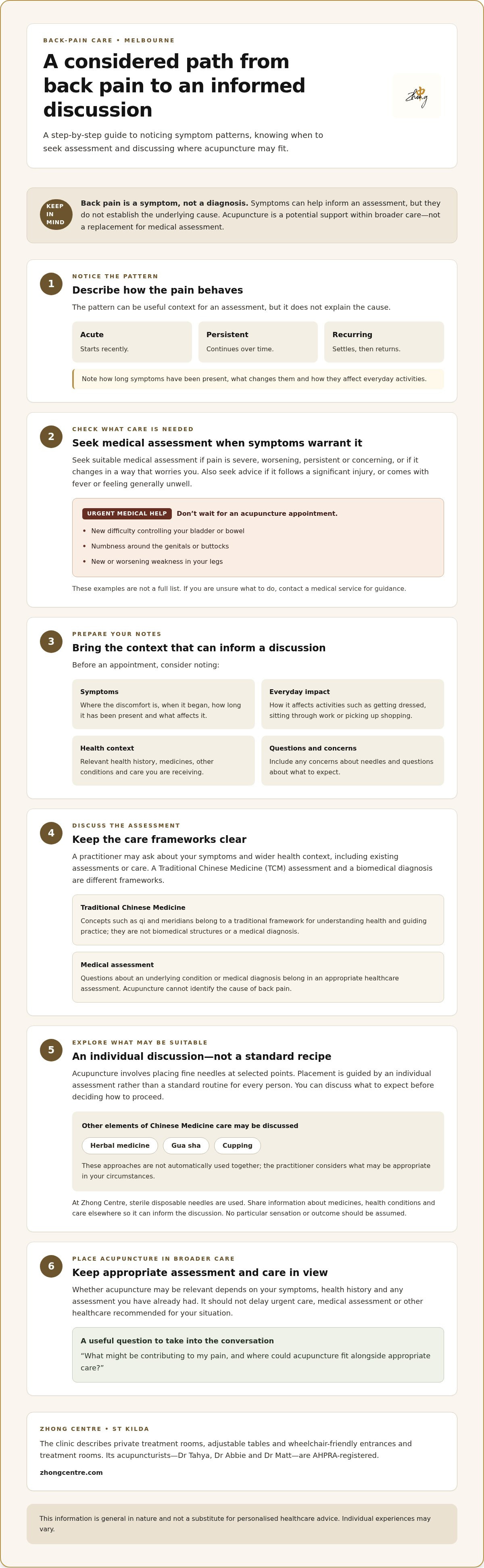
Acute pain starts recently; persistent pain continues over time; recurring pain settles and returns. These descriptions refer to the pattern, not its cause. How long symptoms have been present, what changes them and how they affect daily activities can help inform an assessment. Acupuncture won’t be suitable for every type or cause of back pain, so context matters.
When back pain needs medical assessment
Seek suitable medical assessment if your pain is severe, worsening, persistent or concerning, or if it changes in a way that worries you. Get urgent medical help for new difficulty controlling your bladder or bowel, numbness around the genitals or buttocks, or new or worsening weakness in your legs. These symptoms need prompt attention. Don’t wait for an acupuncture appointment.
Also seek advice if back pain follows a significant injury, or comes with fever or feeling generally unwell. These examples aren’t a full list, and only a health professional can assess what’s happening. Acupuncture should not delay urgent care, medical assessment or other healthcare recommended for your situation. If you’re unsure what to do, contact a medical service for guidance.
How acupuncture and Chinese Medicine approach back-pain support
An acupuncture appointment isn’t a one-size-fits-all recipe. At Zhong Centre, the discussion can cover where your back discomfort is, when it began, what affects it and how it fits with your wider health context. That conversation helps the practitioner shape an individualised approach and consider whether acupuncture or another element of Chinese Medicine care may be appropriate for you.
In Traditional Chinese Medicine (TCM), concepts such as qi and meridians are part of a traditional framework for understanding health and guiding practice. They aren’t biomedical structures or a medical diagnosis. Keeping those lenses distinct matters: a TCM assessment may inform the care approach, while questions about an underlying condition or medical diagnosis belong in an appropriate healthcare assessment.
What happens during an acupuncture appointment?
Your practitioner will ask about your symptoms and relevant health context. This may include how long the discomfort has been present, your general health and any existing assessments or care. You can raise concerns about needles and discuss what to expect before deciding how to proceed. Zhong Centre uses sterile disposable needles. Their placement is guided by the individual assessment, rather than a standard routine for every person.
A TCM consultation may include acupuncture, herbal medicine, gua sha or cupping when appropriate. These approaches aren’t automatically used together; the practitioner considers what may be suitable in your circumstances. If you take medicines, have other health conditions or are receiving care elsewhere, share that information so it can inform the discussion. No particular sensation or outcome should be assumed.
For clarity, All Aesthetic Acupuncture appointments always include a full Chinese Medicine diagnostic treatment. That statement relates to Aesthetic Acupuncture appointments; it isn’t a claim about back-pain outcomes.
Traditional Chinese Medicine concepts and research are different lenses
Traditional explanations can help describe how a practitioner selects an approach, but they shouldn’t be presented as established biomedical mechanisms. Research asks different questions: whether acupuncture may assist with a particular condition, how it compares with other care and what limits apply. Evidence needs to be specific to back pain; findings about another condition or therapy can’t simply be transferred across.
The linked Medicare coverage for acupuncture page describes United States coverage for certain circumstances. It isn’t Australian Medicare guidance, and coverage by itself doesn’t establish what’s appropriate for an individual. For Australian readers, the practical point is to weigh acupuncture as one possible part of a broader care plan, alongside relevant medical advice, and discuss its potential role and limitations with your practitioner.
If you’d like to discuss an individualised Chinese Medicine consultation for back-pain support, you can view appointment booking details.
Does acupuncture help back pain? Evidence, limits and realistic expectations
Acupuncture may be an option for some people, but the evidence doesn’t mean it will help everyone. Research findings depend on the type of back pain studied, the acupuncture approach and the outcomes researchers measure. Individual responses also vary. A study result is not a forecast of what will happen for you.
A Cochrane review of acupuncture for chronic non-specific low back pain found that results differed depending on what acupuncture was compared with. The review’s findings can inform a discussion, but don’t establish a result for every person or every type of back pain. Read the review’s scope and conclusions in Cochrane’s review of acupuncture for chronic non-specific low back pain.
How to read research on acupuncture for back pain
Look beyond a headline. Check who took part, whether the comparison was sham acupuncture or usual care, which outcomes were measured and how long participants were followed. A study of chronic low back pain doesn’t automatically apply to a new injury, a different diagnosis or another acupuncture technique. One study or review can contribute useful evidence, but it can’t predict an individual response.
Clinic experience is a separate kind of information. It may shape how a practitioner discusses and tailors care, but it isn’t a substitute for controlled research. A clinic survey, for example, shouldn’t be presented as a general estimate of how likely acupuncture is to help all people with back pain.
Evidence, limits and questions to take into your appointment
| What the evidence can suggest | What it can’t establish | What to discuss |
|---|---|---|
| Whether acupuncture was associated with changes in measured outcomes for the people studied. | That you’ll experience the same changes, or that results apply to a different back-pain pattern. | How closely your symptoms and health context match the research population. |
| How findings differed between the comparison groups used in a study. | That acupuncture is better than every alternative or replaces medical care. | How acupuncture could fit alongside your current assessment or care plan. |
| What researchers observed during the study’s follow-up period. | What your longer-term experience will be. | How you and your practitioner will review whether the approach remains appropriate. |
Why a realistic plan allows for individual variation
Your health history, symptom pattern and goals help inform an individual practitioner’s approach. Zhong Centre notes that chronic or complex conditions may involve six to ten sessions or more. This is a guide, not a fixed requirement or a promise of improvement. The appropriate plan can vary, and it’s reasonable to discuss how care will be reviewed alongside other healthcare advice.
Preparing for back pain acupuncture at a Melbourne clinic
A little preparation can make your first conversation more useful. You don’t need to arrive with a perfect explanation or know the cause of your back pain. A few notes about your symptoms, health and priorities can help the practitioner understand what matters to you and discuss whether acupuncture may suit your care plan.
A simple preparation sequence
Use this short checklist before your appointment. Bring existing information if it’s handy, but it isn’t a prerequisite.
- Note the pattern. Record when the discomfort began, where you feel it and whether it changes during the day.
- Track what affects it. Note movements, positions or activities that seem to ease or aggravate it, without trying to diagnose the cause.
- Describe the daily impact. Consider what’s harder at work, at home, during sleep or while moving around.
- Gather relevant health context. Write down significant health conditions, medicines, previous assessments and care you’re receiving.
- List your questions and goals. Include needle concerns, positioning needs and what you’d like support with, such as managing day-to-day activities.
What to discuss before a session
Be open about your health context, including medicines and any previous investigations or assessments. If you have a care plan or relevant records, you can share them to help inform the discussion; they’re not required for every appointment. Mention concerns about needles, how you’ll be positioned or anything that may affect your comfort before the session begins. You can also ask what the proposed approach involves and how it fits alongside other care, such as targeted physical rehabilitation from clinics like RED Physiotherapy.
Clear goals help set a practical reference point. Rather than expecting a particular result, you might discuss whether sitting, walking or completing a regular task is an appropriate focus for review. Your practitioner can talk through how the plan may be adjusted if your symptoms, needs or priorities change.
Getting to Zhong Centre in St Kilda
Zhong Centre is at 306a-310 St Kilda Road, St Kilda, VIC 3182. On-site parking availability may vary, so check local parking restrictions before you travel. Allow yourself time to arrive and bring any notes you’d like to discuss.
If you’re considering acupuncture for back pain melbourne, practical preparation can help you make the most of the conversation. Explore the clinic’s pain and injury acupuncture information as you consider your options. If you’re ready to plan a visit, book an appointment and bring your questions to the discussion.
Back-pain acupuncture at Zhong Centre: a considered next step
Zhong Centre offers pain and injury acupuncture and Traditional Chinese Medicine (TCM) consultations in St Kilda. Its three AHPRA-registered acupuncturists are Dr Tahya, Dr Abbie and Dr Matt. If you’re considering acupuncture for back pain, a consultation gives you time to discuss your situation and ask how this approach may fit alongside other healthcare.
A personalised appointment in a calm space
The practitioner considers your needs and health context when discussing possible support. You can share what you hope to address, ask about the proposed approach and raise any concerns before deciding how to proceed. The clinic’s private rooms offer a tranquil setting, with soft linens, blankets and pillows. Optional gowns or towels are available for modesty, and adjustable treatment tables support different positioning needs.
There’s no need to arrive with a firm conclusion about whether acupuncture is right for you. A consultation can help clarify what the approach involves, what its limits are and how it might sit within your broader care plan, whether that includes medical guidance or supportive movement like Pilates at Your Balance Project. You can also discuss how you and your practitioner might review whether the approach remains suitable as your needs change.
Choose a next step that suits your needs
Traditional Chinese Medicine brings its own framework to a consultation. If you’d like more context before deciding, consider how this perspective relates to your health questions and any existing medical advice. You can ask the practitioner to explain the reasoning behind the proposed approach in clear, practical terms.
For a calm, informed conversation about your circumstances, book a consultation at Zhong Centre. Bring the questions that matter to you and take the time you need to decide whether this next step feels appropriate.
Take the next step at your own pace
You don’t need to be certain acupuncture is right for you before starting a conversation. Bring your questions, explain what you hope to address and discuss how acupuncture for back pain melbourne might fit alongside any care you’re already receiving. A thoughtful next step leaves room for clear information, individual needs and appropriate medical advice.
Aesthetic acupuncture and TCM sessions are listed at $80 - $150 AUD per session, with package options available. For readers in St Kilda, Elwood, Melbourne, Bayside, Armadale, Toorak, Windsor, Prahran, St Kilda East, Melbourne East, Elsternwick, Port Melbourne, Albert Park, Caulfield, Malvern, Chadstone, Balaclava and Ripponlea, Zhong Centre is located in St Kilda. To discuss back-pain support and whether an appointment may suit your circumstances, book a consultation.
This information is general in nature and not a substitute for personalised healthcare advice. Individual experiences may vary.
Frequently Asked Questions
Is acupuncture effective for back pain?
Acupuncture may be considered as one option, but research findings and individual experiences vary, so pain relief can’t be promised. A Cochrane review of acupuncture for chronic non-specific low back pain found that findings depended on the comparison used in the studies. Evidence about a group doesn’t predict what one person will experience. If you’re considering acupuncture for back pain Melbourne, discuss your circumstances and goals with an AHPRA-registered acupuncturist. Read the Cochrane review.
Can acupuncture help with sciatica or pain that travels down the leg?
Pain travelling from the back down a leg can have different causes, so it’s best not to assume it’s sciatica or diagnose it yourself. Acupuncture may be discussed as one supportive option after considering your symptoms and health context, but it isn’t a substitute for assessment. Seek appropriate medical advice if symptoms are severe, changing or concerning, and don’t delay urgent care to attend an acupuncture appointment.
How many acupuncture sessions might I need for chronic back pain?
There isn’t one session count that suits everyone. Zhong Centre states that chronic or complex conditions, including chronic pain, may involve six to ten sessions or more. This is a general guide, not a fixed course or a promise of improvement. Your health context and response over time matter. Discuss how appointments could be reviewed as care progresses, and whether continuing remains appropriate for your needs and goals.
Is acupuncture safe for everyone with back pain?
Acupuncture isn’t automatically suitable for everyone; individual health circumstances need to be considered. Share relevant health conditions, medicines and concerns with your practitioner before deciding whether to proceed. Zhong Centre uses sterile disposable needles, but this doesn’t mean acupuncture is risk-free for every person. If your back pain is severe or concerning, seek appropriate medical assessment. Acupuncture should not delay urgent care or other healthcare advice relevant to your situation.
What should I wear to an acupuncture appointment for back pain?
Choose comfortable clothing that lets you discuss positioning and access with your practitioner; there’s no single outfit you must wear. Zhong Centre has adjustable treatment tables, soft linens, blankets and pillows, plus optional gowns or towels for modesty. If movement, changing clothes or lying in a particular position may be difficult, mention it before the session begins so your comfort and mobility needs can be part of the discussion.
Is Zhong Centre in St Kilda wheelchair accessible, and is parking available?
Zhong Centre has wheelchair-friendly entrances, and its treatment rooms accommodate mobility challenges. On-site parking availability may vary, so check local parking restrictions before travelling. Street parking may also be an option where suitable. Allow time to consider your travel and access arrangements when planning the appointment.
This information is general in nature and not a substitute for personalised healthcare advice. Individual experiences may vary.