
TCM for Preparing Your Body for Pregnancy in Toorak
Could preparing for pregnancy be about more than timing alone? If you’re exploring tcm for preparing body for pregnancy toorak, it’s reasonable to want clear information rather than sweeping fertility promises. Traditional Chinese Medicine (TCM) may offer a complementary space to discuss your wellbeing and preconception goals, but it can’t guarantee pregnancy or replace medical and fertility care.
You may also have practical questions about what happens in a consultation, whether acupuncture or herbal medicine could be discussed, and how safety considerations are handled while trying to conceive. An individual consultation can take your health context and current care into account, with options discussed rather than assumed.
This article explains the scope and limits of preconception TCM support, what you might raise at an initial consultation, and how to consider it alongside personalised healthcare. It offers a grounded starting point for deciding whether a consultation at Zhong Centre, within reach of Toorak, could suit your next step.
Key Takeaways
- Define what you want to discuss before an appointment, from preconception goals to questions about your current health context.
- Understand the consultation flow: share relevant history, discuss possible approaches, then consider an individual plan.
- Explore how evidence, personal circumstances and safety considerations inform discussions about acupuncture or herbal medicine.
- Prepare a current list of medicines and supplements, along with details of any fertility care, to help guide the conversation.
- Use this guide to consider whether tcm for preparing body for pregnancy toorak could complement your personalised healthcare through a Zhong Centre consultation.
Considering TCM for pregnancy preparation in Toorak? Start with a clear purpose
Preparing for pregnancy can bring practical questions and mixed emotions. You might be thinking about what to discuss before trying to conceive, or how complementary care could sit alongside fertility support already in place. For Toorak residents considering tcm for preparing body for pregnancy toorak, a useful starting point is to set clear expectations: a consultation can make space to discuss your health context and goals, but it can’t promise conception or a particular pregnancy outcome.
Preconception TCM is an individualised complementary consultation to discuss wellbeing, relevant health history and personal goals. It cannot promise a pregnancy outcome or replace medical or fertility care.
That distinction matters. A GP or fertility specialist can provide medical assessment and care. A Traditional Chinese Medicine consultation has a different scope and may offer a complementary conversation about wellbeing. It shouldn’t delay or stand in for medical advice, investigations or fertility care. If a health concern needs medical attention, discuss it with your GP or specialist.
What does preparing for pregnancy with TCM mean?
A practitioner may ask about your health history, current concerns, medicines or supplements, and what you hope to discuss. Acupuncture may be considered as part of an individual consultation. Herbal medicine may also be discussed, but suitability and safety need to be considered in light of your circumstances and other care. Any plan depends on that conversation, not a standard formula.
For a general introduction to the tradition and its practices, see Traditional Chinese Medicine (TCM). A broad overview isn’t evidence that a particular approach will support conception for an individual. Keep the distinction clear: your clinician can advise on medical care, while a TCM consultation can explore whether complementary support is appropriate for you.
Who might consider a Toorak TCM consultation?
You might consider a consultation if you’re exploring wellbeing support before trying to conceive, or want to discuss how complementary care could fit alongside fertility care. That doesn’t mean it’s right for every person or circumstance. Share your plans and relevant health details so the discussion can take your needs into account. For a broader look at fertility support, Zhong Centre’s Fertility Acupuncture: A Logic-Based Guide explores the topic without making pregnancy outcomes a promise.
Before an appointment, it can help to note:
- Your main questions and what you’d like the consultation to cover.
- Relevant health history, current medicines and supplements.
- Any fertility care you’re receiving, so complementary options can be discussed in context.
These details help make the conversation specific, not predictive. The next step is a considered discussion about your goals, the approaches that may be relevant, and how they fit with personalised healthcare.
What happens in a Zhong Centre TCM consultation for pregnancy preparation?
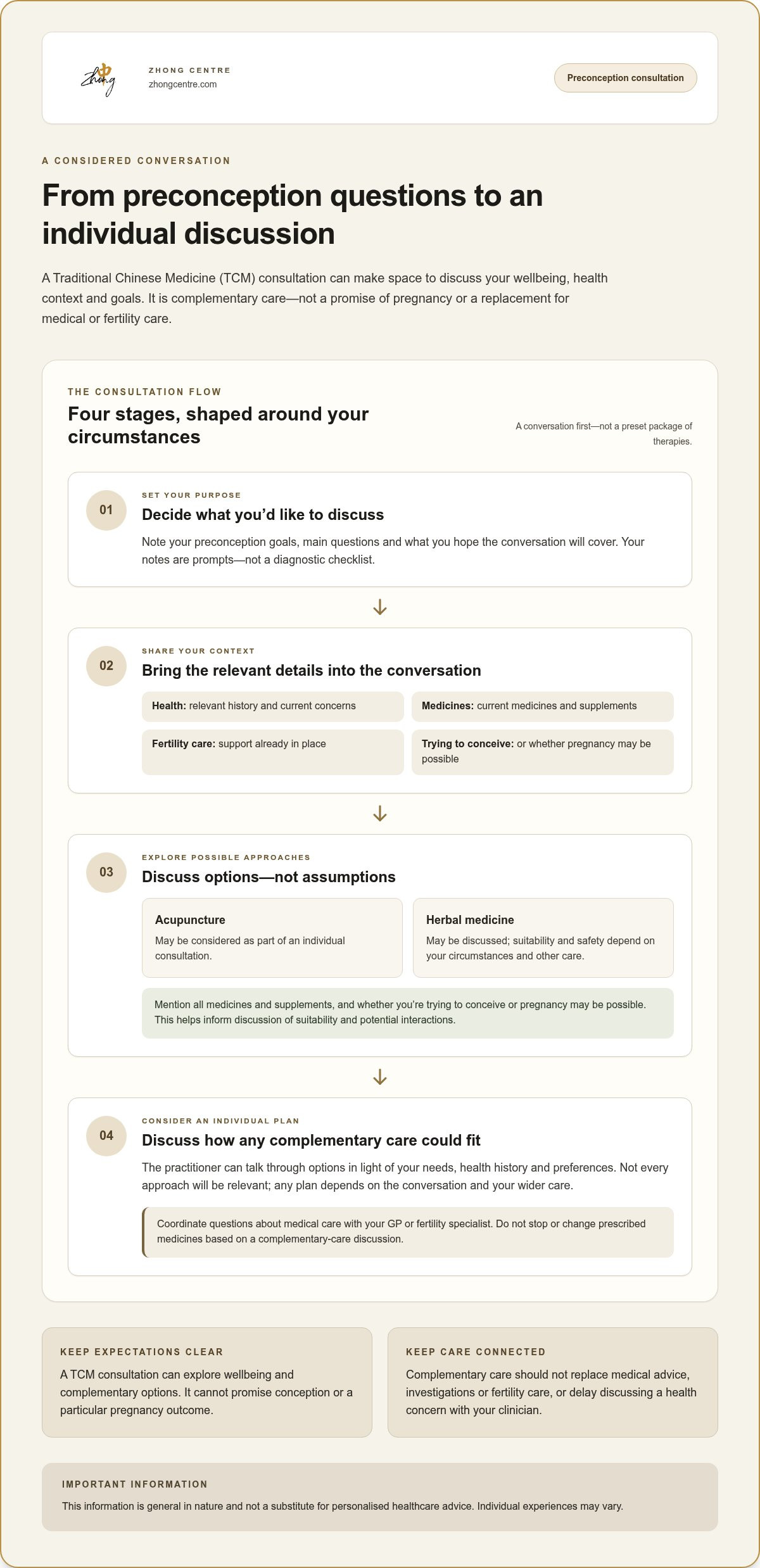
A consultation is a conversation first, not a preset package of therapies. You can share what you’re hoping to discuss, the health context you think is relevant and any questions you’ve been carrying. The practitioner can then talk through options that may suit your circumstances and consider an individual plan with you. Not every approach will be relevant, and the consultation doesn’t replace medical or fertility care.
For someone considering tcm for preparing body for pregnancy toorak, the practical value is having time to explain the full picture: what you’re planning, what care you already receive and what you’d like complementary support to address. You don’t need to arrive with a perfect summary. A few notes can help you remember the points that matter and make the conversation more focused.
What information may be useful to discuss?
Consider noting relevant health history, current medicines and supplements, existing fertility care and your goals for the consultation. You might ask what approaches could be discussed, how they relate to your circumstances and what should be coordinated with your GP or fertility specialist. These notes are conversation prompts, not a diagnostic checklist. Share sensitive information directly with the practitioner so it can be considered in context.
Be sure to mention if you’re actively trying to conceive, receiving fertility care or think pregnancy may be possible. That information can affect how options are considered. If you’re unsure whether a detail matters, raise it rather than leaving it out. Clear communication helps the practitioner understand what you want from the appointment and what other care is already involved.
How can acupuncture or herbal medicine fit into an individual plan?
Acupuncture and herbal medicine are options that may be discussed, not automatic parts of every consultation. Whether either is considered depends on your needs, health history and preferences. The practitioner can explain the approach being discussed and how it may fit alongside your existing care, without presenting it as a way to secure a pregnancy outcome.
Herbal medicine requires particular care. Tell the practitioner about all medicines and supplements you use, and whether pregnancy is possible or you’re trying to conceive. This information is important when considering suitability and potential interactions. Don’t stop or change prescribed medicines based on a complementary-care discussion. Speak with the clinician responsible for your medical care about any proposed changes.
A useful consultation should leave room for questions and shared decision-making. You can discuss what feels appropriate, what needs coordination with your GP or fertility specialist, and whether you want to proceed with any option. If you’re ready to discuss your goals and health context with Zhong Centre, you can book a TCM consultation.
TCM and pregnancy preparation: assess evidence, safety and expectations
Medical assessment and complementary wellbeing support have different roles. A GP or fertility specialist can discuss health concerns, investigations and fertility care. A Traditional Chinese Medicine consultation can be a separate space to consider whether complementary approaches fit your circumstances. One doesn’t need to rule out the other, but complementary care shouldn’t replace or delay recommended medical care.
If you’re considering tcm for preparing body for pregnancy toorak, keep expectations realistic: TCM cannot promise conception or a particular pregnancy outcome. Ask what an approach is intended to address, what is known about it and where uncertainty remains.
What does the research say about TCM and fertility?
Research questions need careful framing. Studies may examine different groups, approaches and outcomes, so a finding about wellbeing or symptoms doesn’t automatically show an effect on conception or live birth. Before relying on a claim, look for the original study or a systematic review, and check who took part, what intervention was assessed, what it was compared with and which outcomes were measured.
A result from a particular study isn’t a prediction for an individual. Ask whether the evidence relates to people in circumstances similar to yours, and whether the study can show that the approach caused the outcome. If those details aren’t clear, treat the claim cautiously rather than as a promise.
How should complementary and medical care work together?
Keep your GP, fertility specialist or other relevant clinician informed about complementary care. Share the details of any acupuncture or herbal medicine being considered, along with your current medicines and supplements. This helps your care team discuss how the proposed approach fits with your circumstances. Don’t stop or change prescribed medication based on a complementary-care conversation; raise those decisions with the clinician responsible for your care.
Safety depends on the person, the modality, medicines and supplements, and whether pregnancy may have begun. Mention possible pregnancy before discussing acupuncture or herbal medicine. Don’t assume an herbal product is suitable simply because it’s described as natural. Preconception questions also differ from care during pregnancy, so make the timing clear when discussing options.
These prompts can help you have a focused discussion with both your TCM practitioner and medical care team. They’re conversation starters, not a substitute for personalised advice.
| Ask your TCM practitioner | Ask your medical care team |
|---|---|
| What does the proposed approach involve, and how does it relate to my goals? | What investigations, medicines or fertility care are recommended for my circumstances? |
| What risks or uncertainties should I understand, including if pregnancy may be possible? | How should I coordinate complementary care with my current plan? |
| How will we review whether the approach remains suitable for me? | Who should I update if my health or care plan changes? |
How to prepare for a preconception TCM appointment in Toorak
A little preparation can make your appointment feel more focused. You don’t need to arrive with all the answers. Start by deciding what you hope to discuss, then gather the information that gives the practitioner a clearer picture of your circumstances. For people in Toorak exploring Melbourne-based care, this is a practical way to keep the consultation centred on your questions rather than assumptions about what you need.
Try this simple sequence:
- Clarify your goals. Note what you’d like support with, such as discussing wellbeing before trying to conceive or understanding how complementary care could sit alongside existing fertility care.
- Gather relevant details. Bring a current list of medicines and supplements, a brief health history and details of any fertility care you’re receiving or planning.
- Write down questions. A short list can help you remember what matters, especially if the conversation feels new or emotionally loaded.
- Discuss next steps together. Ask what options may be relevant, what remains uncertain and how suitability could be reviewed over time.
Questions to take to a TCM consultation
Useful questions are specific to your goals. You might ask what a proposed approach involves, why it’s being discussed in your circumstances, and what potential risks or uncertainties to consider. Ask how the plan could be coordinated with your GP, fertility specialist or other healthcare professional. You can also ask how you and the practitioner would review whether an approach remains suitable, without treating progress as a promise of conception.
Keep your expectations grounded. A consultation can clarify options and give you space to consider them. It can’t guarantee a pregnancy outcome. That distinction is central if you’re researching tcm for preparing body for pregnancy toorak and weighing complementary support alongside the medical care you may already have in place.
What should you share before discussing acupuncture or herbs?
Be open about current and planned fertility care, relevant health history, medicines and supplements. Also disclose if pregnancy is possible, including if you’re actively trying to conceive. That context matters because pregnancy possibility can affect the discussion of acupuncture or herbal medicine, and the practitioner needs to consider your circumstances rather than assume they’re unchanged.
If you have a clinical concern, direct it to your GP, fertility specialist or another appropriate healthcare professional. Don’t stop or change prescribed medicines, or make supplement changes, based on general information or a complementary-care conversation. Instead, raise questions with the clinician responsible for your care so decisions can be made with your health history in view.
Bring your notes, ask what you need to ask, and take time to consider the options discussed. If a tailored conversation feels like a useful next step, you can book a TCM consultation with Zhong Centre.
Explore pregnancy-preparation TCM support with Zhong Centre in Melbourne
Choosing complementary support is a personal decision. You may be weighing whether a TCM consultation fits your goals, what information you want to share, and how it could sit alongside medical or fertility care. For Toorak residents seeking Melbourne-based support, Zhong Centre offers TCM consultations and fertility support, with conversations shaped around individual needs rather than a one-size-fits-all pathway.
What to expect when considering Zhong Centre
A first step is a conversation about your goals, relevant health history and questions. You can explain whether you’re preparing to try to conceive or already receiving fertility care, and discuss what you’d like complementary support to address. The practitioner can consider which approaches may be relevant to your circumstances. Herbal medicine prescriptions may form part of care where appropriate, with suitability discussed in light of your health context and other medicines.
Zhong Centre is led by Dr Abbie Cloherty. You can read Dr Abbie Cloherty’s practitioner profile to learn more about the clinic’s leadership. The focus remains on an individual discussion, not a promise about conception or pregnancy. A consultation doesn’t replace assessment or care from your GP or fertility specialist.
If you’re researching tcm for preparing body for pregnancy toorak, consider whether the approach and conversation suit your needs. You might value the chance to talk through wellbeing and personal goals, while keeping medical advice and fertility care central to decisions about your health.
Choose a next step that feels informed
Before deciding, reflect on what you want from complementary care and what questions still need answers. You might want to discuss:
- How a proposed approach relates to your goals and circumstances.
- How possible pregnancy, medicines or supplements affect the discussion.
- How complementary support can be coordinated with your existing healthcare.
There’s no single route that suits everyone. Your preferences, health history and current care all matter. If a medical concern needs attention, raise it with your GP, fertility specialist or another appropriate healthcare professional. TCM support is complementary, not a substitute for recommended investigations or fertility care.
Zhong Centre’s Melbourne-based TCM consultations are relevant to people in Toorak and surrounding areas, including St Kilda, Elwood, Bayside, Armadale, Windsor, Prahran, St Kilda East, Melbourne East, Elsternwick, Port Melbourne, Albert Park, Caulfield, Malvern, Chadstone, Balaclava and Ripponlea. If a tailored conversation feels like a useful next step, you’re welcome to book a TCM consultation with Zhong Centre. Bring your questions and relevant health details, and use the appointment to discuss what may be appropriate for you.
Make your next step a considered one
Preparing for pregnancy doesn’t need to mean having every answer before you begin. It can mean choosing a conversation that helps you clarify what matters to you, what questions remain and how complementary care could fit your wider healthcare. If you’re considering tcm for preparing body for pregnancy toorak, let your own goals and circumstances guide the decision, not pressure to follow a particular path.
A consultation at Zhong Centre offers space to discuss those goals and your relevant health context. Any options, including herbal medicine, are considered individually. Keep your GP or fertility specialist involved in decisions about your health, and take the time you need to decide whether this support feels appropriate for you.
If you’d like to explore that conversation, you can book a TCM consultation with Zhong Centre. Bring your questions and relevant health information so you can discuss your priorities and consider possible next steps.
Frequently Asked Questions
When should I consider TCM if I am preparing for pregnancy?
You can consider a TCM consultation when you have questions about complementary wellbeing support, whether you’re planning ahead or already discussing fertility care. There’s no single ideal time that suits everyone. If you’re exploring tcm for preparing body for pregnancy toorak, think about what you want from the conversation, such as discussing wellbeing, health history or how complementary care might fit your plans. Keep routine medical advice in the picture.
Can TCM guarantee that I will conceive?
No TCM approach can promise conception or a particular pregnancy outcome. Conception depends on individual factors that a complementary consultation can’t control. You can use an appointment to discuss your goals and ask what the evidence can and can’t say about any proposed approach. Be cautious of claims that promise a particular fertility outcome, and keep decisions about investigations and fertility care with your medical team.
Is acupuncture safe while trying to conceive?
Whether acupuncture is appropriate depends on your personal health context, so no general answer can establish safety for everyone. Before a session, tell the practitioner if you’re trying to conceive, if pregnancy may have begun, and about relevant conditions or medicines. Ask what the proposed acupuncture involves and what risks or uncertainties apply to you. If you have a specific medical concern, discuss it with your GP or fertility specialist.
Can I use Chinese herbal medicine while trying to get pregnant?
That needs an individual safety discussion before using any herbal medicine. Tell the practitioner about prescribed medicines, supplements, allergies and whether pregnancy may be possible. Products described as natural can still have effects or interact with medicines, so don’t assume they’re suitable for you. Don’t stop prescribed medication or start an herbal product based on general information; raise the idea with your relevant healthcare professional.
Can I have TCM support while undergoing IVF?
You can discuss complementary TCM support while receiving IVF care, but coordinate any proposed approach with your fertility team. For example, share the timing of planned procedures and any medicines or supplements so clinicians can consider the full context. Don’t alter an IVF medication schedule or care plan based on complementary advice alone. Whether acupuncture or another approach is suitable is a personal discussion, not a promise of an IVF outcome.
Should my partner attend a preconception TCM consultation?
Your partner’s involvement depends on your goals and preferences. If you’re both considering preconception support, their health context or questions may be relevant to the discussion, particularly if you’re exploring male fertility support. You could decide together what information would be helpful to raise. A consultation can still focus on your own circumstances if that feels more appropriate. Any medical concerns your partner has should be discussed with their healthcare professional.
What should I tell a TCM practitioner before an appointment?
Share the details that could shape a healthcare discussion: relevant health history, current medicines and supplements, existing fertility care, and whether pregnancy may be possible. If you have recent investigations or a planned IVF procedure, noting the dates can help make your questions more specific. You can also explain what you hope to discuss and mention concerns you’d prefer to handle sensitively. Direct urgent or clinical concerns to your appropriate healthcare professional.
This information is general in nature and not a substitute for personalised healthcare advice. Individual experiences may vary.