

Red Dates (Jujubes): The Chinese Medicine Superfood for Vitality and Glow
What if the secret to that elusive lit-from-within radiance wasn't sitting in a synthetic serum, but in a humble bag of red dates found in your pantry? You're likely exhausted by topical creams that promise a transformation but leave your skin looking just as dull and your energy levels just as depleted. It's frustrating to feel like you're constantly chasing vitality through external fixes while your internal battery remains on low. You want a solution that works as hard as you do, without the sterile, clinical vibes.
Similarly, stocking your kitchen with authentic heritage foods, such as those found at Zimtuckshop, allows you to move away from processed alternatives and embrace a more natural approach to nourishment.
This article explores how this cornerstone of Chinese Medicine may help address these systemic imbalances by supporting your Blood and Qi. We will discover how this ancient superfood aims to assist with your sleep quality and natural energy levels from the inside out. We'll break down the nutritional profile of jujubes, explain the traditional logic behind their use for vitality, and provide simple ways to integrate them into your busy lifestyle. It's time to stop masking the symptoms and start nourishing the system.
This information is general in nature and not a substitute for personalised healthcare advice. Individual experiences may vary.
Key Takeaways
- Understand why Hong Zao is a cornerstone "superfood" in Chinese Medicine for those seeking a grounded, internal alternative to synthetic aesthetic procedures.
- Learn how the logic of nourishing Blood and tonifying Qi aims to support your daily energy levels and systemic health.
- Identify the differences between seasonal fresh jujubes and the concentrated dried red dates used for year-round wellness support.
- Discover simple ways to organise these ancient staples into a busy lifestyle using the "Daily Three" method or easy desk-side teas.
- Explore how addressing internal Blood deficiency may help improve the appearance of dull skin and fine lines from within.
This information is general in nature and not a substitute for personalised healthcare advice. Individual experiences may vary.
What are Red Dates? (Hong Zao and the TCM Powerhouse)
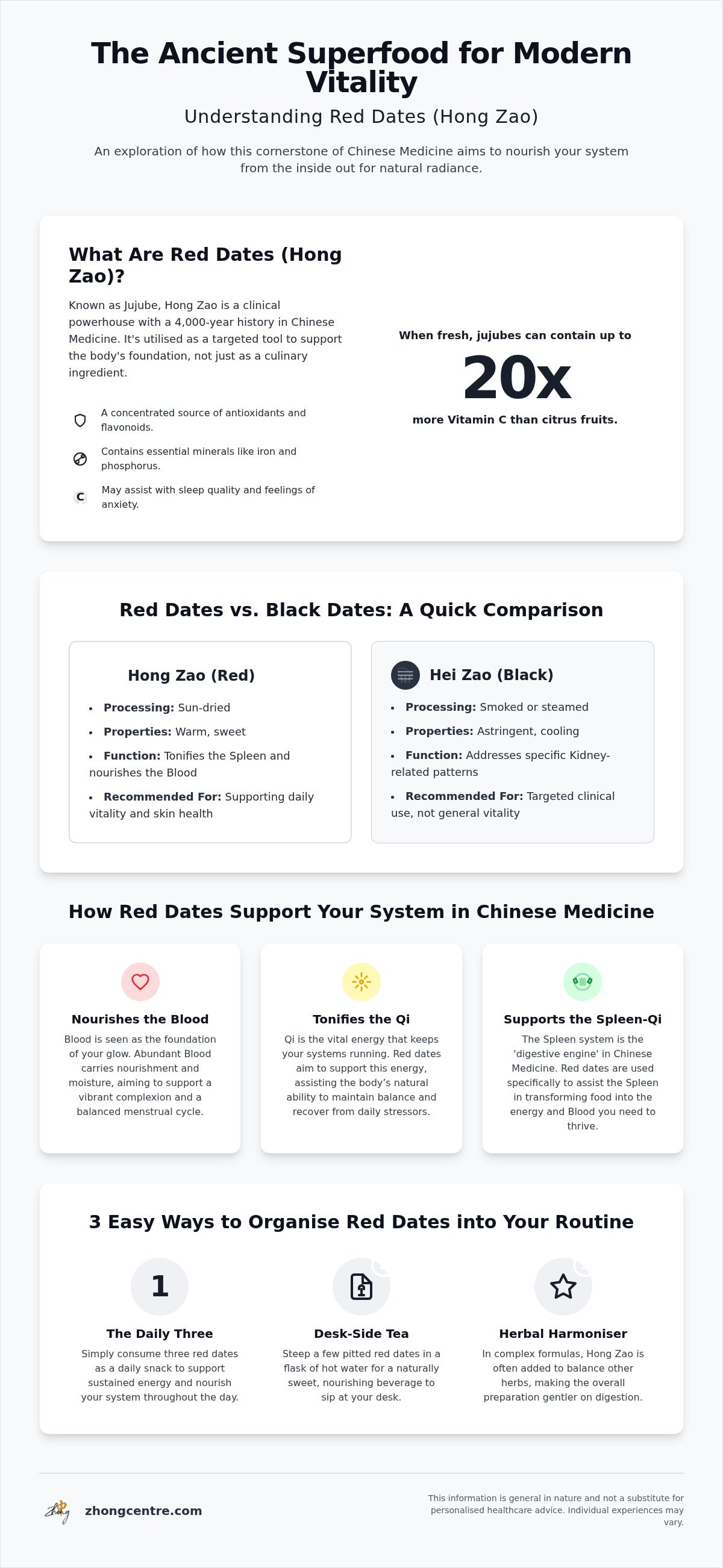
Forget the sticky, syrup-heavy fruits found in the baking aisle of your local supermarket. Jujube (Ziziphus jujuba), known as Hong Zao in Chinese Medicine, is a clinical powerhouse disguised as a humble snack. While the West is just beginning to recognise its potential, these fruits have been utilised for over 4,000 years as a systemic intervention to support the body's foundation. They aren't just a culinary addition; they're a targeted tool for those who refuse to accept "feeling depleted" as a permanent state of being.
Why do we label them a superfood? Because the data matches the tradition. Fresh jujubes can contain up to 20 times more Vitamin C than citrus fruits. When dried, red dates become a concentrated source of antioxidants, flavonoids, and essential minerals like iron and phosphorus. Unlike the common Medjool or Deglet Noor dates, which are primarily used for sweetness, Hong Zao has a lower glycaemic index and a unique profile of triterpenic acids. Research suggests these compounds may help address poor sleep quality and assist with anxiety by interacting with the body's GABA receptors. This makes them an essential "internal serum" for anyone looking to support their natural radiance from the inside out.
The Cultural Significance of the Jujube
In many Asian cultures, these dates are synonymous with a "sweet life." They are frequently gifted at weddings to symbolise harmony and fertility. However, their most vital role is found in Zuo Yue Zi, the traditional month of postpartum recovery. During this critical window, they are used to support Blood replenishment and energy restoration for new mothers. In the context of complex herbal formulas, Hong Zao acts as a "harmoniser." It's the diplomatic mediator that balances the harshness of other herbs, ensuring the formula is gentle on your digestive system while remaining effective for your systemic health.
Red Dates vs. Black Dates: A Quick Comparison
You might notice Hei Zao (Black Dates) at a traditional grocer and wonder if they're interchangeable. They aren't. While they come from the same tree, the processing creates distinct clinical profiles:
- Hong Zao (Red): These are dried in the sun. They are warm, sweet, and primarily used for tonifying the Spleen and nourishing the Blood. We reach for these for daily vitality and skin support.
- Hei Zao (Black): These are smoked or steamed, giving them a more astringent, cooling property. They are typically used to address specific Kidney-related patterns in Chinese Medicine.
For those looking to address a dull complexion or low daily energy, the red variety is the gold standard for your daily routine.
This information is general in nature and not a substitute for personalised healthcare advice. Individual experiences may vary.
How Red Dates Support Your System in Chinese Medicine
In the logic of Chinese Medicine, your skin is a map of your internal health. If you're looking at dullness or fine lines in the mirror, topical creams are often just an expensive band-aid. Red dates are designed to address the root cause by nourishing the Blood. In our practice, we view Blood as the foundation of your glow; it's the substance that carries nourishment and moisture to every cell. When your Blood is abundant, your complexion looks vibrant and your menstrual cycle feels supported. When it's deficient, you feel depleted, look pale, and your body struggles to recover from daily stressors.
Beyond the surface, these fruits aim to tonify your Qi, the vital energy that keeps your systems running. Modern research into the bioactive components and health benefits of jujube highlights polysaccharides and polyphenols that support systemic health. These compounds don't just "fix" a symptom; they assist the body's natural ability to maintain balance. This is why we often recommend them as "homework" for our patients undergoing TCM Consultations in Melbourne.
The Spleen-Qi Connection
The "Spleen" in Chinese Medicine isn't just an organ; it's your digestive engine. It's responsible for transforming the food you eat into the energy and Blood you need to thrive. If this engine is sluggish, you'll feel heavy, bloated, and perpetually tired. Red dates are specifically used to assist the Spleen in its daily work. By supporting your digestive function, they help ensure that the nutrients from your diet actually reach your skin and muscles. It's a logical, internal approach to vitality that bypasses the need for synthetic energy boosters.
Supporting Sleep and Mental Calm
Ever experienced that "tired but wired" feeling at 11:00 pm? In Chinese Medicine, this restlessness is often linked to a lack of Blood nourishing the heart and mind, a concept known as "Calming the Shen." Red dates are frequently included in traditional formulas to assist with mild anxiety and restless sleep. They aim to support the nervous system, helping you transition from a high-pressure workday to a state of internal calm. Rather than relying on heavy sedatives, this method focuses on providing the body with the building blocks it needs to feel safe and grounded.
This information is general in nature and not a substitute for personalised healthcare advice. Individual experiences may vary.
Choosing Quality: Fresh vs. Dried Jujubes in Australia
Shopping for red dates in Melbourne can feel like a gamble if you don't know what you're looking for. You have two main choices: the seasonal fresh fruit and the year-round dried staple. Fresh jujubes typically hit the markets from February to April. They are crisp, slightly tart, and resemble a miniature Granny Smith apple. With up to 20 times the Vitamin C of citrus, they are a fantastic seasonal snack to support your immune system during the transition into autumn.
However, the dried version is the true workhorse of Chinese Medicine. Drying the fruit concentrates its sugars and bioactive compounds, making it more effective for tonifying Blood and Qi. When selecting your stash, look for plump skin and a deep, mahogany colour. If the date is bone-dry or shrivelled to the point of being rock-hard, it’s past its prime. A high-quality date should have a slightly moist, spongy interior when torn open. Most importantly, check the label for "preservative 220" or sulphur dioxide. Many commercial brands use sulphur to maintain an unnaturally bright red colour. It’s a synthetic shortcut that can irritate the respiratory system and has no place in a wellness-focused pantry.
The Sourcing Checklist for Melburnians
Melbourne is home to some of the best traditional grocers in the country, but quality varies wildly. If you’re heading to Footscray, Richmond, or Box Hill, bypass the dusty bags at the back of the shelf. Premium red dates should look clean and vibrant, not covered in a fine grey film. We always recommend opting for organic or pesticide-free varieties where possible. Since you’ll likely be brewing these into a tea or slow-cooking them in a congee, you want to avoid steeping your system in residual chemicals. A clean source ensures the fruit can assist your systemic health without adding to your toxic load.
Storing Your Stash
Because of their high natural sugar content, these dates are prone to mould if they aren't stored correctly. If you plan on using them within a fortnight, a cool, dark pantry is fine. For anything longer, the fridge is your best friend. Keep them in an airtight glass jar to prevent them from absorbing other flavours. If you notice a sour, fermented smell or visible white fuzz, it’s time to toss them. A good date should smell earthy and sweet, like a cross between a prune and a sun-ripened apple.
This information is general in nature and not a substitute for personalised healthcare advice. Individual experiences may vary.
3 Easy Ways to Organise Red Dates into Your Daily Routine
Integrating red dates into a high-pressure Melbourne lifestyle doesn't require hours of slow-cooking or complex herbal knowledge. While traditional recipes often lean towards heavy soups, modern wellness is about efficiency and systemic support. The most famous habit in Chinese Medicine is the "Daily Three." Eating three dates a day is a classic longevity practice designed to provide a consistent baseline of Blood and Qi support. It’s a simple, portable ritual for the desk or the commute.
Before you start, there is one non-negotiable step: always remove the pits. In the logic of Chinese Medicine, the seeds are considered "heating." If you’re already feeling a bit "wired" or prone to inflammation, leaving the pits in can be counterproductive to your internal balance. Once pitted, they become a versatile tool. You can slice them into your morning porridge or overnight oats, where they act as a natural, low-GI sweetener that assists your digestive engine without the sugar crash of synthetic alternatives.
The 5-Minute Beauty Tea
This is the ultimate desk-side companion for anyone staring at a screen all day. Slice three red dates and combine them with a teaspoon of goji berries in your favourite mug. Pour over boiling water and let it steep for five minutes. This combination is designed to assist with eye strain and support energy levels throughout the afternoon slump. Don't throw the fruit away once you’ve finished the tea. Eating the softened dates ensures you’re getting all the fibre and concentrated nutrients. If you’re feeling particularly cold or "stuck," try adding a slice of fresh ginger for warmth or a few dried rosebuds to help move your Qi.
Red Dates in Modern Cooking
You don't have to stay within the lines of traditional tea. Sliced dates add a chewy, sweet pop to a bitter leaf salad, balancing the flavours perfectly. For a more "edgy" approach, blend pitted dates into your raw wellness balls or protein treats. They provide a structural chewiness and a dose of antioxidants that standard Medjool dates can't match. By using them as a natural sugar substitute in your weekend baking, you’re choosing a systemic health boost over a temporary glucose spike. If you're unsure how these dietary shifts fit into your wider health goals, book a TCM Consultation to get a bespoke plan.
This information is general in nature and not a substitute for personalised healthcare advice. Individual experiences may vary.
Beyond the Snack: Internal Support for External Rejuvenation
At Zhong Centre, we don't just look at the lines on your face. We look at the system that created them. Our "Inside-Out" philosophy is the reason we position red dates as a non-negotiable homework staple for our patients. You can't effectively support collagen production if your body is starving for basic building blocks. Natural facial rejuvenation isn't just about what happens on the treatment table; it's about what you're putting in your bowl every morning.
In the logic of Chinese Medicine, Blood deficiency isn't just a clinical diagnostic term. It's a visible state that manifests on your skin. You might notice a persistent paleness, a sallow dullness, or fine lines that topical moisturisers can't seem to reach. This is often your system's way of signalling that it lacks the internal "plumpness" provided by robust Blood and Qi. By incorporating jujubes into your routine, you are providing the building blocks designed to support your systemic health, which may help improve the appearance of your skin's natural radiance.
Alongside internal nourishment, many people find that high-quality external products help maintain their results; you can learn more about Beauty Cosmos Malta to explore their curated collection of premium cosmetics.
The Zhong Centre Approach to Skin Health
We are disruptively honest about the limitations of the beauty industry. Botox and dermal fillers are often used as a "quick fix" to mask the symptoms of a depleted system. Our approach is different. We focus on systemic vitality. When Dr Abbie and the team assess you during a consultation, we aren't just looking at wrinkles. We are evaluating your Blood and Qi to understand why your skin has lost its lustre. We view natural facial rejuvenation as a lifestyle choice. It's a commitment to long-term health rather than a temporary cosmetic mask.
Your Next Steps for a Natural Glow
Transformation starts with small, consistent actions. Begin with the "Daily Three" habit we discussed earlier. It’s a foundational step that aims to address internal depletion before it shows up on your face. If you’re feeling perpetually "flat" or your skin looks grey, it’s time for a deeper look. We recommend booking a TCM Consultation to identify if underlying Blood deficiency is holding you back. To complement your internal efforts, you can support the skin's surface with the Zhong Collection skincare. Combining internal nourishment with external care is the only logical way to achieve a sustainable, natural glow.
This information is general in nature and not a substitute for personalised healthcare advice. Individual experiences may vary.
Cultivate Your Internal Radiance
Real rejuvenation isn't found in a synthetic bottle; it's built through systemic health. You've learned how red dates act as a foundational tool to support your Blood and Qi, addressing the root of dullness and depletion. By shifting from a quick fix mindset to a logic-based approach, you're choosing long-term vitality over temporary cosmetic masks.
Whether you're brewing a beauty tea at your desk or adopting the Daily Three habit, these small shifts aim to assist your body's natural ability to glow. Since 2014, our AHPRA-registered Chinese Medicine practitioners have specialised in natural facial rejuvenation. We're here to help you move away from synthetic standards and toward grounded authenticity. It's time to stop masking symptoms and start nourishing the system that supports you.
Ready to see how your internal health is reflecting on your face? Book a TCM Consultation at Zhong Centre St Kilda to receive a bespoke assessment of your systemic needs.
This information is general in nature and not a substitute for personalised healthcare advice. Individual experiences may vary.
Frequently Asked Questions
Are red dates safe to eat every day?
Eating three red dates daily is a common practice in Chinese Medicine to support Blood and Qi levels. While generally safe for most people, moderation is key to avoid digestive dampness or bloating. Consistency is what helps provide long-term systemic support rather than a temporary energy spike. This habit is designed to assist your body's natural foundation over time through gentle, internal nourishment.
Do red dates really help with sleep and insomnia?
These fruits are traditionally used to assist with restless sleep and mild anxiety by aiming to nourish the Blood and heart. This process supports a state of internal calm known as "Calming the Shen." It's a natural way to support the nervous system after a long day without the grogginess often associated with synthetic sleep aids or heavy sedatives that mask underlying depletion.
Can I eat red dates during my period?
Consuming them during your cycle is often encouraged to support Blood replenishment and address the "depleted" feeling many experience. They are designed to assist with the systemic drain that occurs during menstruation, helping to maintain your energy and vitality. However, if you experience heavy bleeding or specific heat symptoms, it's best to consult with a practitioner for personalised advice regarding your cycle.
Are red dates high in sugar or calories?
They contain natural sugars but have a lower glycaemic index compared to standard supermarket dates. Three dates provide roughly 60 to 80 calories depending on their size and variety. This makes them a logical choice for a natural sweetener that aims to support your energy levels without the dramatic glucose spikes and crashes seen with processed snacks or high-sugar synthetic treats.
Should I peel or pit the red dates before eating?
You should always remove the pits before consuming them or brewing them into tea. In Chinese Medicine logic, the seeds are considered "heating" and can lead to internal imbalance or restlessness if used frequently. There's no need to peel the skin, as it contains many of the beneficial bioactive compounds and fibre your system requires for digestive health and antioxidant support.
Is there anyone who should avoid red dates in their diet?
Individuals with significant digestive dampness, frequent bloating, or high internal heat symptoms should use them cautiously. Because they are tonifying, they can occasionally make "stagnation" or a feeling of heaviness feel more pronounced. If you're dealing with acute phlegm or a thick tongue coating, it's often better to address those systemic issues first during a professional consultation before starting a daily habit.
What is the difference between red dates and normal Medjool dates?
They are entirely different species with distinct nutritional profiles and functions. While Medjool dates are a high-sugar dessert fruit from the palm family, red dates come from the buckthorn family and are a medicinal staple with higher Vitamin C. Medjools are primarily used for quick calories; jujubes are utilised for their ability to support systemic Blood and Qi levels.
How long does it take to see the benefits of eating red dates?
Systemic health is a marathon, not a sprint, and results depend on your baseline health. While some notice a subtle assist with energy levels within a week, it typically takes several weeks of consistent use to support Blood levels visibly on the skin. We view this as a long-term lifestyle shift designed to assist your natural radiance from the inside out.
This information is general in nature and not a substitute for personalised healthcare advice. Individual experiences may vary.