

Pregnancy Acupuncture in South Yarra: What to Know About Support and Safety
What if the key question isn’t whether acupuncture can turn a breech baby, but how complementary care can fit alongside your maternity care? If pregnancy acupuncture south yarra is on your mind, it’s understandable to want clear answers. Conflicting claims can make it difficult to know what an appointment involves, what acupuncture may offer and who should guide decisions about your pregnancy.
This article explains what to expect from a consultation, how to assess claims about acupuncture and breech presentation, and what to discuss with your midwife or doctor. Breech care calls for advice from your maternity team. Acupuncture is complementary support, not a substitute for their assessment or recommendations.
At Zhong Centre, pregnancy support and Traditional Chinese Medicine consultations are tailored to your concerns and care context. We’ll cover how to discuss acupuncture with your maternity team, what to consider when choosing a registered practitioner and how a Melbourne consultation may fit alongside your usual pregnancy care.
Key Takeaways
- Pregnancy acupuncture may offer complementary support, but it doesn’t replace antenatal assessment or advice from your maternity team.
- Acupuncture support and breech care have different roles: your maternity clinicians assess fetal position and discuss appropriate options.
- Before considering acupuncture, clarify what you hope to address and discuss it with your midwife or doctor.
- When exploring pregnancy acupuncture south yarra, consider how a personalised Traditional Chinese Medicine consultation can take your concerns and maternity care context into account.
- Research into complementary approaches can vary in strength. Read evidence carefully and don’t assume acupuncture will change a baby’s position.
Pregnancy acupuncture in South Yarra: what it can and cannot address
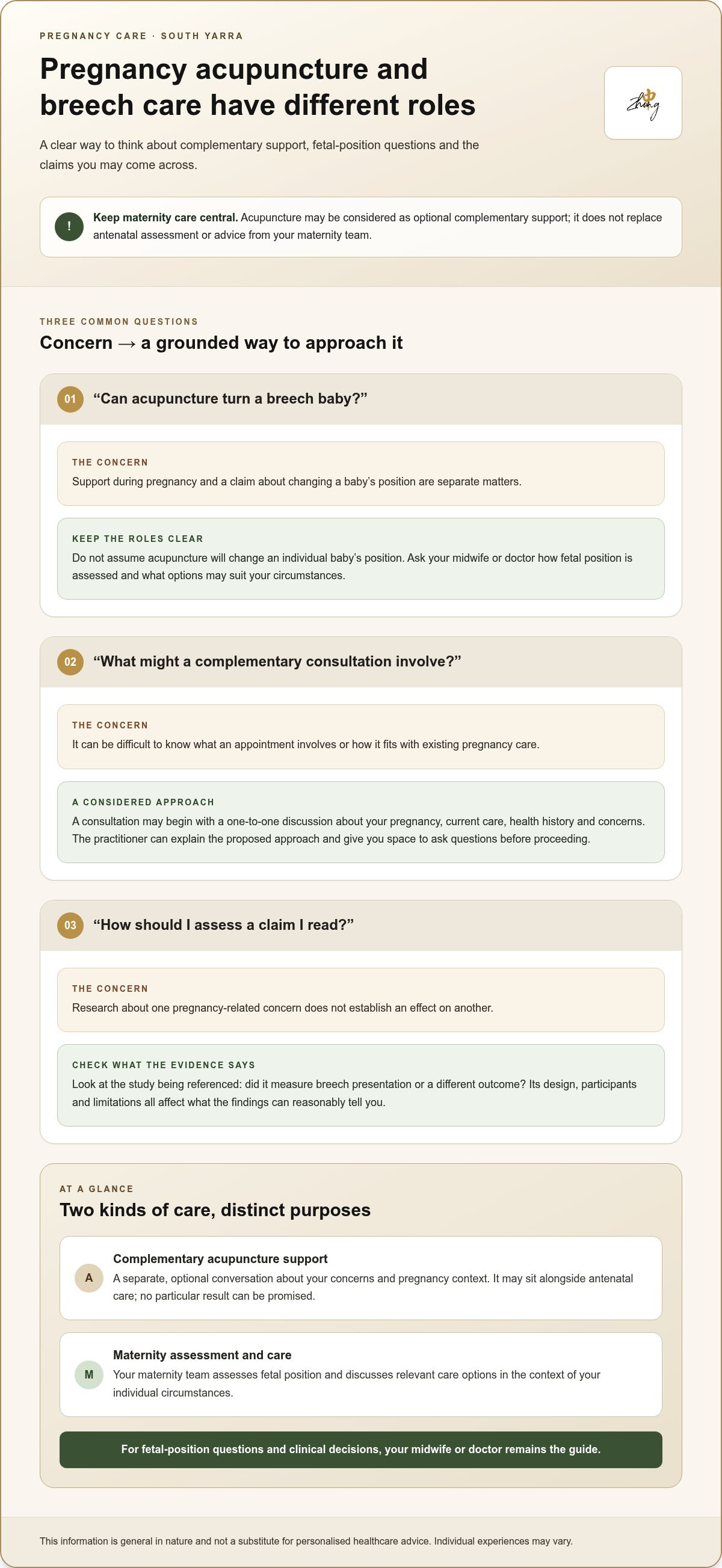
Pregnancy acupuncture is complementary care that may support wellbeing during pregnancy; it doesn’t replace antenatal assessment, maternity advice or decisions about birth. Support for a pregnant person’s concerns and claims about changing a baby’s position are separate matters. One shouldn’t be treated as evidence for the other.
If you’re considering pregnancy acupuncture south yarra, think of it as an additional conversation within your broader care, not a shortcut around it. Your midwife or doctor remains central to pregnancy monitoring and clinical decisions.
What does pregnancy acupuncture involve?
An appointment can begin with a one-to-one discussion about your pregnancy, current care and concerns. The practitioner may ask about your health history and what you hope to explore, then explain the proposed approach before proceeding. Acupuncture involves placing fine needles at selected points on the body. Its proposed effects continue to be studied, so explanations should be measured rather than presented as settled fact.
Care is tailored to the person and their circumstances. A consultation gives you space to discuss your comfort, ask questions and consider how complementary care fits alongside antenatal support. Before proceeding, make sure you understand what the appointment involves and what it can and cannot offer. Where relevant, discuss any proposed plan with your maternity team. No particular result can be promised.
Does acupuncture turn a breech baby?
Acupuncture shouldn’t be presented as a reliable or guaranteed way to turn a breech baby. General pregnancy support and changing fetal position are different claims. Evidence about acupuncture and related approaches for breech presentation should be interpreted cautiously. Findings from a study don’t establish that a particular approach will change an individual baby’s position.
Ask your midwife or doctor how fetal position is assessed and what options may be appropriate for your circumstances. Don’t delay or replace maternity assessment with complementary care. If you’re weighing up acupuncture, discuss it with your maternity team so it can sit alongside, rather than displace, their advice.
For general background on the practice and safety considerations, see this overview of acupuncture and pregnancy safety. It isn’t a substitute for current clinical guidance or personalised advice. A clear conversation about what acupuncture may involve, and what it cannot promise, helps keep expectations grounded.
How pregnancy acupuncture and breech care differ
These forms of care have different roles. Acupuncture may be considered as an optional, complementary conversation about support during pregnancy. Maternity care addresses clinical questions, including assessing fetal position and discussing options if a baby is breech.
Fetal-position assessment and decisions belong with your maternity team; acupuncture is not a substitute for that care. Keeping the roles clear lets you explore complementary support without allowing it to delay or determine clinical decisions.
What does maternity care do when a baby is breech?
Your maternity team can explain how fetal position is assessed and discuss what options may be appropriate for you. The conversation depends on your circumstances and timing, so don’t assume there is one pathway that suits everyone. Bring your questions to your midwife or doctor and follow their personalised advice about assessment and care.
Where might complementary support fit?
If you’re considering pregnancy acupuncture south yarra, treat it as a separate, voluntary support conversation, not a breech intervention. Share relevant pregnancy information with your maternity team and practitioner so your care context is understood. Zhong Centre provides pregnancy support and Traditional Chinese Medicine consultations tailored to individual needs. You can read more in this pregnancy acupuncture guide.
It doesn’t have to be an either-or choice. Keep maternity clinicians central to fetal-position questions, then decide whether complementary support feels relevant to your needs. If you’d like to explore a personalised consultation, you can view appointment options.
Evidence and safety questions to consider before pregnancy acupuncture
Pregnancy care and research into complementary approaches answer different questions. Your maternity team’s guidance informs assessment and decisions about your pregnancy. Acupuncture research may examine particular symptoms or outcomes, but a finding about one concern doesn’t establish an effect on another. This distinction matters especially when claims involve breech presentation.
Evidence about one pregnancy-related concern can’t, by itself, show that acupuncture changes fetal position. Before relying on a claim, look for the study it refers to and check whether it measured breech presentation or a different outcome. A study’s design, participants and limitations affect what its findings can reasonably tell you. Be cautious of claims promising a particular result, timeline or level of effectiveness without credible, relevant evidence.
How to read claims about acupuncture and breech presentation
Check what researchers actually measured. Findings about nausea or pregnancy-related discomfort, for example, don’t establish an effect on a baby’s position. Consider whether a study compared groups, how participants were selected and whether its results apply to your circumstances. A single study or an association doesn’t prove that acupuncture caused a change. If a claim gives a precise success rate or timeframe, look for a named, relevant study behind it.
What to discuss before an appointment
Before considering pregnancy acupuncture south yarra, speak with your midwife or doctor about whether complementary care fits your situation. Share your stage of pregnancy, relevant health information and any advice you’ve received about fetal position or other concerns. This allows your maternity clinician to advise in the context of your care.
During a consultation, your concerns and pregnancy context should inform the discussion and any proposed plan. Be open about current maternity advice. Ask what the appointment involves, what is known about the approach for your specific concern and what its limits are. Care should be tailored to individual circumstances, not presented as a standard answer or substitute for antenatal assessment.
In Australia, you can check an acupuncturist’s registration on the public register managed by AHPRA. Registration is a useful qualification check, but it doesn’t mean every claim about pregnancy or breech presentation is supported by evidence. Keep those questions separate and bring clinical decisions back to your maternity team.
How to decide whether pregnancy acupuncture suits your situation
You don’t need to decide on the spot. A considered approach keeps your pregnancy care at the centre and gives you room to weigh up complementary support without pressure.
- Clarify your concern. Write down what you’d like support with or what you’re unsure about.
- Discuss it with your maternity team. Ask whether acupuncture is appropriate alongside your care and what advice applies to your circumstances.
- Then consider your options. If complementary support feels right for you, discuss what a consultation involves and what it can and cannot offer.
This sequence is especially useful if your question relates to fetal position. Acupuncture shouldn’t determine or delay maternity assessment. The choice to explore it is yours, and it’s also fine to decide it isn’t right for you.
Questions to raise with your maternity team
You might ask how fetal position is assessed and when it would be useful to discuss relevant options. If you’re considering acupuncture, tell your maternity team and ask how it could fit alongside antenatal care. For a health concern, pregnancy complication or change in symptoms, seek personalised advice from your midwife or doctor rather than relying on a complementary consultation for clinical decisions.
What to expect from a Zhong Centre pregnancy consultation
A consultation can begin with an individual discussion about your needs, pregnancy context and concerns. Sharing relevant maternity advice helps the practitioner understand the bigger picture and tailor the conversation to you. You can ask what the proposed approach involves, raise questions and decide whether you want to proceed. You don’t need to arrive with a fixed plan.
Pregnancy support through Traditional Chinese Medicine is complementary. It doesn’t replace antenatal care, and no particular outcome can be promised. If you’d like to learn more about Dr Abbie, you can read her practitioner profile. For questions about your own care, discuss your circumstances with your maternity team.
For pregnancy acupuncture south yarra, a practical next step is a conversation that respects both your preferences and your maternity team’s advice. If you’ve decided a consultation is worth exploring, you can view booking options. Taking time to make an informed, voluntary choice helps keep complementary support in its proper place.
Pregnancy acupuncture in South Yarra: local support and next steps
For South Yarra and Melbourne readers, the next step can be a clear conversation, not a rushed decision. Zhong Centre offers pregnancy support and Traditional Chinese Medicine consultations in Melbourne. Pregnancy acupuncture may be considered as individualised complementary support, while antenatal care remains the place for pregnancy assessment and clinical advice.
People looking for pregnancy acupuncture south yarra may also be comparing options from nearby areas, including St Kilda, Elwood, Bayside, Armadale, Toorak, Windsor, Prahran, St Kilda East, Melbourne East, Elsternwick, Port Melbourne, Albert Park, Caulfield, Malvern, Chadstone, Balaclava and Ripponlea. Wherever you’re travelling from, keep your maternity team involved in decisions about your pregnancy.
Keep the distinction firm: a pregnancy-support consultation is not a promised way to change fetal position. If breech presentation is a concern, your midwife or obstetric clinician is the right person to discuss assessment and options with. Complementary care should sit alongside that conversation, never replace it.
Choosing a considered next step
Before arranging complementary support, consider what you want to discuss. It might be a pregnancy-related concern, questions about acupuncture or how a consultation could fit around your existing care. Sharing relevant information about your pregnancy and the advice you’ve received can help make the discussion personal and grounded in your circumstances.
A Zhong Centre pregnancy consultation offers space to discuss your needs and pregnancy context. The conversation is tailored to the individual, without promising a particular result or taking the place of antenatal care. Choosing to explore it is entirely up to you.
If you’d like to arrange a pregnancy acupuncture appointment, you can do so at a pace that feels right for you. The purpose is to begin a considered discussion about complementary support, not to make a clinical decision about fetal position.
When to seek personalised maternity advice
Bring questions about your pregnancy, fetal position or maternity care to your midwife or obstetric clinician. Their advice can take your individual circumstances into account. If you’re considering acupuncture, tell them and ask how it may fit with the care you’re receiving. You can also share their guidance during a complementary consultation so the discussion reflects your wider care context.
For anyone considering pregnancy acupuncture south yarra, the useful next step is one that respects both your preferences and your maternity team’s guidance. Complementary support can be a choice; it isn’t a substitute for personalised maternity advice, and no specific outcome should be assumed.
This information is general in nature and not a substitute for personalised healthcare advice. Individual experiences may vary.
Choose pregnancy support that fits your care
Pregnancy acupuncture may be considered as complementary support, but it isn’t a replacement for antenatal care or a promised way to change a baby’s position. Keep questions about fetal position and pregnancy decisions with your midwife or obstetric clinician, and discuss any complementary care you’re considering with your maternity team.
If pregnancy acupuncture south yarra is something you’d like to explore, Zhong Centre offers pregnancy support and Traditional Chinese Medicine consultations tailored to individual needs. A consultation gives you space to discuss your concerns and pregnancy context without assuming a particular outcome.
If a personalised conversation feels like a helpful next step, you can book a pregnancy support consultation. Take the time you need to make a choice that feels right for you, with your maternity team’s advice at the centre.
This information is general in nature and not a substitute for personalised healthcare advice. Individual experiences may vary.
Frequently Asked Questions
Can acupuncture turn a breech baby?
Acupuncture shouldn’t be presented as a proven or dependable way to change fetal position. Evidence about other pregnancy concerns, or about moxibustion, doesn’t establish that acupuncture turns a breech baby. The Cochrane review on moxibustion for breech presentation concerns a different approach, so its findings shouldn’t be used as proof for acupuncture. Ask your midwife or obstetric clinician how fetal position is assessed and what options suit your circumstances.
Is acupuncture safe during pregnancy?
Acupuncture shouldn’t be described as universally safe for every pregnancy. Whether it’s appropriate depends on your health, pregnancy circumstances, the proposed approach and the practitioner’s training. Discuss it with your midwife or obstetric clinician before deciding, and share relevant advice with the practitioner. Ask what the appointment involves and how your individual context will shape the discussion. Your maternity team can offer guidance specific to your care.
When can I have acupuncture during pregnancy?
There isn’t one timing recommendation that suits everyone. Whether acupuncture may be appropriate can depend on your stage of pregnancy, health and reason for considering it. Discuss timing with your maternity team, then share their advice and your pregnancy details with the practitioner before deciding. If you have a concern about fetal position or another pregnancy matter, seek guidance from your maternity clinician rather than relying on a general timeframe.
What happens during a pregnancy acupuncture appointment?
A pregnancy acupuncture appointment can begin with an individual discussion about your needs, pregnancy context and concerns. You can share relevant health information and maternity advice, then ask what the proposed approach involves and what its limits are. The consultation should be tailored to your circumstances. There’s no particular result to expect or assume, and the appointment is complementary to, not a replacement for, antenatal assessment and care.
Should I tell my midwife or obstetrician that I am considering acupuncture?
Yes. Let your midwife or obstetrician know you’re considering acupuncture and ask how complementary care fits with your pregnancy care. Share any advice they give with the practitioner, along with relevant health and pregnancy information. This supports an informed conversation about your circumstances. Acupuncture shouldn’t replace antenatal assessment or guide decisions about fetal position or maternity options that belong in a discussion with your care team.
Can acupuncture replace medical care for breech presentation?
No. Acupuncture shouldn’t replace maternity assessment or a personalised discussion of clinical options for breech presentation. Your midwife or obstetric clinician can assess fetal position and explain what options may be relevant to your circumstances. If you’re also considering acupuncture, discuss it with your maternity team and keep it separate from decisions about fetal position. Complementary support should not delay or take the place of antenatal care.
Where can I find pregnancy acupuncture near South Yarra?
If you’re exploring pregnancy acupuncture south yarra, Zhong Centre offers pregnancy support and Traditional Chinese Medicine consultations in Melbourne. Care is tailored to individual needs, with pregnancy acupuncture positioned as complementary support rather than a promised way to change fetal position. You can read about the approach and book a pregnancy support consultation if it feels right for you. Keep maternity advice central to pregnancy decisions.
Individual experiences may vary.