

Perimenopause Brain Fog Support in Elwood: A Considered Guide
Brain fog deserves a proper check, not a quick label. If you’re losing your train of thought, struggling to concentrate or searching for familiar words, it can feel unsettling and disruptive. Looking for perimenopause brain fog support in Elwood? It’s understandable to wonder whether hormonal changes are involved while also wanting to consider other possible contributors.
This guide explains what perimenopausal brain fog may involve, when it’s sensible to seek medical assessment and what kinds of support you could discuss. It also offers a practical way to weigh medical care, everyday strategies and complementary options without treating online claims as proof.
A conversation with your GP can be a useful first step. After or alongside appropriate assessment, an individual TCM consultation may be another option to discuss. Ask how the practitioner approaches your concerns, what evidence relates to the proposed care and whether acupuncture or another Chinese Medicine approach may suit your circumstances. No quick fixes, just clearer questions and a considered next step.
Key Takeaways
- Brain fog describes changes in focus, memory or word-finding. It isn’t a diagnosis on its own.
- When exploring perimenopause brain fog support in Elwood, distinguish medical assessment from everyday wellbeing strategies and complementary care.
- Note when symptoms occur and how they affect daily life. Prepare questions and a list of medicines, supplements and existing care for your consultation.
- A GP can help assess possible causes and discuss appropriate next steps if cognitive changes are concerning or persistent.
- A TCM consultation at Zhong Centre is an opportunity to discuss whether perimenopausal acupuncture or another Chinese Medicine approach may suit your circumstances.
Perimenopause brain fog in Elwood: what might be happening?
Finding a familiar word suddenly takes effort. You lose your place in a conversation or reread the same sentence without taking it in. Changes like these can feel unsettling, particularly when they’re new. But “brain fog” describes an experience, not a medical diagnosis, and it can’t identify the cause by itself.
Perimenopause brain fog is a descriptive term for changes in concentration, memory or word-finding that someone notices during the transition towards menopause. The term doesn’t confirm that perimenopause is the cause or rule out other explanations.
What can people mean by perimenopause brain fog?
People may use “brain fog” to describe feeling distractible, forgetting why they entered a room, struggling to follow a task or needing longer to find the right word. Experiences differ. They may come and go, and they don’t happen to everyone.
Perimenopause involves changes in menstrual patterns and hormones, and some people report cognitive changes during this transition. A broad overview of the stages of perimenopause also lists experiences such as difficulty concentrating. That overview isn’t a diagnostic tool. Noticing cognitive changes alongside cycle changes doesn’t establish their cause.
Focus and memory can be affected by more than one factor. Sleep disruption, stress, mood changes, medicines and other health concerns may also be relevant. Consider the whole picture rather than assuming hormones explain everything. Searching for perimenopause brain fog support in Elwood can help you identify questions to ask, but it isn’t a substitute for assessment.
When should you speak with a GP?
Arrange a medical assessment if cognitive changes are new, persistent, worsening or concerning to you. Seek prompt medical attention for sudden or severe changes, particularly if they occur with other alarming symptoms. Don’t wait for a local complementary health consultation to assess an urgent concern.
A GP can ask when the changes began, how they affect daily activities, and about your menstrual and general health, sleep, mood, medicines and supplements. They can consider possible contributors and discuss suitable next steps. An assessment helps distinguish what’s known from what remains uncertain.
Before the appointment, jot down what you’ve noticed, when it tends to happen, whether it’s changing and anything else affecting your wellbeing. A brief record can make the conversation more specific. If you later explore complementary care in Elwood, you’ll have a clearer picture to discuss alongside appropriate medical advice.
What does evidence say about perimenopause, cognition and support?
Research can help put cognitive changes in context, but it can’t diagnose the reason for one person’s concentration or memory difficulties. It’s also important to distinguish evidence that some people report changes during the menopause transition from evidence that a particular therapy can address them.
What research can and cannot tell you
A longitudinal study of midlife women, published by Greendale and colleagues in Neurology, followed cognitive test performance across the menopause transition. It reported changes in some areas of measured cognition over time. As an observational study, it can identify patterns, but it can’t prove that hormonal changes caused them, explain every person’s everyday experience or establish the effect of a specific intervention. You can read the paper, “The menopause transition and cognition”.
Test performance isn’t the same as the subjective experience people call brain fog. Study results also can’t tell you whether your own symptoms relate to perimenopause or another factor. That’s why new or concerning cognitive changes deserve individual medical assessment, rather than a diagnosis based on an article or research finding.
Current evidence supports that cognitive experiences can change around the menopause transition, but it does not establish the cause of an individual’s symptoms or prove that acupuncture improves perimenopausal brain fog. Evidence about symptoms and evidence for a particular intervention are separate questions. Claims about acupuncture and cognition need directly relevant research. Without it, improvement shouldn’t be presented as an expected outcome.
How TCM may frame an individual consultation
Traditional Chinese Medicine uses a practitioner-led framework to consider a person’s concerns and broader health history. Its concepts aren’t biomedical diagnoses, and a TCM consultation isn’t a substitute for GP assessment. At Zhong Centre, a consultation offers an opportunity to discuss whether perimenopausal acupuncture or another TCM approach may be appropriate to consider in light of your circumstances and existing care.
Bring up medicines, supplements, relevant health conditions and any assessment or care already underway. Ask what the proposed approach involves, what evidence relates specifically to your concern and how it would sit alongside your GP’s advice. For more information, you can read about booking a TCM consultation. The purpose is to discuss suitability, not promise a change in symptoms.
Comparing perimenopause brain fog support: GP care, daily strategies and acupuncture
There isn’t one route that suits everyone. Your next step may depend on how long the cognitive changes have been present, how much they affect daily life, your health history and the care you already have in place. Use this comparison to plan a conversation, not to rank the options.
| Option | Purpose | Evidence considerations | Questions to ask |
|---|---|---|---|
| GP assessment | Discuss symptoms, health history and possible contributors, then consider appropriate next steps. | An individual assessment can help explore possible explanations. It can’t be replaced by assuming symptoms are hormonal. | What factors could be relevant? Is any further assessment or follow-up appropriate? |
| Practical wellbeing strategies | Notice whether routines around sleep, activity, workload or stress are affecting how you feel day to day. | These are practical areas to discuss and observe, not proof of a cause or a guaranteed way to change cognitive symptoms. | Which routine feels realistic to review? How could I track changes without making too many adjustments at once? |
| Acupuncture or TCM consultation | Discuss your concerns and whether an individualised complementary approach may be suitable alongside existing care. | Evidence for acupuncture specifically for perimenopausal brain fog shouldn’t be overstated. Research about cognitive experiences during perimenopause doesn’t, by itself, demonstrate that acupuncture changes them. | What would the consultation involve? What evidence supports the proposed approach, and what are its limits? |
What to consider before choosing a support option
Start by identifying what you’re looking for: an assessment, help considering possible contributors or a conversation about complementary care. Your health history, current medicines and supplements, and how clearly a practitioner explains their approach are also relevant. If symptoms persist or concern you, discuss them with your GP. Complementary care shouldn’t delay medical assessment or replace prescribed care. When considering perimenopause brain fog support in Elwood, look for a process that gives you room to ask questions and respects your existing healthcare.
Questions to ask about acupuncture and TCM
- What happens in an initial consultation, and how will my individual needs and health history inform the discussion?
- What evidence relates specifically to my concern, and what can’t that evidence establish about acupuncture and brain fog?
- How might any proposed care sit alongside my current medicines, GP advice and other healthcare?
- With my consent, how would you communicate with my existing healthcare practitioners where appropriate?
Clear answers matter. A TCM consultation should be a considered conversation about suitability, not a promise of symptom change. If you’d like to discuss whether a consultation may fit alongside your current care, you can read about booking a TCM consultation.
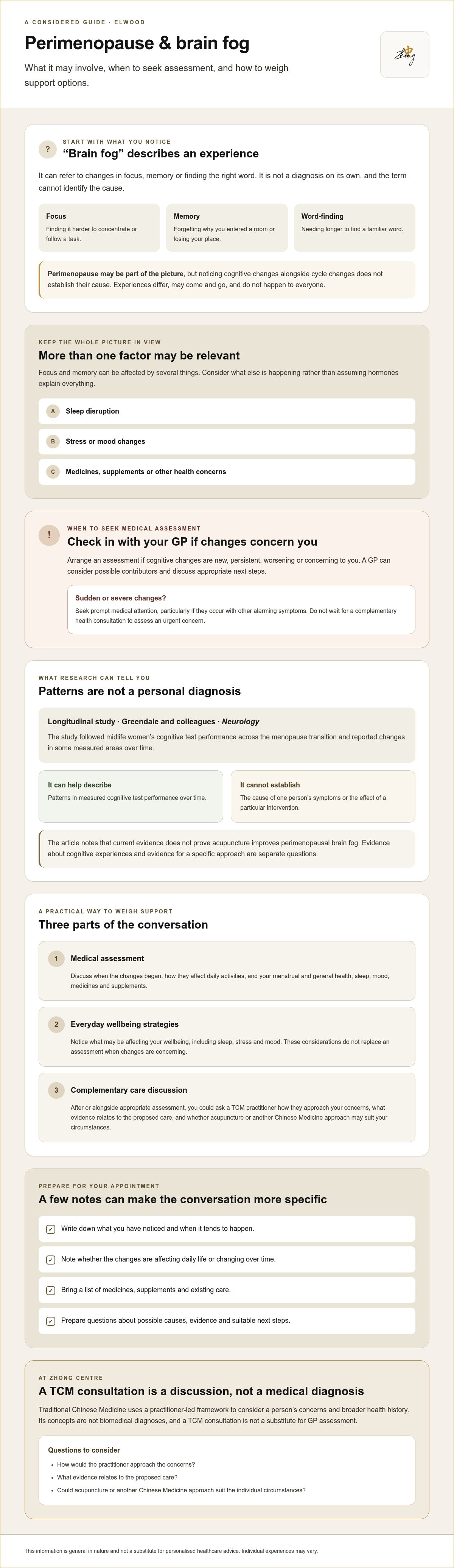
Preparing for a perimenopause brain fog consultation near Elwood
A little preparation can help you make the most of a health consultation. Whether you’re speaking with your GP or considering complementary care, clear notes can help you explain what you’ve noticed and ask focused questions. If you’re exploring perimenopause brain fog support in Elwood, keep medical assessment and any TCM conversation distinct, while sharing relevant information between practitioners where appropriate.
A simple checklist before your appointment
Use your notes app or a piece of paper. You don’t need a perfect record. A few useful details are enough to start the conversation:
- Describe the changes: note whether you’ve noticed distractibility, forgetfulness, difficulty concentrating or trouble finding words.
- Track timing and patterns: record when the changes began, whether they come and go, and anything you’ve noticed alongside them.
- Explain the day-to-day impact: consider work, conversations, household tasks or other activities where the changes stand out.
- List relevant health information: include medicines, supplements, existing diagnoses and any healthcare or assessment already underway.
- Write down your questions: ask what the consultation involves, what assessment or proposed care may be appropriate, what evidence supports it and what follow-up could look like.
For a TCM consultation, ask how your individual needs and health history inform the discussion, and how any proposed approach might fit alongside your current care. Bring a list of medicines and supplements rather than relying on memory.
Finding suitable support from Elwood
Zhong Centre is a Melbourne clinic offering TCM consultations, perimenopausal acupuncture, and menopause and hormonal support. It may be an option to consider if you’re travelling from Elwood or a nearby suburb. If you’re in Elwood, St Kilda, St Kilda East, St Kilda East, Elwood, Melbourne, Bayside, Armadale, Toorak, Windsor, Prahran, Elsternwick, Port Melbourne, Albert Park, Caulfield, Malvern, Chadstone, Balaclava, Ripponlea or Melbourne’s eastern suburbs, check the clinic’s current location and practical arrangements directly before planning a visit. The available information doesn’t confirm an Elwood clinic address, travel time, parking or public transport access.
You can read Dr Abbie Cloherty’s practitioner profile to learn more about her. A consultation is a chance to discuss your concerns and ask whether an approach may suit your circumstances. It isn’t a replacement for GP assessment or a promise of symptom change.
If you’d like to discuss whether a TCM consultation may fit alongside your existing healthcare, explore booking options.
Personalised TCM for perimenopause at Zhong Centre
If you’re considering complementary support, start with a conversation, not an expectation of symptom change. Zhong Centre is a Melbourne wellness clinic offering TCM consultations, perimenopausal acupuncture, and menopause and hormonal support. An individual consultation gives you space to explain what you’ve noticed, what matters to you and what care you already have in place.
What to expect from an individual discussion
A practitioner may ask about your concerns, relevant health history and personal goals. Bring notes on your symptoms, medicines, supplements and any GP assessment or other care underway. This can inform a discussion about whether acupuncture or another Chinese Medicine approach may be suitable to consider in your circumstances.
Any proposed care depends on individual assessment and may not suit everyone. Ask what an approach involves, what evidence relates specifically to your concern and what its limits are. If herbal medicine is discussed, mention your current medicines and supplements so the practitioner can consider your circumstances. You can also ask how proposed care would sit alongside your GP’s advice and whether communication with your existing healthcare team is appropriate.
TCM care is complementary. It shouldn’t delay medical assessment or replace care recommended by your GP. Continue appropriate healthcare, and raise any questions about coordinating different forms of support during the discussion.
Deciding whether to book in Melbourne
A TCM consultation may be worth exploring if you’d like to discuss perimenopausal concerns through a Chinese Medicine framework, understand what a practitioner-led consultation involves or ask whether perimenopausal acupuncture may suit your needs. It can’t confirm the cause of cognitive changes. If symptoms are new, persistent, worsening or concerning, speak with your GP about assessment as well.
Before booking, consider what you want to ask: How will my health history inform the conversation? What evidence supports any approach suggested for my concern? How might it fit with my current care? Clear, considered answers can help you decide whether the consultation feels right for you. For readers seeking perimenopause brain fog support in Elwood and considering a Melbourne option, focus on suitability and an informed discussion, not an expected result.
If you’d like to explore whether a TCM consultation may suit your circumstances, see Zhong Centre booking information.
This information is general in nature and not a substitute for personalised healthcare advice. Individual experiences may vary.
Take a thoughtful next step with perimenopause support
Changes in focus or memory can have several possible contributors, so don’t assume hormones are the whole story. A GP can help assess persistent or concerning symptoms. Complementary care is a separate conversation, and current evidence shouldn’t be taken as proof that acupuncture improves perimenopausal brain fog.
If you’re exploring perimenopause brain fog support in Elwood, Zhong Centre offers Melbourne TCM consultations, perimenopausal acupuncture, and menopause and hormonal support. A consultation can help you discuss your concerns, health history and whether an approach may suit your circumstances alongside appropriate medical care. It’s a conversation, not a promise of a particular result.
If a considered discussion feels like a useful next step, you can book a TCM consultation. Take your questions and relevant health information with you. You deserve care that respects both your concerns and the limits of what’s known.
This information is general in nature and not a substitute for personalised healthcare advice. Individual experiences may vary.
Frequently Asked Questions
Can perimenopause cause brain fog?
Some people report changes in concentration, memory or word-finding during the menopausal transition, but that doesn’t establish the cause of one person’s symptoms. Other factors may contribute, so don’t rely on online information alone to identify what’s happening. If changes persist, worsen or affect daily life, speak with a GP for an individual assessment. You can describe when symptoms began and how they affect your usual activities.
What does perimenopause brain fog feel like?
People may use “brain fog” to describe distractibility, difficulty concentrating, forgetfulness or trouble finding words. Experiences differ, and the phrase isn’t a medical diagnosis. Note what you notice, when it happens and how it affects everyday activities, such as following a conversation or completing a task. A GP can consider these details alongside your health history and discuss whether other contributors or further assessment need attention.
Can acupuncture help with perimenopause brain fog?
Evidence about acupuncture should be assessed specifically for cognitive symptoms, rather than inferred from studies of other concerns. Research may be limited or vary by study, so a possible benefit shouldn’t be treated as certain. A TCM consultation can provide an opportunity to discuss whether acupuncture may suit your circumstances and current care. It shouldn’t replace medical assessment or lead you to stop care recommended by your healthcare practitioner.
Should I see a GP about perimenopause brain fog?
Consider speaking with a GP if cognitive changes are new, persistent, worsening or affecting daily life. A clinician can discuss what you’ve noticed and consider whether other possible causes or further assessment need attention. Sudden or severe changes warrant prompt medical attention. Complementary support can be discussed alongside appropriate healthcare, but don’t use it to postpone an assessment. Sharing when the changes began and any medicines you take may help inform the conversation.
What should I ask an acupuncturist about perimenopause support?
Ask what the consultation involves, how your health history will inform the discussion and what evidence supports any suggested approach. You can also ask about possible risks, how care may fit alongside your existing healthcare and when to check back with your GP. A practitioner should explain uncertainty clearly and avoid guaranteeing a particular result. These questions can help you decide whether the proposed approach feels appropriate for your needs.
Is there perimenopause brain fog support near Elwood?
Zhong Centre is a Melbourne clinic offering TCM consultations, perimenopausal acupuncture and menopause support. If you’re in Elwood or nearby Bayside, you can contact the clinic to confirm current appointment details and ask whether a consultation may suit your needs. For cognitive changes, consider GP assessment as well. A complementary consultation is an option to discuss, not a substitute for personalised medical care or an assessment of possible causes.
What should I bring to a perimenopause support appointment?
Bring a brief note of the changes you’ve noticed, when they began and how they affect daily life. It may also help to list your medicines, supplements, relevant health history and questions about evidence or suitability. Share details of any existing healthcare so the practitioner can discuss your situation in context. You don’t need to diagnose yourself before attending; clear notes can help you explain your concerns.
This information is general in nature and not a substitute for personalised healthcare advice. Individual experiences may vary.