

Natural IUI Support: Chadstone Guide to Integrative Care
What if the smartest way to back your upcoming fertility protocol isn't another generic supplement, but targeted physiological regulation? If you're looking for evidence-informed natural support for IUI cycle chadstone pathways, you need strategies that respect your clinical timeline rather than complicate it. Rigid clinic appointments, hormonal side effects, and constant worry about uterine lining thickness can quickly leave you feeling overwhelmed and physically run down.
Western reproductive medicine offers incredible precision, yet it rarely has the scope to address the autonomic stress responses and blood flow that influence your pelvic environment. In this guide, you'll discover how evidence-informed Chinese Medicine and acupuncture logically support your IUI cycle near Chadstone while coordinating seamlessly with medical protocols. We'll explore how cycle-phased acupuncture protocols aim to encourage healthy pelvic circulation, regulate nervous system tension, and build a collaborative bridge with your fertility specialist.
Key Takeaways
- Discover how accessing evidence-informed natural support for IUI cycle chadstone protocols bridges clinical timing with proactive physical preparation.
- Learn how cycle-phased acupuncture is designed to assist with pelvic microcirculation and calm autonomic nervous system tension across critical cycle windows.
- Understand why medicated reproductive protocols require a selective strategy, clarifying when to utilise acupuncture and when to safely pause herbal prescriptions.
- Explore the diagnostic roadmap for Chadstone residents, spanning systemic health analysis, lifestyle pacing, and coordinated scheduling.
- See how modern Chinese Medicine rejects rigid wellness dogmas to deliver a logic-based, respectful adjunct to your specialist's care plan.
Understanding Natural Support for Your IUI Cycle in Chadstone
Intrauterine insemination involves placing prepared, concentrated sperm directly past the cervix into the uterine cavity, precisely synchronized with your ovulatory window. While the clinical procedure handles the structural mechanics, integrative reproductive care focuses entirely on optimising pelvic tissue perfusion, regulating autonomic stress responses, and supporting uterine microvascular flow alongside your fertility specialist's treatment roadmap. Choosing evidence-informed natural support for IUI cycle chadstone treatments ensures that your systemic vitality is bolstered rather than compromised by generic wellness advice.
Modern clinical pathways do not have to exist in isolation from supportive holistic practices. Rather than replacing necessary medical intervention, targeted Chinese Medicine protocols act as a collaborative partner. Local individuals and couples living across Chadstone and Melbourne's south-eastern corridor routinely turn to integrative strategies to manage both the demanding physical cadence and the significant emotional pressures that accompany assisted conception.
What an IUI Cycle Entails for Melbourne Patients
A cycle may follow an unmedicated, natural rhythm or incorporate pharmaceutical stimulation using agents such as clomiphene citrate (Clomid) or letrozole. Standard clinical protocols require serial transvaginal ultrasound monitoring and serum hormone tracking to evaluate follicle recruitment alongside endometrial lining thickness. For many women, medicated cycles introduce palpable abdominal bloating, pelvic fullness, and rapid hormonal shifts, making physical support invaluable during these intensive monitoring windows.
The Role of Integrative Chinese Medicine in Fertility
In classical Chinese Medicine, optimal reproductive vitality relies on the unobstructed flow and abundant supply of Qi and Blood throughout the body's channels. Through a modern physiological lens, these concepts translate to robust pelvic microcirculation, balanced endothelial function, and reduced vascular resistance within the uterine and ovarian arteries. High-level care never works at cross-purposes with reproductive medicine; it respects medical boundaries while using logic-based acupuncture protocols to nourish tissue health and settle systemic tension. You can learn more about how intrauterine insemination operates within modern reproductive medicine to better understand how clinical milestones align with holistic support.
By framing fertility through both vascular physics and whole-person wellness, seeking natural support for IUI cycle chadstone services transforms a clinical medical process into an integrated, supported experience. It provides actionable physical regulation while respecting every step prescribed by your medical specialist.
How Chinese Medicine and Acupuncture Support Key IUI Milestones
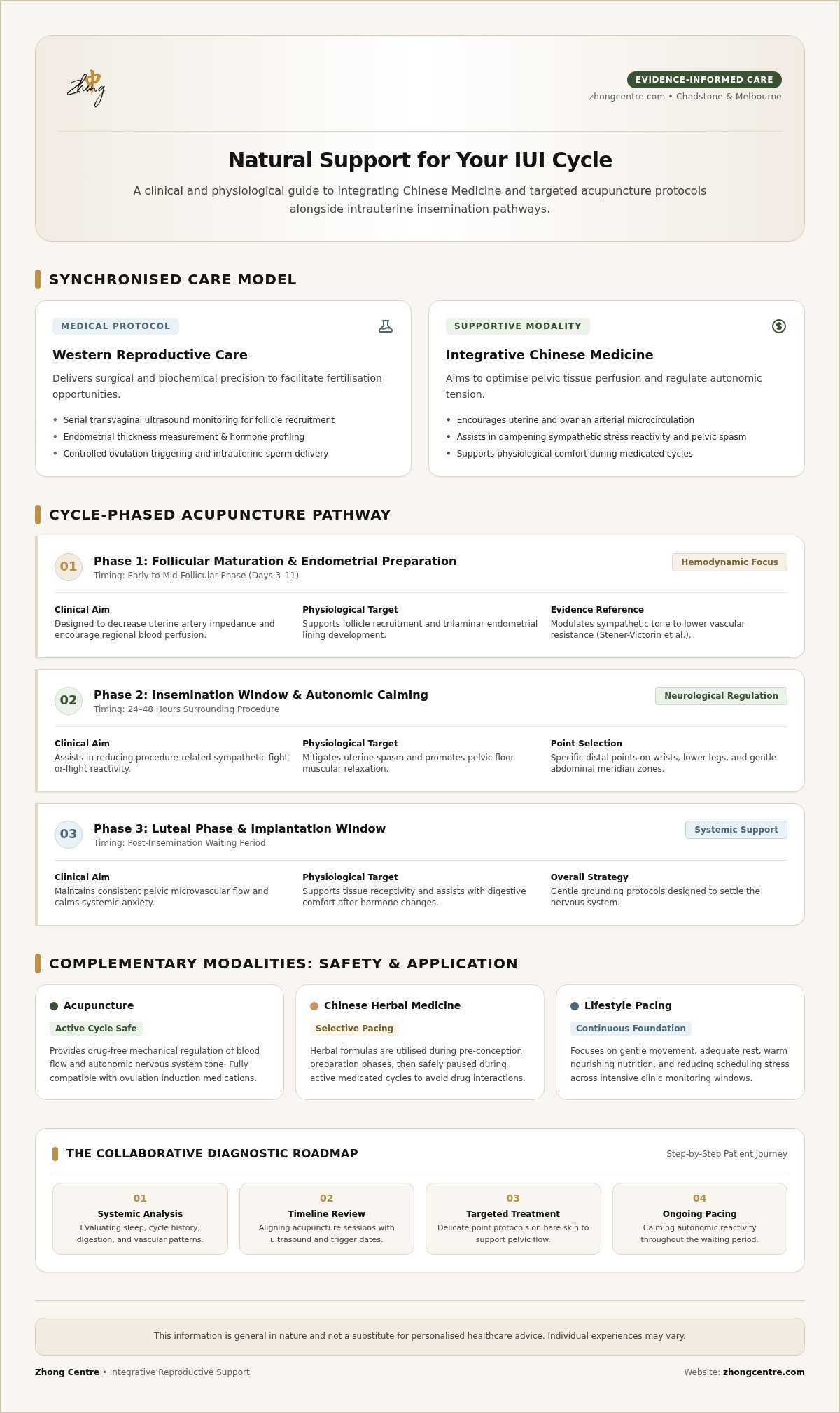
Precision timing dictates the success of assisted conception. Generic wellness routines simply cannot adapt to the rapid hormonal shifts of an insemination cycle. Instead, targeted acupuncture protocols align directly with each physiological phase, shifting focus as your body transitions from follicular stimulation to post-insemination waiting.
For patients seeking evidence-informed natural support for IUI cycle chadstone plans, care integrates directly with the medical markers identified during clinical monitoring.
Phase 1: Follicular Maturation and Endometrial Circulation
During the early follicular phase, treatments aim to optimize regional hemodynamics. Studies led by Stener-Victorin et al. demonstrate that specific electro-acupuncture protocols can modulate sympathetic tone and decrease uterine artery impedance. By encouraging blood flow through the ovarian and uterine arteries, these sessions aim to support follicle recruitment and encourage a healthy, trilaminar endometrial lining before ovulation triggers occur.
Phase 2: Insemination Window and Autonomic Calming
The 24 to 48 hours surrounding the insemination procedure require deep muscular relaxation and autonomic nervous system regulation. Sessions scheduled around your catheter appointment focus on reducing procedural stress and down-regulating sympathetic fight-or-flight reactivity. Practitioners utilise specific distal points on the lower legs, wrists, and abdomen to mitigate uterine spasm and encourage pelvic relaxation. Reviewing the Mayo Clinic overview of intrauterine insemination helps contextualise why keeping the pelvic musculature calm on the day of sperm transfer matters for overall comfort.
Phase 3: The Luteal Phase and the Two-Week Wait
Once insemination concludes, the clinical focus shifts from stimulating blood flow to maintaining a calm systemic environment. Over 50% to 60% of individuals undergoing fertility procedures report elevated anxiety during this holding pattern, according to research published in reproductive and integrative medicine journals. Luteal phase acupuncture seeks to moderate heightened cortisol markers, support deep restorative sleep, and regulate nervous system distress as you await your scheduled beta hCG blood test.
- Follicular window: Supports vascular supply to the maturing ovarian bed and endometrium.
- Periovulatory window: Promotes somatic relaxation to ease procedure-related pelvic tension.
- Luteal window: Regulates autonomic stress responses throughout the post-procedure wait.
Structuring your treatments around these clinical milestones ensures that your complementary care actively complements your specialist's timing rather than disrupting it.
Comparing Complementary Modalities: Acupuncture, Herbs, and Lifestyle
Sorting through wellness options during assisted conception can feel like wading through contradictory noise. One practitioner suggests twenty different supplements. Another recommends aggressive herbal teas without asking what your fertility nurse prescribed. When seeking evidence-informed natural support for IUI cycle chadstone care, clarity and clinical safety must guide every decision. Not every complementary modality fits an active medical cycle, especially when pharmaceutical stimulation is underway.
Working alongside reproductive endocrinologists requires clear boundaries. Transparent communication between your complementary clinician and your fertility team protects your protocol while supporting your overall well-being.
Acupuncture vs. Chinese Herbal Medicine During Cycles
Acupuncture presents minimal contraindications. It does not alter circulating medication levels or compete with synthetic hormone triggers. Instead, it works mechanically and neurologically. Chinese herbal medicine formulas require a far more cautious strategy. When patients take medications like letrozole, clomiphene, or gonadotropins, botanical compounds can interact with hepatic pathways or confound follicular monitoring. Qualified Chinese Medicine practitioners generally recommend pausing internal herbal prescriptions throughout active stimulated cycles, leaning entirely into somatic acupuncture support unless working in close coordination with your specialist.
Lifestyle Habits: Nutrition, Hydration, and Rest
Outside the treatment room, simple daily practices keep your baseline stable. Classical Chinese Medicine emphasises warm, easily digested, nutrient-dense meals like broths, roasted vegetables, and slow-cooked proteins. These choices spare digestive energy and support systemic nourishment. Hydration remains equally crucial; maintaining consistent fluid and electrolyte balance supports cellular function and blood rheology. Swap out high-intensity, cortisol-spiking workouts for grounding daily walks, mobility work, and early sleep schedules.
Stress Reduction and the Hypothalamic-Pituitary-Ovarian Axis
Persistent mental tension stimulates sustained sympathetic nervous system activation. This prolonged state can disrupt the delicate pulsatile signalling of gonadotropin-releasing hormone (GnRH) along the hypothalamic-pituitary-ovarian axis. Navigating public pathways like Victoria's Public Fertility Care services or coordinating private appointments can strain your emotional bandwidth. Dedicated sessions provide tangible physical downtime. They guide the autonomic nervous system into a parasympathetic recovery state, which aids hormonal communication. Explore how fertility acupuncture provides structured physical downtime during intense clinical cycles, offering a grounded space to reset while your medical protocol does its job.
Balancing these modalities gives you a cohesive roadmap. You gain the physiological benefits of acupuncture alongside daily restorative habits, keeping your active IUI cycle safe, focused, and free from unnecessary cross-treatment friction.
Preparing for Treatment: What Chadstone Residents Should Expect
Stepping into integrative care should feel seamless, not like another logistical hurdle in an already packed schedule. When you arrange evidence-informed natural support for IUI cycle chadstone protocols, establishing a calm, coordinated routine helps ground your entire clinical pathway. Mapping out visits alongside your monitoring appointments removes last-minute panic and ensures your body receives structured care exactly when pelvic circulation and nervous system tone need it most.
Practical coordination bridges your medical milestones with your restorative treatments, turning a fragmented journey into a structured collaboration.
Ideal Timelines for Commencing Complementary Care
Biologically, folliculogenesis takes around 90 days. Because dormant ovarian follicles recruit and develop over this three-month window, starting Chinese Medicine care 2 to 3 months prior to an insemination cycle allows practitioners to address baseline circulatory vitality, cycle regularity, and sleep quality. If your insemination is already scheduled for next week, starting right away remains valuable. In-cycle treatments focus primarily on acute nervous system regulation and supporting localized pelvic blood flow, typically scheduled once weekly leading straight into the insemination window.
The Initial Consultation and Treatment Experience
Your initial session centres on practical diagnostics. Practitioners review your reproductive history, blood pathology, scan reports, and cycle signs, alongside tongue and radial pulse assessments. Once your pattern is established, you rest on a comfortable treatment table while hair-thin, single-use sterile needles are gently placed at targeted acupuncture points. These rest in place for 25 to 35 minutes. Most clients experience a profound drop in somatic stress, often drifting into restful sleep as parasympathetic recovery kicks in.
Scheduling Around Fertility Clinic Visits
Fertility cycles rarely run on a predictable 9-to-5 timetable. Ultrasound tracking dictates trigger injections, and trigger injections determine the exact hour of insemination. Coordinated care offers the flexibility required to work around those tight clinical notices. For residents in Chadstone, Hughesdale, and Malvern East, heading straight down Dandenong Road or the Princes Highway directly to St Kilda makes attending these time-sensitive appointments simple and stress-free.
You can learn more about the experienced clinical team behind Dr Abbie Cloherty to see how their modern approach supports your reproductive goals. When you are ready to align your cycle with logic-based care, explore our available consultation times and book your initial fertility support consultation to get started.
Integrative Reproductive Care at Zhong Centre: A Modern Approach
Fertility journeys often feel like an endless rotation through sterile, fluorescent-lit clinic rooms. Zhong Centre was built as an antidote to that clinical exhaustion. Bridging traditional diagnostic assessment with modern physiology, our practitioners reject rigid dogmas in favour of grounded, evidence-informed care. For those seeking dedicated natural support for IUI cycle chadstone pathways, our clinic provides focused treatments that integrate cleanly with your medical specialist's plan.
Every person enters treatment with a distinct hormonal profile, medical history, and emotional baseline. We match your care plan to your exact pharmaceutical schedule, respecting the boundaries of assisted reproductive protocols.
Evidence-Informed Practice Without Outdated Dogma
Our AHPRA-registered Doctors of Chinese Medicine stay closely engaged with emerging reproductive literature. We focus on demonstrable mechanisms: modulating central sympathetic tone, encouraging peripheral blood circulation, and relieving pelvic muscular guarding. You won't encounter mystical generalisations or unsupported promises here. We believe in transparent communication, ensuring your wider medical team remains informed about the complementary care you receive.
A Supportive Space for Your Reproductive Journey
Stepping into our St Kilda clinic offers an immediate nervous system reset. Away from the sterile pressure of blood labs and ultrasound suites, our treatment rooms are intentionally designed to be calm, restorative, and empowering. Our practitioners understand the delicate interplay between systemic well-being and hormonal stability, connecting your reproductive protocols with broader Chinese Medicine care. We meet you exactly where you are, respecting your physical comfort, your timing, and your personal boundaries throughout every appointment.
Taking the Next Step Towards Cycle Support
Coordinating care well before insemination day gives your practitioner the time needed to review blood pathology, assess cycle patterns, and align sessions with your clinic dates. Accessing our location from Chadstone and Melbourne's south-eastern suburbs is straightforward via Dandenong Road or the Monash Freeway. If you are ready to introduce calm, logic-based support to your treatment cycle, book your consultation to discuss how we can assist with your upcoming IUI protocol.
Seeking experienced natural support for IUI cycle chadstone care gives you the structure, comfort, and physiological alignment needed to navigate assisted conception with confidence.
Empowering Your Next Step Towards a Supported IUI Cycle
Navigating assisted conception demands both clinical precision and intentional systemic care. Integrating cycle-phased acupuncture into your medical roadmap supports pelvic circulation, eases autonomic stress, and establishes physical space for genuine recovery throughout the waiting phases. By aligning holistic support directly with each physiological milestone, you give your body clear, practical backing without interfering with your medical prescriptions.
When choosing evidence-informed natural support for IUI cycle chadstone pathways, having care that actively respects your fertility specialist's schedule makes all the difference. At Zhong Centre, our AHPRA-registered Chinese Medicine practitioners formulate tailored treatment plans that sync with your cycle appointments, ultrasound tracking, and insemination dates. Located just a short drive down Dandenong Road, our modern clinic offers a grounding sanctuary distinct from sterile waiting rooms. You don't have to carry the physical and emotional weight of treatment alone. Book your personalised cycle support consultation to build a steady, collaborative foundation for your upcoming cycle.
Frequently Asked Questions
Can acupuncture help support my IUI cycle if I am taking hormone medication?
Yes, acupuncture can safely support an IUI cycle alongside hormone medications like letrozole or gonadotropins. It functions through neurological and circulatory mechanisms rather than altering biochemical pathways directly. The needles encourage pelvic blood circulation and down-regulate autonomic stress responses. By focusing on somatic relaxation, it aims to ease medication-induced side effects such as bloating or abdominal tension without interfering with your medical team's prescriptions.
How many acupuncture sessions are recommended during an IUI cycle?
Most individuals benefit from three to four sessions across an active cycle. A standard protocol includes one to two visits during the early follicular stimulation phase, a session close to the insemination date, and one during the luteal wait. For those seeking comprehensive natural support for IUI cycle chadstone protocols, this rhythm provides consistent circulatory and nervous system care aligned with clinic tracking.
Is it safe to have acupuncture on the day of the IUI procedure?
Having acupuncture on the day of your insemination is generally considered safe and beneficial. Treatment scheduled shortly before or after catheter placement focuses on easing smooth muscle tension in the pelvic floor and settling procedure-related autonomic distress. Gentle distal point selections avoid strong abdominal stimulation, aiming instead to keep the uterine environment calm, comfortable, and receptive as you complete your clinic visit.
Can Chinese herbal medicine be taken alongside fertility drugs during IUI?
Chinese herbal formulas are typically paused during stimulated cycles involving medications like Clomid, letrozole, or trigger injections. Because concentrated herbs can interact with hepatic pathways or confound follicle tracking, reputable Chinese Medicine practitioners prioritise acupuncture during medicated phases. Unmedicated natural cycles may occasionally integrate tailored formulas, but safety protocols demand full transparency and alignment with your fertility specialist beforehand.
What happens during a fertility acupuncture consultation at Zhong Centre?
Consultations begin with a detailed review of your reproductive history, blood panels, and ultrasound findings, paired with traditional tongue and pulse assessment. Once your pattern is established, you rest in a quiet, modern treatment room while sterile, fine needles are inserted into targeted points. Needles remain retained for 25 to 35 minutes, providing a restorative pause designed to regulate systemic stress and support circulation.
Is there scientific evidence supporting acupuncture for assisted reproduction?
Clinical studies, including research by Stener-Victorin et al., indicate that acupuncture protocols can decrease uterine artery vascular resistance and modulate sympathetic nervous activity. Additional research in reproductive journals highlights statistically significant reductions in procedural anxiety and cortisol markers among patients undergoing assisted cycles. While research into reproductive outcomes remains ongoing, evidence confirms its value for stress mitigation and pelvic hemodynamics.
How far in advance of an IUI cycle should Chadstone residents start treatment?
Initiating care two to three months prior offers optimal lead time, matching the 90-day follicular development window. This runway allows practitioners to address cycle patterns and blood circulation before pharmaceuticals begin. Chadstone residents can easily access our St Kilda clinic via Dandenong Road, making proactive natural support for IUI cycle chadstone care convenient to maintain, even if starting midway through an active cycle.
This information is general in nature and not a substitute for personalised healthcare advice. Individual experiences may vary.