

Managing Stress During Fertility Treatment in Toorak: A Practical Guide
What if managing stress during fertility treatment isn’t about staying calm every minute, but finding ways to make the process feel more manageable? Appointments, procedures and waiting periods can disrupt everyday routines, and it’s understandable to want support that fits your care plan. If you’re searching for “managing stress during fertility treatment toorak”, start with a practical principle: stress support should sit alongside your fertility care team, not replace their medical guidance.
This guide covers ways to build a realistic routine, compare self-guided, professional and complementary support, and prepare useful questions for practitioners. There’s no single approach that suits everyone. Discuss complementary care such as acupuncture or Traditional Chinese Medicine with your fertility team to check what may be appropriate for you. You’ll also find guidance on coordinating care and considering a Zhong Centre consultation as one option for discussing your individual needs.
Key Takeaways
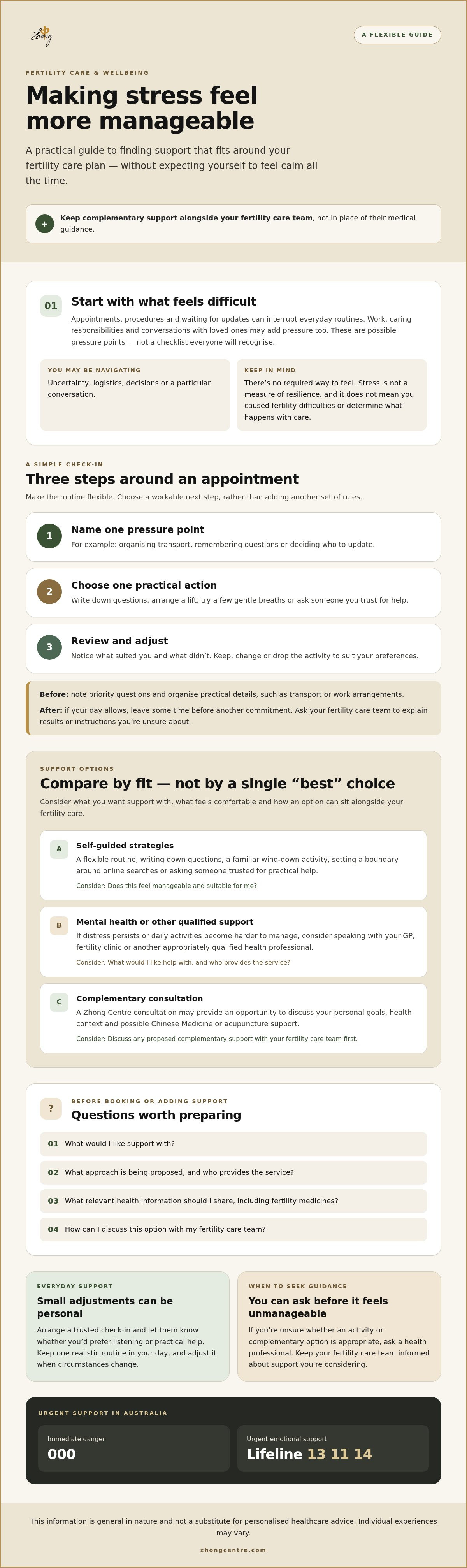
- Build a flexible routine by identifying a pressure point, choosing one practical coping action and reviewing what feels manageable.
- For managing stress during fertility treatment toorak, compare self-guided strategies, mental health support and complementary consultations against your needs and preferences.
- Before booking, clarify your goals, ask about the proposed approach and share relevant health information, including fertility medicines.
- Keep your fertility care team informed so any complementary support can be discussed in the context of your current care plan.
- A Zhong Centre consultation may offer a chance to discuss your personal goals, health context and possible Chinese Medicine or acupuncture support.
Managing stress during fertility treatment Toorak: what may feel difficult?
Fertility care can involve uncertainty, and people respond to it in different ways. You might feel steady, unsettled or somewhere in between. Stress support means practical emotional and wellbeing strategies considered alongside clinical fertility care. It isn’t a measure of how resilient you are, and there’s no required way to feel.
Appointments, procedures and waiting for updates can make planning feel less straightforward for some people. Work, caring responsibilities and everyday commitments still need attention. Conversations with loved ones may bring questions or differing views. These are possible pressure points, not a checklist everyone will recognise. Feeling stressed does not mean you caused fertility difficulties or determine what happens with treatment.
Why fertility care can make everyday stress feel different
Scheduling appointments around work, adapting plans and considering decisions can take time and attention. Waiting for information may also be difficult for some people, while others find it manageable. Your experience is your own, so try not to compare it with someone else’s. Instead, name the moments you’d like support with, such as logistics, uncertainty or a particular conversation. That gives you a clearer starting point for considering your options.
When stress support may be worth seeking
If you or someone else is in immediate danger, call 000. For urgent emotional support in Australia, contact Lifeline on 13 11 14. A practical starting point is to identify what you want support with and decide whom to speak to.
A practical stress-management routine around fertility appointments
A routine can be simple and flexible. Shape it around your calendar and what feels manageable, rather than adding another set of rules. Try this three-step check-in around an appointment or waiting period:
- Name the pressure point. Identify one specific concern, such as organising transport, remembering questions or deciding who to update.
- Choose one practical action. You might write down your questions, arrange a lift, try a few gentle breaths or ask someone you trust for help.
- Review and adjust. Notice what suited you and what didn’t. Keep, change or drop the activity according to your preferences.
These are practical options, not a prescribed programme. Adapt or stop any self-guided activity that feels unsuitable, and ask your health professional for guidance if you’re unsure what’s appropriate. The aim is to choose a workable next step, not to force yourself to feel a certain way.
Before and after an appointment
Before you go, note your priority questions and organise practical details such as transport or work arrangements. If your day allows, leave some time afterwards before taking on another commitment. Write down follow-up questions as they arise, then ask your fertility care team to explain any results or instructions you’re unsure about rather than trying to interpret them yourself.
Managing the waiting periods and daily demands
Set a boundary that suits you around online searches, such as deciding when you’ll look for information. You could arrange a check-in with someone you trust and let them know whether you want listening or practical help. Keep one realistic routine in your day, perhaps a planned catch-up, a familiar wind-down activity or a short list of tomorrow’s essentials. Adjust it when your circumstances change.
If you’d like to discuss complementary support alongside your fertility care, you can explore booking a Zhong Centre consultation. Raise any proposed approach with your fertility care team.
Comparing stress support options in Toorak and Melbourne
There’s no universal best choice. The right fit depends on what you want support with, what feels comfortable and how an option can sit alongside your fertility care. Use this comparison to prepare questions as you explore managing stress during fertility treatment toorak and nearby Melbourne.
| Option | Purpose and provider | Access and questions to ask |
|---|---|---|
| Self-guided strategies | Everyday coping, such as planning appointments, gentle breathing, journalling or arranging a check-in with someone you trust. You choose and adapt the activity. | These strategies may fit around your schedule, but they aren’t personalised clinical care. Ask yourself: does this feel manageable, or would I prefer guidance? |
| Mental health professional | Emotional support from a psychologist, counsellor or another appropriately qualified professional. Ask whether they have experience supporting people through fertility care. | Check qualifications, appointment format, fees, availability and whether a referral or Medicare arrangements apply to your situation. |
| Complementary consultation | A Chinese Medicine consultation or acupuncture appointment may provide an opportunity to discuss wellbeing goals and an individual approach with a practitioner. | Ask about qualifications, proposed care, fees and appointment format. Discuss suitability and coordination with your fertility care team first. |
Acupuncture and Traditional Chinese Medicine are complementary options. They don’t replace fertility assessment, advice or care from your fertility clinic. A guide to fertility acupuncture and supportive care can provide context. Use it to prepare questions, not as a substitute for advice specific to you.
What to consider when choosing a support option
Look beyond the label. Ask who provides the service, what a consultation involves, what it costs and whether appointments are available in a format you can manage. Consider travel from Toorak, timing around your treatment schedule, accessibility needs and any recommendations from your care team. No modality suits everyone, and you can decide an option isn’t right for you.
How to discuss complementary care with your fertility team
Discuss the proposed approach with your fertility clinician before starting. Share details of any acupuncture, Chinese Medicine or products you’re considering, including herbal medicines. Ask about possible interactions, timing around procedures and individual health considerations. A clear conversation helps your care team understand what else is part of your plan and supports a more informed choice.
Questions to ask before booking fertility-related stress support
A useful first appointment starts with clear expectations. Before booking, note what you’d like support with, what your fertility care team is already doing and what you need to know before deciding. This can help you compare options for managing stress during fertility treatment in Toorak without adding pressure to find one perfect answer.
- Your goals: What would you like to discuss or feel more prepared to manage?
- Your health context: What relevant medical history, fertility medications or other medicines should the practitioner know about?
- Your current care: Who is part of your fertility team, and what guidance have they given about complementary support?
- The proposed approach: What does it involve, what evidence supports it, and what are its limitations?
Share your fertility medications and relevant health information with any practitioner you consult. This gives them important context when discussing whether an approach may be suitable and whether you should check it with your fertility clinician. Don’t change or pause prescribed medicines based on complementary advice alone.
Questions for a complementary health practitioner
Ask what an initial consultation involves and how recommendations are shaped around your circumstances. You can also ask how the practitioner might communicate with your fertility care team, where appropriate and with your consent. Request a clear explanation of the proposed approach, the evidence behind it and its limitations. A good conversation should leave room for questions, uncertainty and your preferences.
Preparing for a Zhong Centre consultation
Zhong Centre offers fertility support and Traditional Chinese Medicine consultations in Melbourne. If you’re considering a consultation, confirm directly whether the relevant service is currently available, who you would see, their practitioner details and practical appointment information. Bring a current medication list and any questions from your fertility clinic. Discuss proposed acupuncture or herbal medicine with your fertility care team before adding it to your plan.
If a conversation about your individual needs and complementary support feels useful, you can discuss your support options with Zhong Centre.
Considering Zhong Centre for stress support during fertility care
Complementary support may be one option to discuss as part of your wider wellbeing plan. Zhong Centre is a Melbourne wellness clinic offering fertility support, Traditional Chinese Medicine consultations and acupuncture. These services may be relevant if you’re exploring additional support, but they shouldn’t be understood as a way to change fertility outcomes.
If you’re considering managing stress during fertility treatment in Toorak, focus on whether an option fits your needs and can be coordinated with your care. Your fertility clinician remains central to medical decisions, including medicines, procedures and interpreting results. Complementary care does not replace their guidance.
What a reader can clarify in a consultation
A consultation can be an opportunity to discuss your current fertility care, your concerns and the support you’re comfortable exploring. Share relevant health information, including fertility medications and other medicines. Ask what methods may be proposed, why they’re being considered, what their limitations are and when another health professional or referral may be appropriate. You can also ask how information might be shared with your fertility team, with your consent.
Ask for unfamiliar approaches to be explained in plain language. Take time to consider any recommendations and decide whether they suit you.
A considered next step for Toorak readers
Zhong Centre is a Melbourne clinic. Before making plans from Toorak, confirm the current clinic location, service availability and travel details directly. You can also ask about practitioner details and appointment logistics. Use published information about acupuncture as background for questions, not as evidence of a promised result. Discuss proposed complementary care with your fertility clinician, especially if herbal medicines or other products are involved.
If a conversation about your goals and health context would be useful, you can book a consultation to discuss your needs. Choose what feels appropriate and keep your fertility care team involved.
This information is general in nature and not a substitute for personalised healthcare advice. Individual experiences may vary.
Choose support that fits your next step
Managing stress during fertility treatment toorak starts with noticing what feels difficult, then choosing support that fits your needs and daily life. A small, flexible routine can help you prepare for appointments and waiting periods. If you’re comparing professional or complementary options, ask about the approach, its limitations and how it can sit alongside your fertility care.
Zhong Centre offers fertility support and Traditional Chinese Medicine consultations in Melbourne. Founded in 2014 and led by Dr Abbie Cloherty, the clinic may be one option for discussing your goals and health context. Confirm current service availability and practitioner details directly, and keep your fertility clinician central to medical decisions.
For readers in Toorak and surrounding Melbourne areas, including St Kilda, Elwood, Bayside, Armadale, Windsor, Prahran, St Kilda East, Melbourne East, Elsternwick, Port Melbourne, Albert Park, Caulfield, Malvern, Chadstone, Balaclava and Ripponlea, confirm the clinic location and travel details before making plans.
If you’d like to explore whether a consultation suits your preferences, book a consultation to discuss your support options. Take it one considered step at a time. You deserve support that respects your choices and your care plan.
This information is general in nature and not a substitute for personalised healthcare advice. Individual experiences may vary.
Frequently Asked Questions
Can acupuncture help with stress during fertility treatment?
Acupuncture may be considered as complementary wellbeing support, but whether it suits you is an individual question. Research on acupuncture and fertility outcomes should not be taken as proof that it changes those outcomes or reliably reduces stress. The American Society for Reproductive Medicine’s information on stress and infertility discusses coping support and the limits of claims about stress and fertility. Ask a qualified practitioner and your fertility team about your circumstances.
Is acupuncture safe while I am having fertility treatment?
Acupuncture may be suitable for some people, but individual circumstances, treatment timing and health history matter. Ask your fertility specialist whether there are considerations for your planned procedures or current medicines, then share that advice with the practitioner. Tell them about fertility medications, other medicines, relevant health conditions and pregnancy possibility. Before deciding, you can also ask about practitioner registration, infection-control practices and the use of single-use sterile needles.
Should I tell my fertility specialist if I am considering acupuncture?
Yes. Let your fertility specialist know before adding acupuncture or other complementary care, and ask whether timing or your personal health context needs consideration. Share the proposed approach and any products or herbal medicines being considered. This gives your medical team a clearer picture of your care and a chance to discuss possible interactions or concerns. Don’t change prescribed medicines or scheduled fertility care without speaking with your clinician.
What can I do to manage stress while waiting for fertility treatment results?
Choose one manageable action rather than trying to control the whole waiting period. You could arrange a check-in with someone you trust, write down questions for your clinic or set a boundary around online searching. Keep one familiar routine for rest, connection or everyday structure. If an activity feels uncomfortable, stop or adapt it. These steps are for general wellbeing, not a way to influence test results.
How do I choose a fertility support practitioner near Toorak?
Start with your goals and practical needs. Check the practitioner’s qualifications and relevant experience, what an appointment involves, fees, format and current availability. Ask how they coordinate with your fertility team, with your consent, and what evidence and limitations apply to their approach. If considering a Melbourne provider such as Zhong Centre, confirm the current clinic location and travel details from Toorak rather than assuming proximity or availability.
Can Traditional Chinese Medicine replace care from a fertility specialist?
No. Traditional Chinese Medicine and acupuncture are complementary options, not substitutes for fertility assessment, medical advice or decisions made with your fertility specialist. If you’re exploring a consultation, discuss the proposed approach with your care team first, including any herbal medicine or other products. Keep your specialist informed about changes in your health and fertility care. A complementary practitioner should not ask you to stop prescribed medicines or medical care.
When should I seek professional help for stress during fertility care?
Consider speaking with your GP, fertility clinic or a mental health professional if distress persists or starts disrupting sleep, work, relationships or daily activities. You can ask your fertility clinic what counselling support is available and seek help before things feel unmanageable. If you or someone else is in immediate danger, call 000. For urgent emotional support in Australia, contact Lifeline on 13 11 14.
Individual experiences may vary.