

How to Use a Gua Sha Tool: Rebel’s Guide to Sculpting
Your bathroom mirror shouldn't feel like a confrontation every morning, yet many of us wake up battling stubborn puffiness and a heavy, tense jaw. With 73% of first-time buyers discovering this practice through social media, it's no wonder there's so much noise to filter through, especially when every influencer seems to have a different opinion on the right way to move. Learning how to use gua sha tool on face is less about following a fleeting trend and more about understanding the internal plumbing of your lymphatic system.
We know you're tired of conflicting tutorials. You're over synthetic industry standards that prioritise temporary fixes over systemic health. You deserve a routine that actually assists with fluid movement and supports a brighter skin tone without the guesswork. This guide provides a professional, step-by-step Chinese Medicine routine designed to help you master the Zhong Gua Sha Tool. We'll explore how this practice can increase microcirculation by up to 400% according to clinical research, helping you create a relaxing self-care ritual that aligns with your holistic health goals right here in Melbourne.
Key Takeaways
- Uncover the logic-based Traditional Chinese Medicine roots of this ancient practice to move beyond social media myths and support your lymphatic health.
- Master the precise 15-degree angle and stroke count to understand exactly how to use gua sha tool on face for a safe, effective daily ritual.
- Learn why meticulous skin preparation and using a professional Zhong Gua Sha Tool are essential to avoid irritation and support long-term skin integrity.
- Identify the warning signs of over-working the skin and learn why moderate pressure is far more effective than aggressive scraping for facial rejuvenation.
- Discover how to use your at-home practice as vital maintenance between professional Cosmetic Acupuncture sessions for a truly holistic approach to wellness.
Beyond the Trend: What is Facial Gua Sha?
Gua Sha isn't a modern discovery. It's a 2,000-year-old pillar of Traditional Chinese Medicine. While the internet treats it like a new toy, Gua Sha actually translates to "scraping redness." In traditional body work, practitioners aim for "sha," which are small red dots known as petechiae. On the face, we do things differently. We avoid the redness. We want the flow without the trauma. This practice is a sophisticated way to support systemic health by managing your skin's internal environment. It's the antithesis of synthetic fillers that just park foreign substances under your skin to create a temporary, artificial volume.
The TCM Logic Behind the Glow
Stagnation is the thief of radiance. When Qi and Blood flow becomes sluggish, your face shows it through puffiness and a dull, lacklustre tone. Facial Gua Sha aims to assist with the release of "stuck" fascia. Fascia is the connective tissue that can become tight and restricted over time, essentially pinning your skin in place. By gently moving a tool over these layers, you help release that tension. There is a specific logic to the movement. You're supporting lymphatic drainage to move excess fluid out, while simultaneously encouraging microcirculation to bring fresh nutrients in. Learning how to use gua sha tool on face correctly ensures you're stimulating the right systems. It's about encouraging the body's natural ability to maintain itself, rather than relying on a temporary cosmetic mask.
Why Melbourne Skin Needs This Ritual
Living in St Kilda means your skin deals with a lot. We have wild weather shifts and urban pollution that can leave the complexion feeling congested and stressed. Many of our clients also carry immense stress in their jaw. This jaw tension doesn't just feel uncomfortable; it affects your entire facial structure and can lead to TMJ symptoms. Gua Sha acts as a logic-based alternative to the "quick fix" culture of invasive procedures. It's a grounding ritual that addresses tension at the source. Instead of reaching for a needle, you're learning how to use gua sha tool on face to support your own anatomy. It's a rebellious act of self-care that prioritises long-term health over a fleeting aesthetic trend. By taking five minutes each morning, you're assisting your skin in navigating the daily Melbourne grind with resilience.
This information is general in nature and not a substitute for personalised healthcare advice. Individual experiences may vary.
Setting the Stage: Choosing Your Tool and Prepping Your Skin
Hygiene isn't a suggestion; it's the foundation of the work. You must start with a clean canvas. Wash your hands thoroughly and ensure your face is free from the day's debris. Applying a stone to skin congested with urban pollution or old makeup is a recipe for irritation. This preparation is the first step in mastering how to use gua sha tool on face for systemic health. It's about creating a safe environment for your skin to respond to the treatment.
The non-negotiable "Golden Rule" is simple: never use the tool on dry skin. Tugging at the skin creates unnecessary drag and can lead to micro-tears or premature fine lines. You need a medium that allows the tool to glide effortlessly. This "slip" is what protects the skin barrier while you're working on the deeper tissues. Without it, you're just scraping the surface, which is exactly what we want to avoid in a facial ritual.
Selecting a Professional-Grade Tool
Not all stones are created equal. While social media often showcases cheap, flimsy alternatives, the material and weight of your tool dictate the quality of your practice. Jade is traditionally valued for its cooling properties and connection to longevity. It's a classic choice for a reason. Rose quartz is often chosen for its aesthetic appeal, while stainless steel offers a clinical, non-porous surface that is exceptionally easy to sanitise between uses. Each material has its own energetic and physical profile.
Shape is everything. A professional tool should have multiple contours to match your unique anatomy. You need a curved edge for the jawline, a notched edge for the brow bone, and a pointed tip for specific acupressure points. The weight matters too. A tool with significant "heft" allows you to engage the fascia without having to apply excessive, bruising pressure. The Zhong Gua Sha Tool is our professional standard. It's designed to assist with the specific ergonomic support needed for fascia release, ensuring your home routine matches the logic of a clinical session.
The Importance of Slip: Oils and Serums
The right oil acts as the essential lubricant for your internal plumbing job. It prevents the tool from catching and allows for a smooth, rhythmic flow. Without proper slip, you risk irritating the delicate skin on your neck and face. We recommend The Night Oil for deep nourishment during your evening ritual. Its composition provides the perfect amount of glide for masterfully learning how to use gua sha tool on face.
Once you've finished your massage, your skin's microcirculation is at its peak. This is the ideal time to apply The Glow masque serum. This serum is designed to support skin health and lock in the benefits of your session. Before you dive in, reviewing Gua sha benefits and risks helps you understand the physiological impact of the practice. Understanding the risks, such as potential bruising from excessive pressure, is just as important as knowing the benefits. If you're unsure which tool or oil suits your specific skin needs, you can always book a clinical consultation for personalised guidance.
This information is general in nature and not a substitute for personalised healthcare advice. Individual experiences may vary.
Step-by-Step: Your Professional At-Home Facial Routine
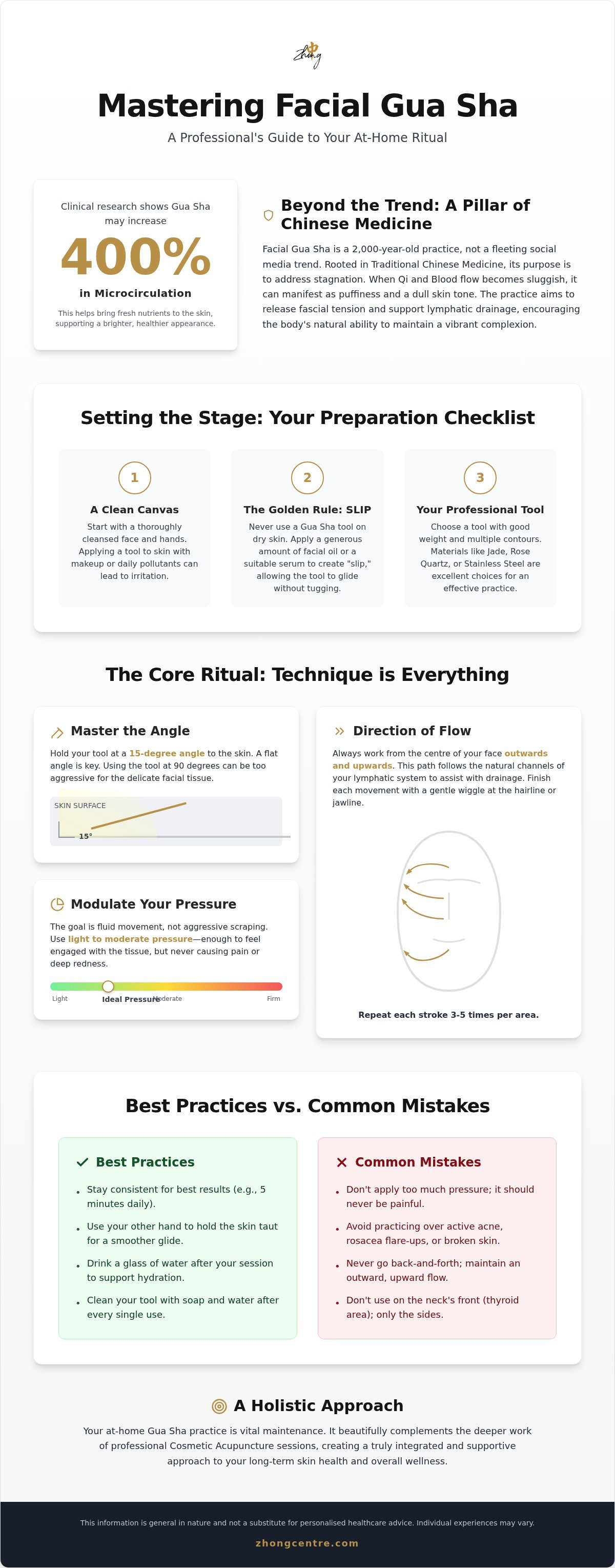
Precision is the difference between a superficial massage and a clinical fascia release. Hold your tool at a 15-degree angle, almost flat against the skin, to ensure you are engaging the deeper tissues rather than just scraping the surface. When you are learning how to use gua sha tool on face, the sequence is just as vital as the pressure. Perform 3 to 5 strokes per area using light to medium pressure. Always move in an upward and outward direction, working with the natural flow of your anatomy. To finish each stroke, give the tool a small, gentle wiggle at the hairline or ear to "anchor" the movement and support the lymphatic nodes.
The Neck and Jawline: Opening the Drainage Pathways
Most tutorials make the mistake of starting mid-face, but you cannot drain a sink if the pipes are blocked. Start with downward strokes on the sides of the neck. This movement is designed to clear the lymphatic nodes and open the pathways for facial fluid to exit. Once the neck is "open," move to the jawline using the notched edge of your tool. Sweep from the chin toward the earlobe. This technique aims to reduce the appearance of tension-related "jowls" by addressing the masseter muscle tension that many Melbourne locals carry from daily stress.
The Cheeks and Under-Eyes: Reducing Puffiness
For the mid-face, use the large flat side of your tool. Start at the side of the nose and sweep across the cheekbone toward the temple. This motion supports the reduction of fluid build-up that often causes morning puffiness. When you reach the under-eye area, switch to feather-light pressure. The skin here is delicate and requires a ghost-like touch. Gently glide from the inner corner of the eye toward the hairline. Mastering this specific part of how to use gua sha tool on face assists with a refreshed, well-rested appearance without the need for invasive synthetics.
The Brow and Forehead: Easing Tension
Finish your routine by addressing the upper third of the face. Stroke from the brow bone directly up toward the hairline. Focus specifically on the "third eye" area between your eyebrows to assist with stress-induced furrowing. There is a direct connection between scalp tension and facial sagging. By releasing the forehead fascia, you support a more lifted appearance. This systematic approach transforms a simple beauty step into a logic-based self-care ritual that respects your body's internal systems.
This information is general in nature and not a substitute for personalised healthcare advice. Individual experiences may vary.
Avoiding the 'Scrape': Pro-Tips and Common Mistakes
Gua Sha translates literally to scraping, but your face isn't a kitchen floor. One of the most damaging myths in the wellness industry is the "no pain, no gain" mentality. If you're bruising your skin or leaving behind angry red welts, you're doing it wrong. In Traditional Chinese Medicine bodywork, redness is often the goal, but facial rituals require a more sophisticated touch. Over-working the skin can lead to broken capillaries and excessive inflammation, which is the opposite of the systemic health we're aiming for. Learning how to use gua sha tool on face is about finding the sweet spot between effective fascia release and gentle lymphatic support.
Consistency beats intensity every single time. A five-minute daily ritual is significantly more effective than a once-a-month aggressive session that leaves your skin tender. We also need to talk about hygiene. Stones can be porous, and they sit in your bathroom collecting bacteria. If you don't sanitise your tool after every use, you're just pushing old oil and microbes back into your pores, which often leads to avoidable breakouts. Wash your tool with warm, soapy water after every session to maintain a clean practice.
Pressure and Angle: The Golden Rules
Pressure is a sliding scale. Use a "feather touch" for the delicate under-eye area where the skin is thinnest. For the jawline and brow, you can transition to a "fascia release" pressure, which is firm but never painful. The angle of your tool is your most important technical detail. Holding the tool at a 90-degree angle is a common mistake that creates too much friction. By keeping the tool flat at roughly 15 degrees, you maximise the surface area contact. This allows the stone to assist with fluid movement more effectively without tugging at the skin barrier. If you have sensitive or acne-prone areas, reduce your pressure even further or glide around the active inflammation rather than directly over it.
When to Skip Your Gua Sha Session
There are days when the best way to support your skin is to leave it alone. If you're dealing with active cystic acne, a fresh sunburn, or you've recently had a professional chemical peel, put the tool down. High-inflammation days require rest, not stimulation. For those who utilise aesthetic injectables, timing is everything. We recommend waiting at least four weeks after Botox or dermal fillers before resuming your home Gua Sha routine. This ensures the products have properly settled and reduces the risk of unintended migration. Listening to your skin's "no" is a vital part of a logic-based health routine. If you want a professional assessment of your skin's readiness, you can book a consultation with our clinical team to create a bespoke plan.
This information is general in nature and not a substitute for personalised healthcare advice. Individual experiences may vary.
Elevating Results: Combining Home Care with Cosmetic Acupuncture
Home Gua Sha is your daily upkeep. It keeps the fluid moving and the tension at bay. However, even the most diligent home practice has its limits. Think of your at-home ritual as the daily maintenance that supports the heavy lifting done in a clinical setting. While you've mastered how to use gua sha tool on face to assist with surface-level stagnation, Cosmetic Acupuncture acts as the deep-tissue equivalent, addressing structural concerns from the inside out. A stone moves the fluid; a needle communicates with the architecture.
By combining your home practice with professional intervention, you create a feedback loop of health. A professional Traditional Chinese Medicine diagnosis allows us to tailor your home routine to your specific needs. Perhaps your puffiness is linked to digestive heat, or your jaw tension is a symptom of systemic stress. We look past the surface to ensure your ritual is actually working for your unique biology. This holistic integration is what separates a fleeting beauty hack from a sustainable health strategy.
Why Clinical Intervention Matters
Surface massage with a stone is brilliant for lymphatic drainage. But needles do what stones cannot. Acupuncture is designed to support collagen production and address the root cause of skin concerns by balancing your internal systems. At our St Kilda clinic, about Dr Abbie and the team provide a level of diagnostic depth that a tutorial simply cannot offer. We don't believe in one-size-fits-all beauty. We believe in logic-based health that respects your body's complexity. Clinical work provides the "reset" your skin needs, while your home tool provides the "maintenance" to keep those results thriving.
Creating a Sustainable Ritual
Melbourne life moves quickly. We understand that a 40-minute spa ritual isn't always realistic. Your practice doesn't need to be an hour-long ordeal to be effective. On busy mornings, a "3-minute flush" is enough to address morning puffiness and wake up your complexion. Focus on the neck and jaw to get the "drain" open before you head out. When you have more space in the evening, a "20-minute deep dive" allows you to release the day's tension and truly engage with the fascia. Consistency is the goal. By integrating these moments of care, you're not just chasing an aesthetic; you're investing in your systemic wellbeing. Refining your technique at home is easier when you've felt the professional standard in person. Book a session at Zhong Centre to refine your technique and bridge the gap between your DIY practice and clinical results.
This information is general in nature and not a substitute for personalised healthcare advice. Individual experiences may vary.
Own Your Glow
Mastering how to use gua sha tool on face is an act of rebellion against the synthetic status quo. By opening your lymphatic pathways at the neck and maintaining a consistent, low-pressure ritual, you're assisting your body's natural ability to manage fluid and tension. This isn't just about surface aesthetics; it's about logic-based systemic health that respects your anatomy. Remember that while your home practice is essential maintenance, clinical intervention provides the structural support needed for deeper results.
Led by Dr Abbie Cloherty, our St Kilda centre offers a sophisticated blend of Traditional Chinese Medicine and modern skin science. We use professional-grade tools and supportive skincare to address your concerns at the source. Whether you're looking to refine your technique or want a bespoke skin assessment, our team is here to guide your journey toward long-term vitality. It's time to swap temporary fixes for sustainable, non-invasive care that actually works with your body. You have the tools; now you have the technique.
Book your professional Facial Rejuvenation session at Zhong Centre St Kilda to take your ritual to the next level.
This information is general in nature and not a substitute for personalised healthcare advice. Individual experiences may vary.
Frequently Asked Questions
How often should I use a Gua Sha tool on my face?
Aim for consistency rather than intensity. Using your tool 3 to 5 times per week is ideal for most people. A 5-minute daily session is often more effective than a long, aggressive session once a month. This regular rhythm helps support fluid movement and manages daily facial tension. Listen to your skin; if you feel sensitive or inflamed, take a break and return when your skin feels resilient.
Can Gua Sha help with double chin or jawline contouring?
Gua Sha is designed to assist with lymphatic drainage and release muscle tension around the jaw. While it won't permanently alter structural fat, it can help reduce the appearance of puffiness and jowls caused by fluid stagnation. By learning how to use gua sha tool on face to sweep from the chin toward the ear, you're supporting the natural contours of your anatomy. This practice aims to create a more defined look by moving excess fluid out of the tissues.
What is the best time of day to do Gua Sha?
Morning sessions are brilliant for addressing overnight puffiness and waking up the complexion. It's a logic-based way to start your day with fresh microcirculation. Alternatively, an evening ritual helps release the day's accumulated stress and jaw tension. There is no wrong time, but choose a window where you can focus on your technique without rushing. The goal is a relaxed nervous system and systemic health.
Should I use a jade or rose quartz Gua Sha tool?
Both materials offer unique benefits, but jade is the traditional choice in Traditional Chinese Medicine. Jade is naturally cooling and is valued for its connection to longevity and balance. Rose quartz is often linked to calming energy and holds its temperature well. Ultimately, the shape and weight of the tool matter more than the stone type. Ensure your tool has the right contours to match your unique facial anatomy for effective work.
Why does my skin turn red after using Gua Sha?
Mild redness is a sign of increased microcirculation, which research shows can increase by up to 400% during treatment. However, we want to avoid sha or petechiae on the face. If your skin is bright red or bruised, you're likely using too much pressure or an incorrect angle. Aim for a gentle flush that fades quickly. This indicates you are supporting blood flow without causing trauma to the delicate facial tissues.
Can I use Gua Sha if I have Botox or fillers?
Yes, but timing is critical for your safety. We recommend waiting at least four weeks after receiving injectables like Botox or fillers before you resume your home routine. This allows the product to settle properly and prevents unintended migration. When you do return to your practice, be mindful of the pressure around the injection sites. Learning how to use gua sha tool on face safely means respecting the healing timeline of professional procedures.
How do I clean and store my Gua Sha tool?
Hygiene is non-negotiable to prevent breakouts and skin irritation. Sanitise your tool after every single use with warm, soapy water. Dry it thoroughly with a clean towel before storing it. Because stones can be fragile, keep your tool in a padded pouch or its original box to prevent chips or cracks. A chipped edge can scratch the skin, so inspect your tool regularly for any damage.
Does Gua Sha actually work for lymphatic drainage?
Gua Sha is specifically designed to support the lymphatic system by assisting with fluid movement. Unlike the circulatory system, the lymph does not have a pump; it relies on movement and external stimulation. By using light, rhythmic strokes, you are helping to clear metabolic waste and reduce the appearance of fluid retention. This logic-based approach supports your skin's internal plumbing and overall systemic health through gentle, manual assistance.
This information is general in nature and not a substitute for personalised healthcare advice. Individual experiences may vary.