
Holistic Perimenopause Support in Melbourne: A Practical Guide to Your Options
What if perimenopause support didn’t have to mean choosing between conventional healthcare and a more holistic perspective? When your cycles, sleep, mood or general wellbeing start to shift, it can be hard to know what may be connected, what needs medical attention and which online claims to trust. If you’re exploring holistic perimenopause treatment melbourne, start with your individual health context rather than one-size-fits-all promises.
You deserve clear information and space to make your own decisions. A personalised Traditional Chinese Medicine (TCM) consultation may explore your concerns, health history and priorities, with acupuncture and Chinese Medicine considered as supportive options alongside your existing care. Complementary care doesn’t replace individual medical advice, and claims about benefits should be weighed against the available evidence.
This guide explains what perimenopause can involve, when to seek medical advice and how to assess supportive care without the hype. You’ll also learn what a TCM consultation and acupuncture appointment in Melbourne may involve, so you can decide whether local support feels right for you.
Key Takeaways
- Perimenopause experiences differ. Learn why changes to your cycle, sleep or mood may be worth discussing with a health professional.
- See how a personalised TCM consultation can explore your concerns, health history and priorities before discussing supportive options.
- Understand why complementary care should sit alongside, not replace, medical assessment and advice.
- Find out what to note before an appointment to help make the conversation more useful.
- Explore what holistic perimenopause treatment melbourne may involve, including personalised support at Zhong Centre.
What Perimenopause Can Feel Like, and When Holistic Support May Help
If your cycle, sleep or mood feels different and you’re unsure why, that uncertainty is understandable. Perimenopause can involve a range of experiences, but a symptom list can’t diagnose the cause of what you’re noticing. Changes may have other explanations, so consider your overall health rather than assuming every new symptom is hormonal.
Perimenopause is the transition before menopause, during which menstrual patterns and other aspects of wellbeing may change. Menopause is reached after menstrual periods have stopped for 12 consecutive months, when there isn’t another explanation. Timing and experience vary from person to person. For an Australian overview of menopause and the transition around it, see Healthdirect’s menopause information. Online information can provide context, but it can’t identify what’s causing your symptoms.
How is perimenopause different from menopause?
In plain English, perimenopause is the transition; menopause marks the end of menstrual periods. During the transition, some people notice irregular or changing cycles, hot flushes, night sweats, sleep disruption, mood changes or changes in concentration. These are examples, not a checklist or diagnostic criteria. One symptom, or several together, doesn’t confirm perimenopause.
When should you seek individual medical advice?
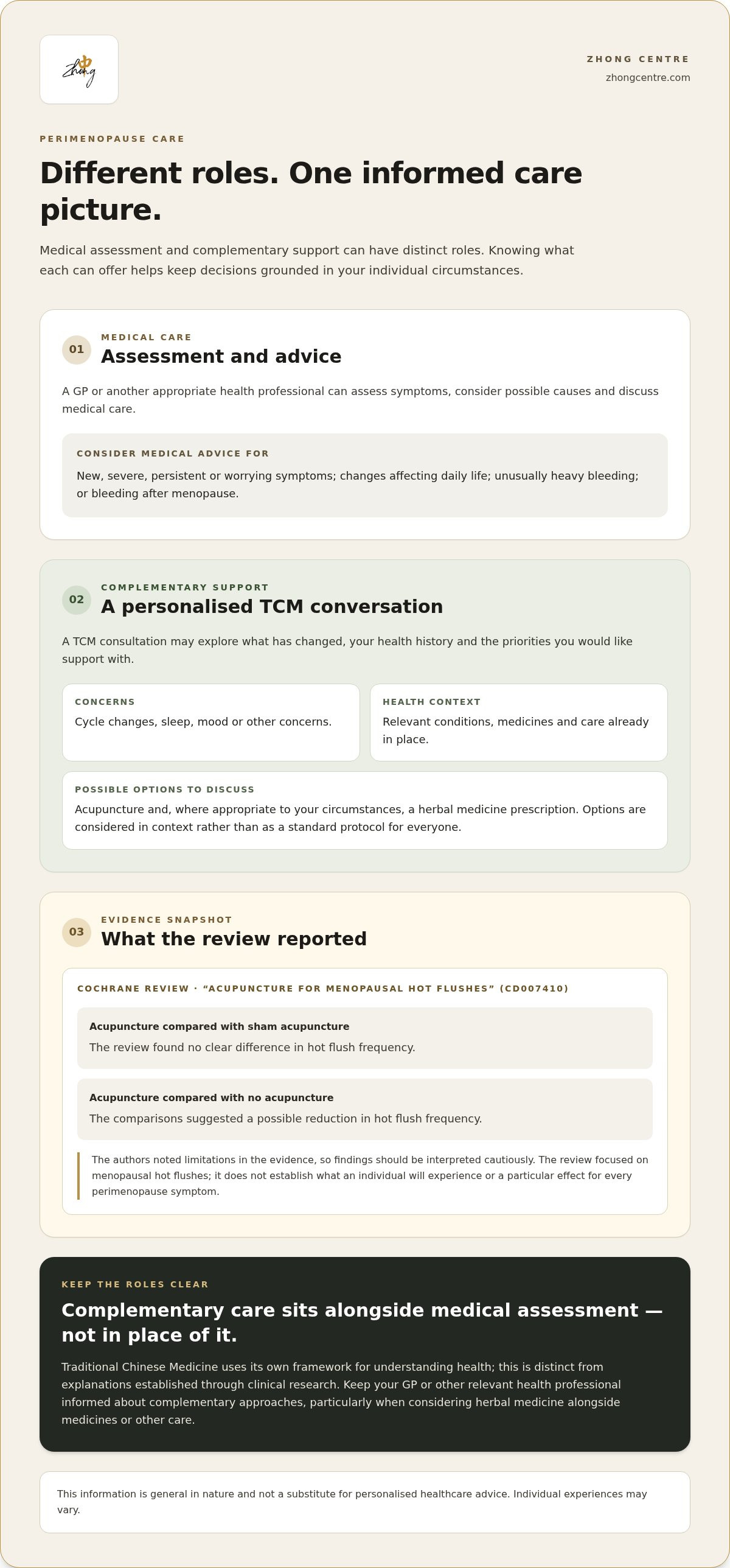
Speak with a GP or another appropriate health professional about new, severe, persistent or worrying symptoms, or changes that affect daily life. Discuss unusually heavy bleeding or bleeding after menopause with a health professional. Don’t rely on complementary care or an online guide to identify the cause. If symptoms feel urgent or severe, seek prompt medical attention.
Why consider a holistic approach in Melbourne?
Whole-person care considers your concerns alongside relevant health context, rather than viewing each symptom in isolation. A TCM consultation can provide space to discuss what you’ve noticed and what matters to you. Chinese Medicine and perimenopausal acupuncture may be considered as supportive options alongside medical assessment and care, not as a replacement.
If you’re exploring holistic perimenopause treatment melbourne, look for an approach that makes room for your individual experience without promising a particular result. Zhong Centre offers TCM consultations and perimenopausal acupuncture in Melbourne, with St Kilda as a local point of access. You can make an informed decision at your own pace.
How TCM Consultations and Acupuncture May Support Perimenopause Care
A useful consultation starts with your experience, not a preset symptom checklist. At Zhong Centre, a TCM consultation gives you space to discuss what’s changed, your health history and the priorities you’d like support with. This context can inform a personalised discussion of possible options, including perimenopausal acupuncture and, where appropriate to your circumstances, a herbal medicine prescription.
What might a personalised TCM consultation cover?
You might discuss cycle changes, sleep, mood or other concerns, as well as relevant health conditions, medicines and care you’re already receiving. You can explain what you hope to explore and ask questions. Traditional Chinese Medicine uses its own framework to understand health; this is distinct from explanations established through clinical research. Any options discussed can be considered in light of your circumstances, rather than as a standard protocol for everyone.
What can research say about acupuncture and perimenopause?
Acupuncture involves inserting fine needles at selected points on the body. A Cochrane review, “Acupuncture for menopausal hot flushes” (CD007410), examined research involving people experiencing menopausal hot flushes. It found no clear difference between acupuncture and sham acupuncture for hot flush frequency, while comparisons with no acupuncture suggested a possible reduction. The authors noted limitations in the evidence, so the findings should be interpreted cautiously.
The review focused on menopausal hot flushes. It doesn’t establish what an individual will experience or demonstrate a particular effect for every perimenopause symptom. A Traditional Chinese Medicine framework may guide a practitioner’s approach, but it isn’t the same as a conclusion established by clinical trials. For a medical overview of physical and emotional symptoms associated with perimenopause, Johns Hopkins Medicine provides further context.
Complementary care may offer additional support, but it can’t diagnose symptoms or replace medical assessment. Keep your GP or other relevant health professional informed about complementary approaches, particularly if you’re considering herbal medicine alongside medicines or other care. To discuss your concerns and priorities in a personalised setting, you can book a TCM consultation in Melbourne.
Holistic Perimenopause Support Versus Medical Care: How to Assess Your Options
Can acupuncture and conventional care work alongside each other?
They may form part of a broader care plan, but complementary support isn’t a substitute for diagnosis or medical management. Tell your relevant clinicians about acupuncture and any herbal medicine you’re considering, as well as prescribed medicines and other care. This gives them a fuller picture when discussing your options. Don’t stop, delay or change prescribed care without speaking with the clinician responsible for it.
| Consideration | Medical care | Complementary support |
|---|---|---|
| Purpose | Assess symptoms, consider possible causes and discuss medical management. | Explore supportive options in relation to your concerns and individual priorities. |
| Scope | May include clinical assessment and discussion of appropriate investigations or care. | A TCM consultation may discuss your health context; acupuncture or an individually considered herbal medicine prescription may be explored. |
| Decision point | Seek individual advice for new, severe, persistent or concerning symptoms. | Consider whether the approach, available evidence and appointment experience feel appropriate to you. |
What should you weigh when comparing support options?
Start with what you want support with, then consider what each option is intended to do and what evidence is available. Symptom support and medical assessment have different purposes. Ask whether the approach has been explained clearly, whether your questions are welcomed and whether you feel comfortable discussing your health context. For holistic perimenopause treatment melbourne, a personalised conversation can clarify what complementary care may involve without implying a particular result.
Suitability and response vary between individuals, so an option that feels appropriate for one person may not suit another. For broader support with hormonal and chronic health concerns, services like Megan Clarke Natural Health provide personalised natural health care that can work alongside medical guidance. Take time to weigh your preferences, the available evidence and advice from your healthcare team before deciding what fits.
What to Expect Before and During a Perimenopause Support Appointment
You don’t need a perfect timeline or a neatly organised folder to start a conversation. A few notes can help you remember what’s been on your mind, but the consultation is a chance to discuss your experience at your own pace. The practitioner can explore your concerns, relevant health history and priorities before discussing suitable support options.
How can you prepare for your first consultation?
If it feels useful, jot down a few details beforehand. Keep it simple:
- Changes you’ve noticed, such as cycle patterns, sleep, mood or other wellbeing concerns.
- Relevant health history, including existing health conditions or recent changes in your care.
- Medicines, supplements and complementary approaches you’re currently using or considering.
- Questions you’d like answered, including what you hope to explore through a consultation.
Bring health information that’s readily available, but don’t feel you need to gather everything before booking. It’s fine to say you’re unsure when a change began or how to describe it. You can add context as the conversation unfolds.
What questions can help you make an informed decision?
Use the appointment to understand the proposed approach, not to sign up to a preset plan. You might ask what a suggested option involves, what evidence is available for the concern you want to address and what realistic expectations look like. Ask how complementary support could fit alongside your existing healthcare and whether discussing it with your GP or another clinician would be appropriate.
Be open about prescribed medicines and other care you’re receiving. This gives the practitioner important context for discussing possible support, including whether a herbal medicine prescription is being considered. Don’t stop, delay or change prescribed care based on a complementary consultation; speak with the clinician responsible for that care.
There’s no need to arrive with a conclusion. A useful conversation can clarify your priorities, explain the options and leave room for you to decide what feels appropriate. If you’re exploring holistic perimenopause treatment melbourne, you can also read this guide to menopause and hormonal support for more context.
When you’re ready to discuss your concerns in a personalised setting, you can book a TCM consultation with Zhong Centre.
Explore Personalised Perimenopause Support at Zhong Centre in Melbourne
Perimenopause can raise questions that don’t fit neatly into a standard checklist. Zhong Centre offers TCM consultations and perimenopausal acupuncture in Melbourne, with support tailored to individual needs. The starting point is a conversation about your concerns, health context and priorities, so options can be considered in relation to you.
How Zhong Centre frames holistic perimenopause support
A TCM consultation gives you an opportunity to explain what you’ve noticed and what you’d like to explore. You can discuss relevant health history and existing care, then consider whether perimenopausal acupuncture or another supportive option feels appropriate. There’s no single plan assumed to suit everyone, and no particular outcome can be promised. Medical assessment remains important for symptoms that need individual clinical advice.
For a wider introduction to Chinese Medicine and its place in holistic health, read the Chinese Medicine in Melbourne guide.
Is a Melbourne TCM consultation a fit for your next step?
A consultation may suit you if you’d like to discuss complementary support in a personalised setting, ask questions and consider how it could sit alongside your existing healthcare. Take time to weigh the information and decide what feels right. If you’re near St Kilda, Zhong Centre offers a local point of access in Melbourne.
Bring the concerns you want to discuss, along with relevant health information and details of medicines or other care you’re receiving. The practitioner can use that context to talk through possible support and its limits. Individual experiences vary, and a TCM consultation or acupuncture isn’t a substitute for medical assessment or advice.
If you’d like to explore whether this approach fits your priorities, you can book a personalised TCM consultation with Zhong Centre. There’s no pressure to arrive with all the answers. Start with your questions.
Take Your Next Step with Clear, Personalised Support
Perimenopause can bring changes that are hard to interpret, but an online symptom list can’t tell you what’s causing yours. Individual medical advice matters, especially for new, severe or concerning symptoms. Complementary care, including acupuncture or Chinese Medicine, may be explored alongside appropriate healthcare, not as a replacement for it.
If you’re considering holistic perimenopause treatment melbourne, focus on a personalised conversation, realistic expectations and an approach that takes your health context into account. Zhong Centre offers TCM consultations, perimenopausal acupuncture, and menopause and hormonal support in Melbourne. Individual experiences vary, and your existing healthcare remains part of the picture.
Bring your questions, share relevant health information and discuss what support may suit your priorities. To explore your options with Zhong Centre, book a personalised consultation. You can take an informed, pressure-free next step at a pace that feels right for you.
Frequently Asked Questions
What is holistic perimenopause support?
Holistic perimenopause support considers your concerns and wider health context together. It may include a TCM consultation or acupuncture as complementary options alongside appropriate medical care. The approach should take account of your priorities, health history and existing care, rather than assume one plan suits everyone. It can offer space to discuss supportive options, but it can’t diagnose the cause of symptoms or replace individual medical advice.
Can acupuncture help with perimenopause symptoms?
Acupuncture may be considered as a complementary option, but a particular effect can’t be assumed. The Cochrane review “Acupuncture for menopausal hot flushes” (CD007410) found no clear difference between acupuncture and sham acupuncture for hot flush frequency. Comparisons with no acupuncture suggested a possible reduction, but the authors noted limitations in the evidence. The review focused on menopausal hot flushes, not every perimenopause symptom or individual experience.
Is Chinese Medicine a substitute for menopause medical care?
No. Chinese Medicine and acupuncture should be considered complementary options, not substitutes for medical assessment or care. A GP or other appropriate health professional can assess symptoms, discuss possible causes and explain medical options. If you’re also considering acupuncture or herbal medicine, let your healthcare team know so your care can be discussed with the full picture in mind. Don’t stop or change prescribed care without speaking with the clinician responsible for it.
What happens at a perimenopause TCM consultation?
A TCM consultation is an opportunity to discuss your concerns, health history and individual priorities. You might talk about changes to your cycle, sleep, mood or general wellbeing, along with relevant medicines and existing care. The practitioner can then discuss possible supportive options, which may include perimenopausal acupuncture. You don’t need to arrive with every detail worked out. Notes and questions can help, but a conversation can start wherever you are.
How do I choose holistic perimenopause support in Melbourne?
If you’re considering holistic perimenopause treatment melbourne, look for clear explanations of the approach, its limits and the available evidence. Consider whether your priorities are heard and whether complementary care is described as sitting alongside appropriate medical assessment. Zhong Centre offers TCM consultations and perimenopausal acupuncture in St Kilda, with local access for people from Elwood, Bayside, Armadale, Toorak, Windsor, Prahran, St Kilda East, Melbourne East, Elsternwick, Port Melbourne, Albert Park, Caulfield, Malvern, Chadstone, Balaclava and Ripponlea.
Can herbal medicine be part of perimenopause support?
Herbal medicine may be discussed as an individually considered option during perimenopause support. Tell the practitioner about medicines, supplements and other care you’re receiving, and discuss any proposed herbal prescription with your GP or relevant healthcare professional. Don’t assume a herbal product is suitable for everyone or change prescribed medicines on your own. Useful questions include why an option is being considered, what is known about it and how it may fit your wider care.
When should I seek medical advice about perimenopause symptoms?
Seek individual medical advice about new, severe, persistent or worrying symptoms, or changes that affect your daily life. Discuss unusually heavy bleeding or bleeding after menopause with a health professional. Symptoms can have different causes, so an online list or complementary consultation can’t diagnose them. If symptoms feel urgent or alarming, seek prompt medical attention rather than waiting for a complementary appointment.
This information is general in nature and not a substitute for personalised healthcare advice. Individual experiences may vary.