
Gua Sha for Lymphatic Drainage in Toorak: The Natural Alternative to Fillers
What if the secret to a sculpted jawline isn’t tucked away in a syringe, but lives within the "waste management" system already hiding beneath your skin? If you’re tired of waking up to "heavy" features or searching for gua sha for lymphatic drainage toorak because luxury creams just aren’t cutting it, you’re not alone. We agree that your skin deserves more than a temporary solution; it deserves a foundation built on movement, health, and vitality.
This article explores how this ancient Chinese Medicine technique aims to support lymphatic flow and reduce the appearance of facial puffiness without the need for synthetic fillers. We’ll examine how this sophisticated manual therapy is designed to assist with defining your natural features while encouraging a healthy, vibrant glow that starts from within. By prioritizing systemic health over quick cosmetic fixes, you can rediscover a complexion that feels as light as it looks.
This information is general in nature and not a substitute for personalised healthcare advice. Individual experiences may vary.
Key Takeaways
- Discover how ancient Chinese Medicine techniques are designed to support systemic lymphatic flow and facial radiance from the inside out.
- Understand why sophisticated locals are pivoting toward gua sha for lymphatic drainage toorak to address "filler fatigue" and facial puffiness naturally.
- Contrast the temporary masking effect of synthetic injectables with the long-term goal of supporting tissue health and micro-circulation.
- Learn the professional sequence for clearing the neck and terminus to ensure your at-home practice assists with effective fluid drainage.
- Explore how clinical Cosmetic Acupuncture can be integrated with Gua Sha to further support your journey toward a healthy, natural glow.
Beyond the Surface: Why Gua Sha is Toorak's Sophisticated Secret for Lymphatic Support
In the leafy, high-stakes streets of Toorak, a quiet revolution is taking place. The era of the "over-filled" face is fading. We call it filler fatigue. It’s that moment when you realise that chasing lines with synthetic injectables has left your features looking heavy rather than healthy. This is why gua sha for lymphatic drainage toorak has become the sophisticated choice for those who value authenticity. It isn't just a beauty ritual; it's a systemic recalibration designed to support your body's own waste-management logic.
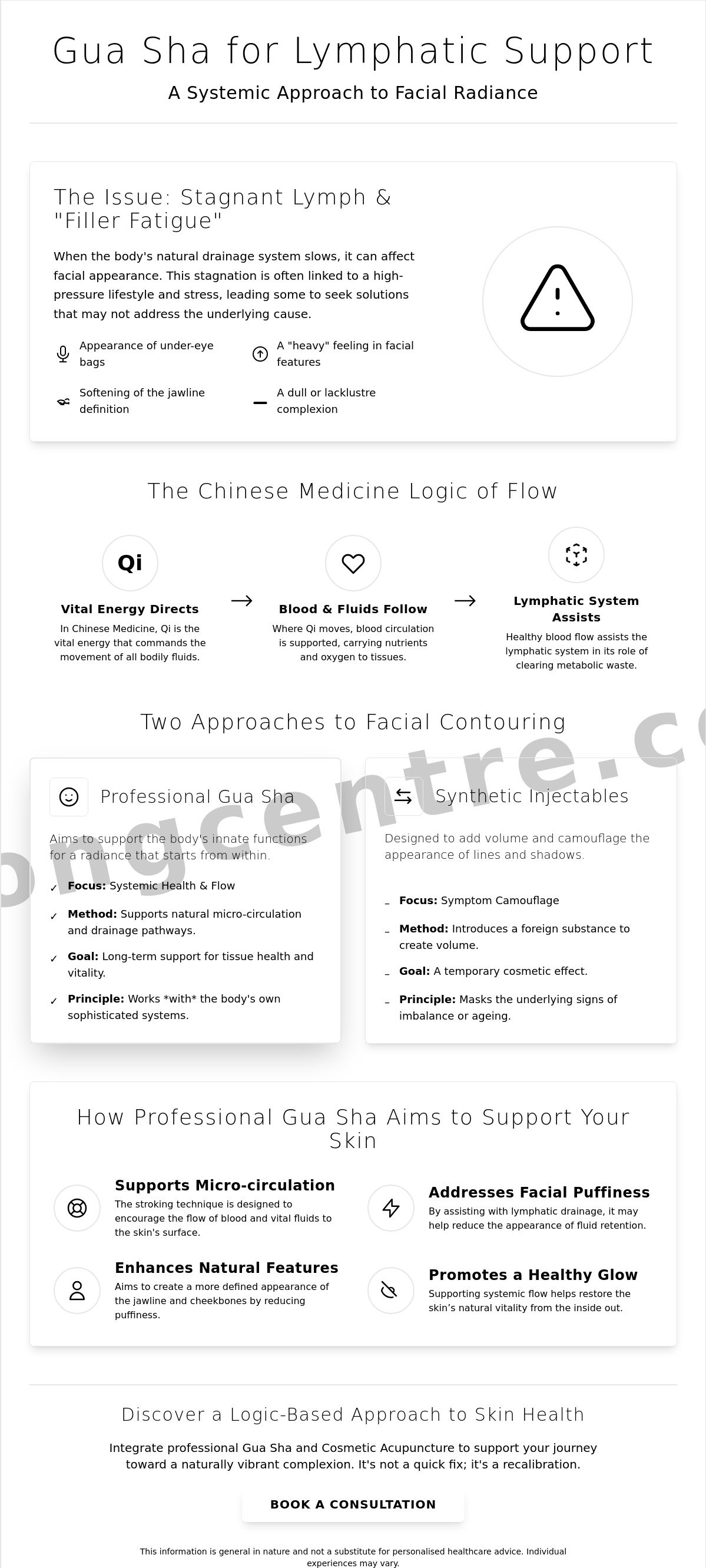
Gua Sha is a cornerstone of Traditional Chinese Medicine. It involves using a smooth, hand-held tool to gently stroke the skin, which aims to support micro-circulation and encourage the movement of vital fluids. We don't believe in masking the skin with foreign substances. We believe in movement. We believe in flow. When you choose this natural alternative, you’re opting for a logic-based approach that prioritises long-term tissue health over the temporary "quick fix" of a syringe.
Toorak locals are savvy. They’ve seen the long-term effects of synthetic fillers and are looking for a path that feels grounded and real. They want their own faces back. Gua Sha assists with this by addressing the underlying causes of facial puffiness rather than just camouflaging the symptoms. It’s about restoring the skin’s natural vitality from the inside out.
The Problem with Stagnant Lymph in the Face
Your lymphatic system is your body’s internal drainage network. It’s responsible for clearing out metabolic waste, yet it lacks a central pump like the heart. It relies entirely on movement. When it stalls, we see it immediately. Under-eye bags appear. The jawline softens. Features feel "heavy." Melbourne’s high-pressure lifestyle and chronic stress often lead to this systemic "sludge," where stagnant lymph may contribute to the appearance of ageing by dulling your natural radiance.
Gua Sha: More Than Just a Beauty Trend
Don't confuse clinical Chinese Medicine with the generic crystal rolling seen on social media. True radiance is an internal health metric, not a filter. Our "Rebel Expert" approach views the skin as a living architecture. Professional Gua Sha aims to support this structure by assisting with fluid movement and encouraging systemic flow. We aren't stretching your skin with synthetic volume. We are supporting its natural ability to thrive and glow with its own inherent energy.
This information is general in nature and not a substitute for personalised healthcare advice. Individual experiences may vary.
The Logic of the Flow: How Gua Sha Supports Lymphatic Drainage and Skin Health
In Chinese Medicine, we follow a simple but profound axiom: where Qi moves, blood and lymph follow. Qi is the vital energy that directs every fluid movement in your body. When we use gua sha for lymphatic drainage toorak, we aren't just rubbing the skin. We are engaging with an energetic directive. By supporting the flow of Qi, we naturally assist the blood and lymphatic systems in their essential roles. This isn't a superficial trend; it's a sophisticated method designed to support micro-circulation and improve the appearance of skin texture from the inside out.
The technique is designed to assist with the removal of metabolic waste. Think of it as a systemic "clear out." By stimulating specific pathways, Gua Sha aims to reduce fluid retention and may help with the appearance of fine lines by relaxing overactive facial muscles. Unlike synthetic fillers that add volume to hide shadows, this approach focuses on the health of the tissue itself. If you're ready to experience this systemic restoration, booking a consultation is the first step toward understanding your body's unique flow.
Qi, Blood, and the Lymphatic Connection
Qi acts as the commander. When Qi stagnates, fluids pool. This leads to the "heavy" features and puffiness that many mistake for permanent ageing. By using rhythmic strokes, we aim to support the movement of blood, which in turn assists the lymphatic system in its drainage process. This integrated approach ensures that we aren't just moving fluid around, but supporting the body’s innate ability to maintain balance and vitality. It is a logic-based alternative to the "masking" philosophy of the modern beauty industry.
Targeting the Lymph Nodes
Effective lymphatic support requires a precise map. We focus on key drainage points that serve as the body's filtration centres. These include:
- The terminus (area just above the collarbone)
- The deep and superficial nodes around the neck
- The parotid nodes in front of the ears
- The submandibular nodes along the jawline
A common mistake is starting directly on the face. In professional practice, we always "open" the neck and collarbone area first. This is designed to clear the "drain" before we move facial fluids downward. Without this step, you're essentially trying to push water into a blocked pipe. The pressure must be light and rhythmic. Lymphatic vessels are delicate and live just beneath the surface, so heavy-handedness is counterproductive.
This information is general in nature and not a substitute for personalised healthcare advice. Individual experiences may vary.
Gua Sha vs. Synthetic Injectables: Choosing Systemic Health Over Temporary Fixes
Choosing between a temporary mask and a systemic restoration is a defining moment for your skin's future. While synthetic injectables offer an immediate change in volume, they often do so by stretching the skin and potentially obstructing the body's natural drainage routes. In contrast, gua sha for lymphatic drainage toorak is designed to support the movement of those fluids, assisting in the maintenance of your unique facial architecture. We believe in rejuvenation that respects your biology rather than overriding it.
For the busy Toorak professional, the "zero downtime" advantage is significant. There are no bruises to hide and no inflammatory periods to navigate. Instead, this technique aims to reduce the very puffiness that fillers can sometimes exacerbate. By focusing on flow rather than just filling, you are investing in a logic-based approach that prioritises tissue health. It is a sophisticated alternative for those who want to look like the best version of themselves, not a generic, "over-filled" version of someone else. For those seeking expert guidance on maintaining this balance through medical-grade care, Dr Jinah Yoo Dermatology & Anti-Ageing Clinic provides advanced treatments that prioritise dermatological health and natural results.
The Filler-Face Phenomenon
We’ve all seen it: the "heavy" look that occurs when the face appears pillowy but lacks definition. This often happens when synthetic substances inadvertently compress lymphatic pathways, leading to fluid stagnation. Gua Sha assists in maintaining natural facial contours by encouraging that fluid to move along its intended course. We position ourselves as the rebel choice in a sea of sameness. We aren't interested in the "frozen" look. We are interested in a face that moves, breathes, and radiates health because its internal systems are supported.
A Long-Term Strategy for Skin Integrity
True skin integrity isn't found in a vial. It’s built through consistent, manual stimulation that aims to support natural collagen production and systemic vitality. Using a professional at-home tool like the Zhong Gua Sha Tool allows you to maintain this momentum between clinical sessions. This isn't just about "anti-ageing" in the traditional sense. It is about a long-term strategy where systemic health is the primary driver of aesthetic renewal. When your internal "waste management" is functioning, your skin doesn't need to be camouflaged; it simply needs to be supported.
This information is general in nature and not a substitute for personalised healthcare advice. Individual experiences may vary.
Mastering the Movement: A Professional Guide to Gua Sha for Facial Puffiness
You’ve understood the logic. Now, let’s talk technique. Mastering gua sha for lymphatic drainage toorak requires more than just a tool; it requires a deep respect for the body's natural rhythm. It isn't a race. It's a deliberate conversation with your body's fluid systems. To see results that assist with a defined jawline and reduced puffiness, you must follow the correct sequence. Pushing fluid around without a plan is just a facial massage; following the Chinese Medicine logic is a systemic protocol. If you want to refine your technique with expert guidance, book your clinical session to learn the bespoke movements your face needs.
The "Slip" Factor: Serums and Oils
Never drag your tool across dry skin. It’s the fastest way to cause irritation or broken capillaries. A high-quality slip agent like The Night Oil is non-negotiable. It provides the necessary glide while the Gua Sha action itself assists with the absorption of active botanical ingredients. By warming the oil between your palms first, you prepare the skin for the deep, restorative work to follow. This ensures the tool moves effortlessly, supporting the skin's natural architecture rather than tugging at it.
A Step-by-Step Sequence for Flow
- Step 1: Open the drain. Gently stroke from the base of your ears down to the terminus (the hollow just above your collarbone). This clears the path for facial fluids to exit.
- Step 2: Work from the centre. Using light, flat strokes, move from the bridge of your nose toward the temples. This encourages fluid to move away from the midline.
- Step 3: Sculpt the architecture. Target the jawline and cheekbones using the notched side of your tool. This is designed to support structural definition and reduce the "heavy" look of stagnant lymph.
- Step 4: The delicate under-eye. Use a feather-light touch for the under-eye area. This stroke aims to reduce the appearance of bags and assist with fluid clearance in this sensitive zone.
Pressure and Technique Tips
Angle is everything. Keep your tool nearly flat against your skin, roughly at a 15-degree angle. If you’re perpendicular, you’re digging; if you’re flat, you’re draining. For lymphatic support, the pressure should be feather-light. Think of moving a leaf across the surface of water. If you want to address muscle tension, you can increase pressure slightly, but never at the expense of your skin's integrity. Consistency is your best friend. A five-minute daily ritual is far more effective than a monthly marathon for maintaining systemic flow.
This information is general in nature and not a substitute for personalised healthcare advice. Individual experiences may vary.
The Zhong Centre Experience: Professional Gua Sha and Cosmetic Acupuncture in Melbourne
While the at-home ritual is a powerful foundation, there’s a distinct shift that happens when you step into a clinical environment. At the Zhong Centre, Dr Abbie and our team of practitioners operate as "Rebel Experts" in a beauty landscape often obsessed with the synthetic. We don’t just follow trends. We lead a revolution in natural aesthetics by grounding our work in the rigorous logic of Chinese Medicine. When you search for gua sha for lymphatic drainage toorak, you aren't just looking for a tool. You’re looking for a systemic strategy.
Our approach is inherently bespoke. We don't believe in a one-size-fits-all facial. During a consultation, we identify your specific patterns of stagnation. Perhaps your Qi is pooling around the jawline, or maybe your lymphatic system needs systemic support due to chronic stress. By combining manual techniques with Cosmetic Acupuncture, we aim to address both the internal landscape and the external reflection. This is about more than just appearance; it’s about restoring your body's natural flow.
Why Clinical Gua Sha Hits Differently
Professional-grade Gua Sha is a diagnostic tool as much as a therapeutic one. In our Melbourne clinic, we can feel the subtle textures of tissue stagnation that a DIY session might miss. We integrate professional-grade products like The Glow masque into our sessions to support the skin's barrier while we work on the deeper fluid systems. This high-potency serum assists with surface radiance while the manual work targets the "waste management" below.
The synergy here is vital. While acupuncture needles are designed to support structural integrity and internal balance, manual Gua Sha assists with the immediate clearance of metabolic waste. It’s a two-pronged approach to puffiness. This combination aims to improve the appearance of skin tone and support a healthy, natural "glow" that no injectable can replicate. We aren't just moving skin. We are moving energy.
Join the Natural Rejuvenation Revolution
It’s time to move beyond the quick fix. If you’re ready to trade "filler fatigue" for systemic vitality, we invite you to experience the "Zhong Glow" for yourself. Located a stone's throw from Toorak in the heart of Melbourne's wellness precinct, our centre is a sanctuary for those who value authenticity over artifice. We pride ourselves on being disruptively honest about what it takes to maintain long-term skin health.
Don’t settle for a temporary mask. Choose a logic-based path to rejuvenation that respects your body's intelligence. You can start your journey by visiting our Booking Page to secure a consultation. We’re here to help you rediscover your most vibrant, defined self through the power of movement, flow, and professional Chinese Medicine expertise.
This information is general in nature and not a substitute for personalised healthcare advice. Individual experiences may vary.
Reclaim Your Facial Architecture Naturally
True rejuvenation isn't about adding volume to hide shadows. It’s about supporting the systemic flow that defines your unique features. You've discovered how gua sha for lymphatic drainage toorak serves as a logic-based alternative to synthetic injectables, assisting with fluid movement and addressing puffiness at its source. By prioritising long-term tissue health over temporary cosmetic masking, you are investing in a foundation of vitality that only deepens with time.
At the Zhong Centre, we invite you to move beyond the DIY ritual. Experience a professional recalibration. Led by Dr Abbie Cloherty, a Doctor of Chinese Medicine, our team provides bespoke treatments tailored to your specific facial architecture. We integrate our proprietary Zhong Collection skincare into every session to support your skin's barrier while addressing the internal landscape. Choose a path that respects your body’s intelligence and radiates a healthy, natural glow from within.
Book Your Cosmetic Acupuncture and Gua Sha Session at Zhong Centre and step into your natural radiance today.
This information is general in nature and not a substitute for personalised healthcare advice. Individual experiences may vary.
Frequently Asked Questions
Can Gua Sha help with double chin and jawline definition?
Gua Sha is designed to assist with fluid movement around the jawline, which may help with the appearance of a double chin caused by stagnant lymph. By using the notched side of your tool, you aim to support the structural definition of your natural features. This systemic approach focuses on clearing the fluid stagnation that can often soften your profile and obscure your natural bone structure.
How often should I do Gua Sha for lymphatic drainage?
Consistency is the cornerstone of success when using gua sha for lymphatic drainage toorak. We recommend a daily five minute ritual or a minimum of three to five sessions per week to maintain systemic flow. Unlike a one off clinical treatment, your at-home practice is designed to support the body's natural waste management system on a regular basis for long term results.
Will Gua Sha move my Botox or fillers if I already have them?
It is essential to wait at least four weeks after receiving Botox or fillers before performing Gua Sha in those specific areas. You don't want to interfere with the integration of the injectable. Once the substance has settled, Gua Sha may actually assist by supporting the health of the surrounding tissue, though we always recommend a logic based consultation with your practitioner first.
Is Gua Sha safe for acne-prone skin?
Gua Sha can be used for acne prone skin, provided you avoid active, inflamed lesions or cystic breakouts. You don't want to spread bacteria or cause further irritation to compromised skin. Instead, focus on the neck and areas of clear skin to support lymphatic drainage, which aims to assist with the body's natural detoxification processes and support overall skin health.
What is the best time of day to perform lymphatic Gua Sha?
The best time depends on your specific goals, though many find a morning ritual most effective for addressing overnight puffiness. Performing the technique early in the day aims to wake up the lymphatic system and encourage fluid movement. Alternatively, a night session is designed to support the release of facial tension accumulated during a high pressure Melbourne workday.
Why is my face red after Gua Sha, and is that normal?
Mild redness, often called Sha in Chinese Medicine, is a normal response that signifies a temporary increase in micro-circulation. It is not an injury; it’s a sign that blood and Qi are moving toward the surface. This flush typically fades within minutes to an hour. If the redness is accompanied by pain or lasts for days, your pressure is likely too firm.
Can I do Gua Sha if I am pregnant or breastfeeding?
Gua Sha is generally considered safe during pregnancy and breastfeeding, as it is a non invasive, manual therapy. It’s a wonderful way to address the fluid retention often associated with hormonal shifts. However, because pregnancy involves complex systemic changes, we always advise consulting your Chinese Medicine practitioner to ensure the technique is tailored to your unique needs and safety.
How do I clean and store my Gua Sha tool properly?
Clean your tool after every use with warm, soapy water to remove residual oils and bacteria. Since natural stones are often porous, they require regular sanitisation to maintain skin hygiene. Dry it thoroughly with a clean cloth and store it in a padded pouch to prevent chipping. A well maintained tool is essential for a hygienic and effective gua sha for lymphatic drainage toorak practice.
This information is general in nature and not a substitute for personalised healthcare advice. Individual experiences may vary.