

Fertility Acupuncture Melbourne: A Logic-Based Approach to Supporting Your Journey
Your body isn't broken. But somewhere between the blood tests, the cycle tracking, and the clinical appointments, it can start to feel that way. If you're exploring fertility acupuncture in Melbourne, chances are you're looking for something more than another waiting room and a referral form.
That feeling is valid. The fertility journey is one of the most emotionally loaded experiences a person can navigate, and the standard system doesn't always leave room for the whole person. You're more than your hormone panel.
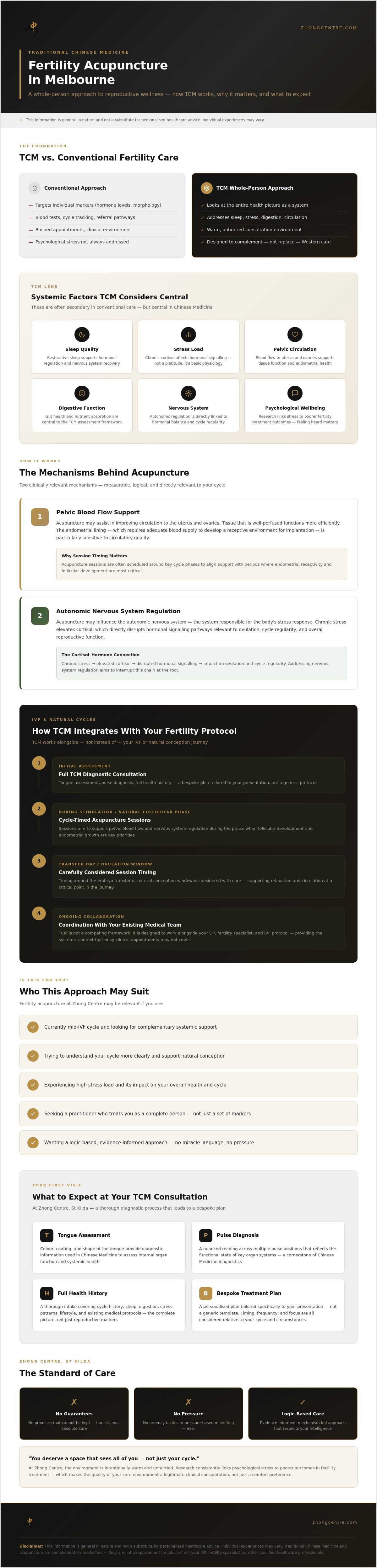
Here's what this article will walk you through: how Traditional Chinese Medicine approaches reproductive wellness as a systemic conversation rather than a single problem to be solved, how it may complement your existing Western medicine protocols, and what a logic-based TCM consultation actually looks like in practice. Whether you're mid-IVF cycle, trying to understand your cycle more clearly, or simply seeking a practitioner who sees you as a complete human being, this is for you. Think of it as a clear-headed introduction to an ancient system that's a lot more evidence-informed than you might expect.
This information is general in nature and not a substitute for personalised healthcare advice. Individual experiences may vary.
Key Takeaways
- Fertility acupuncture Melbourne isn't a standalone fix — it's a systemic, whole-person modality rooted in Traditional Chinese Medicine that looks at your entire health picture, not just your reproductive markers.
- Acupuncture may support blood flow to pelvic organs and assist in regulating the nervous system, which plays a meaningful role in hormonal balance — and there's a logical mechanism behind why this matters for your cycle.
- TCM can work alongside your existing IVF or natural conception protocols, with session timing carefully considered around key stages like stimulation cycles and transfer day.
- Your first consultation at Zhong Centre involves a thorough diagnostic process — including tongue and pulse assessment — that leads to a bespoke plan tailored specifically to your presentation.
- Honest, non-absolute care is the standard here: no guarantees, no pressure — just a logic-based approach to supporting your fertility journey from a St Kilda clinic that sees you as a whole person.
Navigating Fertility Support in Melbourne: Why Systemic Balance Matters
Fertility acupuncture Melbourne isn't a niche wellness trend. It's a clinically grounded modality within Traditional Chinese Medicine that approaches reproductive health as a whole-body conversation. Not a single problem with a single solution. A system, in dialogue with itself, that sometimes needs support finding its rhythm again.
That distinction matters more than it might seem. When the focus narrows exclusively to ovarian reserve or sperm morphology, the surrounding ecosystem gets overlooked. Sleep quality. Stress load. Digestive function. Circulation. These aren't secondary concerns in TCM; they're central to the picture. Because a body under chronic pressure isn't a body in an optimal state for conception, regardless of what the bloodwork says.
The Role of Chinese Medicine in Reproductive Health
Chinese Medicine aims to harmonise the body's internal environment rather than isolate and target individual symptoms. In the context of reproductive wellness, that means looking at how the whole system is functioning: the quality of sleep, the regulation of the nervous system, the efficiency of blood flow to pelvic organs, and the body's response to ongoing psychological stress.
This isn't a replacement for your GP, your fertility specialist, or your IVF protocol. It's designed to work alongside that care, addressing the systemic factors that clinical medicine doesn't always have the appointment time to explore. Think of it as the broader context your body exists in, not a competing framework.
Moving Beyond the Sterile Clinical Experience
Melbourne is a city that moves fast. Long commutes, demanding careers, housing pressure, social comparison — the modern lifestyle here creates a cortisol environment that's genuinely at odds with reproductive wellness. Chronic stress affects hormonal signalling. That's not a wellness platitude; it's basic physiology.
The clinical environment itself can compound this. Sterile waiting rooms, rushed appointments, and the feeling of being reduced to a set of markers on a page don't exactly create the conditions for calm. Research consistently links psychological stress to poorer outcomes in fertility treatment, which makes the quality of your care environment a legitimate clinical consideration, not just a comfort preference.
At Zhong Centre in St Kilda, the space is intentionally different. Vibrant, warm, and built around the idea that feeling genuinely heard is part of the support itself. Dr Abbie Cloherty and the team operate from a logic-based philosophy: no miracle language, no pressure, no promises that can't be kept. Just a considered, evidence-informed approach to fertility acupuncture in Melbourne that respects both your complexity and your intelligence.
You deserve a space that sees all of you. Not just your cycle.
The Mechanisms of Chinese Medicine: How Acupuncture Aims to Support Fertility
Let's get into the actual logic. Because "acupuncture helps balance hormones" isn't an explanation. It's a bumper sticker. If you're a sceptical person navigating fertility acupuncture in Melbourne, you deserve to understand the why behind the approach, not just the what.
Acupuncture works by stimulating specific points on the body to influence physiological responses. In a reproductive context, two of the most clinically relevant mechanisms are its potential effect on pelvic blood flow and its influence on the autonomic nervous system. These aren't abstract concepts. They're measurable, logical, and directly relevant to your cycle.
Improved circulation to the uterus and ovaries matters because tissue that's well-perfused functions more efficiently. The endometrial lining, which needs adequate blood supply to develop the receptive environment required for implantation, is particularly sensitive to circulatory quality. Acupuncture may assist in supporting that blood flow, which is why session timing is often considered carefully around key cycle phases.
Acupuncture and the Stress Response
Here's where it gets genuinely interesting. The sympathetic nervous system, the one that governs your fight-or-flight response, directly competes with the parasympathetic state your body needs for reproductive function. Chronic activation of the sympathetic system, which is frankly the default setting for most people living and working in Melbourne, disrupts the hypothalamic-pituitary-ovarian (HPO) axis. In Chinese Medicine terms, the HPO axis is the governing conversation between your brain and your reproductive organs, the internal communication network that coordinates ovulation, hormone release, and cycle regulation. When that conversation gets disrupted by ongoing stress load, the downstream effects show up in your cycle.
Acupuncture may assist in down-regulating sympathetic nervous system activity, creating a physiological environment that's more conducive to hormonal signalling. Think of it as quieting the background noise so the important signals can actually get through.
Supporting the Menstrual Cycle Phases
TCM doesn't treat the cycle as a single event. It treats it as a series of distinct phases, each with its own priorities.
- Follicular phase: Support is aimed at promoting optimal follicle development and building the endometrial lining, with a focus on circulation and what TCM describes as Blood and Yin nourishment.
- Luteal phase: The emphasis shifts to supporting the internal environment for progesterone activity and implantation, addressing what TCM identifies as Yang energy to sustain warmth and stability in the uterus.
- BBT tracking: Basal body temperature charting remains a practical tool in modern TCM practice. The temperature pattern across your cycle gives a practitioner meaningful data about ovulation timing, luteal phase length, and how your body is responding to support over time.
Chinese herbal medicine often works alongside acupuncture to support this phase-based approach from the inside out. Herbal prescriptions at Zhong Centre are tailored to your specific presentation, not a generic formula pulled from a shelf.
If you'd like to explore how this phase-based approach might be applied to your own cycle, booking a consultation is a straightforward first step.
This information is general in nature and not a substitute for personalised healthcare advice. Individual experiences may vary.
Integrating TCM with Modern Fertility Journeys: Natural Cycles and IVF Support
TCM and Western reproductive medicine aren't competing philosophies. They're complementary systems that, when coordinated thoughtfully, address different layers of the same goal. The logic is straightforward: your IVF specialist manages the clinical protocol; a Chinese Medicine practitioner supports the systemic environment that protocol is working within. Two different lenses. One shared purpose.
Acupuncture for IVF Support in Melbourne
Timing is everything in an IVF cycle, and that applies to acupuncture sessions too. During a stimulation cycle, sessions are generally considered around the follicular phase to support pelvic circulation and the body's response to hormonal stimulation. Around transfer day, acupuncture may aim to support a calm, receptive physiological state, with sessions sometimes scheduled before and after the transfer itself. This isn't based on intuition; it's based on a considered understanding of what the body is doing at each stage and where supportive input may be most relevant.
IVF medications can be demanding on the body. Bloating, disrupted sleep, mood fluctuation, and general physical heaviness are commonly reported experiences during stimulation cycles. Supportive acupuncture and herbal medicine, prescribed specifically to your presentation, may assist in managing some of these side effects, making the process more tolerable without interfering with your clinical protocol. At Zhong Centre, practitioners work within evidence-informed frameworks and maintain open communication with your treating specialist where appropriate.
Natural Fertility and Preconception Planning
For those pursuing natural conception, TCM operates on a different timeline than most people expect. The three-to-six month preconception window is considered the foundation period in Chinese Medicine practice. Here's the biological reason: it takes approximately three months for both eggs and sperm to complete their maturation cycle. Systemic support during this window, rather than in the final weeks before trying, is where the logic-based approach really earns its name.
Conditions like PCOS and endometriosis are approached through this same systemic lens. Rather than targeting a single symptom, a TCM consultation looks at the full pattern: cycle irregularity, inflammatory markers, sleep quality, stress load, and digestive function. The aim is to support the body's overall regulatory capacity, not to override its biology. For a deeper exploration of how this approach applies across different fertility presentations, the Fertility Acupuncture: A Logic-Based Guide is worth reading alongside this article.
Male fertility is 50% of the equation. Full stop. Sperm health, including morphology, motility, and DNA fragmentation, responds to the same systemic factors that affect female reproductive wellness: oxidative stress, heat exposure, lifestyle load, and sleep quality. Zhong Centre offers dedicated Male Fertility Support as part of its integrated approach, because addressing only one partner's health while ignoring the other's is, frankly, incomplete logic.
Fertility acupuncture Melbourne works best when it's part of a coordinated picture, not an afterthought bolted onto an existing protocol. Whether you're mid-IVF or three months out from trying naturally, the timing of when you start matters. Book a consultation to understand what a tailored preconception or IVF support plan might look like for your specific situation.
This information is general in nature and not a substitute for personalised healthcare advice. Individual experiences may vary.
What to Expect During Your TCM Consultation at Zhong Centre
Walking into a TCM consultation for the first time can feel like stepping into unfamiliar territory. What exactly happens? What are they looking for? Why does the practitioner want to look at your tongue? These are fair questions, and they deserve straight answers rather than vague reassurances about "holistic healing."
Here's the honest version of what a Zhong Centre consultation actually involves.
The Zhong Centre Diagnostic Edge
Tongue and pulse assessment aren't mystical rituals. They're diagnostic tools with a coherent logic behind them. The tongue's colour, coating, texture, and shape offer a practitioner observable data about circulation, digestive function, fluid metabolism, and systemic heat or cold patterns. The pulse, felt at three positions on each wrist, provides information about the quality and character of blood flow across different organ systems. Together, they build a picture that no single blood test captures on its own.
What makes Zhong Centre's approach particularly grounded is that it doesn't exist in isolation from your existing pathology results. The team includes naturopathy-background trained staff who understand how to read your blood tests alongside TCM diagnostic findings. That means your AMH levels, FSH, thyroid markers, and inflammatory indicators become part of the same conversation as your tongue coat and pulse quality. Ancient diagnostic method, modern clinical context. Both inform the plan.
From that initial assessment, your practitioner builds a bespoke treatment plan. Not a template. Not a generic fertility protocol pulled from a textbook. A plan shaped specifically around your presentation, your cycle history, your stress load, and your current fertility pathway, whether that's natural conception, IVF support, or something in between. This is what logic-based fertility acupuncture Melbourne looks like in practice.
Your Treatment Sanctuary in St Kilda
Zhong Centre isn't designed to feel like a hospital annex. The clinic environment is deliberately sophisticated and warm, the kind of space that signals immediately that this experience is going to be different from your last waiting room. Vibrant without being chaotic. Calm without being sterile. It's built for people who want real care, not a clinical transaction.
The acupuncture itself? Most people are surprised. The needles used in TCM are extremely fine, nothing like a blood draw or a vaccination. The sensation is often described as a mild heaviness, warmth, or gentle tingling at the insertion point, followed by a deep physical relaxation that many patients find genuinely unexpected. Adjunctive therapies like heat lamps or moxibustion, a traditional technique using warming herbs near acupuncture points, may be incorporated to support circulation and uterine warmth during specific cycle phases.
Ongoing support extends well beyond the treatment table. Cycle tracking, progress check-ins, and herbal medicine adjustments between sessions mean your care evolves as your body does. Dr Abbie Cloherty leads a team that operates from this philosophy consistently: your appointment is a starting point, not a standalone event.
Ready to experience a consultation that actually sees the full picture? Book your initial TCM consultation at Zhong Centre and find out what a bespoke plan looks like for your specific situation.
This information is general in nature and not a substitute for personalised healthcare advice. Individual experiences may vary.
Taking the Next Step: Comprehensive Fertility Support in St Kilda
No miracle language. No pressure. No promises that can't be kept. That's not a disclaimer buried in fine print; it's the operating philosophy at Zhong Centre. Logic-based care means being honest about what Chinese Medicine can and can't do, and then doing the work with genuine rigour within that honest frame. If that sounds refreshingly different from what you've encountered elsewhere, it's meant to.
Your reproductive wellness journey belongs to you. The role of a good practitioner is to support your agency within it, not to replace your clinical team, override your instincts, or sell you certainty that doesn't exist. What Zhong Centre offers is a considered, evidence-informed partnership. One that respects your intelligence, your complexity, and your right to make informed decisions about your own body.
Taking the first step is straightforward. Book your initial TCM consultation online, and you'll be connected with a practitioner who will take the time to actually understand your full picture before suggesting anything.
Bayside Fertility Support
St Kilda sits at the centre of a broader community that stretches through Elwood, Elsternwick, Albert Park, Prahran, and Windsor. If you're based anywhere across Melbourne's inner south and bayside corridor, Zhong Centre is genuinely accessible, not just technically reachable. And that matters more than it sounds. Consistency of care is one of the most clinically meaningful variables in a fertility support plan, and you're far more likely to maintain that consistency when your clinic doesn't require a 45-minute commute.
There's also something to be said for a clinic that understands the specific lifestyle pressures of inner Melbourne. The pace here is real. The housing stress is real. The professional load is real. Fertility acupuncture Melbourne-based practitioners who actually live and work in this environment bring a contextual understanding that a generic wellness chain simply can't replicate. Zhong Centre is embedded in this community, not parachuted into it.
Book your consultation and find out what bespoke, locality-aware fertility support actually feels like.
AHPRA Compliance and Your Safety
Every practitioner at Zhong Centre is registered with AHPRA, Australia's national health practitioner regulation authority. That registration isn't a formality; it means your care is delivered within a regulated framework that includes strict standards around safety, clinical practice, and ethical conduct. In a Melbourne wellness landscape that can sometimes blur the line between qualified clinical care and unregulated wellness services, that distinction matters.
Evidence-informed practice is the standard here, not the exception. Treatments are selected based on a logical clinical rationale, not trend cycles or marketing language. You deserve to know that the person supporting your fertility journey is accountable to a professional body, not just a brand aesthetic.
Your reproductive wellness is worth taking seriously. And so are you.
This information is general in nature and not a substitute for personalised healthcare advice. Individual experiences may vary.
Your Fertility Journey Deserves a Smarter Kind of Support
Fertility acupuncture Melbourne isn't about replacing your specialist or promising outcomes that can't be guaranteed. It's about addressing the full picture: the systemic environment your body is working within, the stress load that disrupts hormonal signalling, and the whole-person context that clinical appointments rarely have time to explore.
The logic is sound. The care is real. And the difference between a practitioner who sees your cycle and one who sees you is significant.
At Zhong Centre St Kilda, AHPRA-registered Doctors of Chinese Medicine build bespoke, whole-person health plans inside a clinic environment that's genuinely different from anything you've sat in before. No pressure. No miracle language. Just considered, evidence-informed support that respects both your intelligence and your journey.
Wherever you're at right now, the best time to start building a supportive foundation is before you need it most. Book your logic-based fertility consultation at Zhong Centre St Kilda and take the first step toward care that actually sees the whole you.
This information is general in nature and not a substitute for personalised healthcare advice. Individual experiences may vary.
Frequently Asked Questions About Fertility Acupuncture in Melbourne
How may acupuncture support my fertility journey in Melbourne?
Acupuncture may support fertility by influencing two key physiological systems: pelvic blood flow and the autonomic nervous system. Better circulation to the uterus and ovaries supports tissue function, while down-regulating the stress response may help restore clearer hormonal signalling through the hypothalamic-pituitary-ovarian axis. It's not a standalone solution. It's a systemic support tool designed to work alongside whatever fertility pathway you're already on.
Fertility acupuncture Melbourne practitioners also consider the full picture: sleep quality, digestive function, stress load, and cycle regularity. These aren't peripheral concerns in Chinese Medicine. They're central to the diagnostic conversation from the very first consultation.
Is acupuncture safe to use alongside IVF medications and protocols?
Yes, acupuncture is generally considered compatible with IVF medications and protocols when delivered by a qualified, AHPRA-registered Chinese Medicine practitioner. At Zhong Centre, practitioners work within evidence-informed frameworks and maintain open communication with your treating fertility specialist where appropriate. The aim is always to complement your clinical protocol, not interfere with it.
Herbal medicine prescriptions are assessed more carefully in this context. Some herbal formulas aren't appropriate during specific phases of a stimulation cycle, which is exactly why bespoke prescribing matters. Generic formulas off a shelf carry real risks. A tailored prescription from a qualified practitioner doesn't.
When is the best time in my cycle to start fertility acupuncture?
Honestly? Earlier than most people expect. TCM works on a three-to-six month preconception timeline because that's how long it takes for eggs and sperm to complete their maturation cycle. Starting support during this window, rather than in the final weeks before trying, is where the logic-based approach genuinely earns its name. If you're mid-IVF cycle, session timing is typically considered around the follicular phase and around transfer day.
If you're tracking your basal body temperature, bring that data to your first consultation. It gives your practitioner meaningful, real-world information about ovulation timing and luteal phase length that shapes the treatment plan from day one.
How many sessions of acupuncture are typically suggested for fertility support?
There's no universal number, because there's no universal patient. Session frequency and duration are shaped by your specific presentation, your cycle history, and your fertility pathway. That said, TCM is not a one-session modality. Systemic change takes time, and a practitioner who tells you otherwise isn't being straight with you.
Your Zhong Centre practitioner will outline a realistic plan during your initial consultation, with built-in review points to assess how your body is responding. The plan evolves as you do. Ongoing cycle tracking and check-ins between sessions mean your care isn't static.
Can Chinese Medicine help with male factor fertility concerns?
Absolutely, and it's a conversation that doesn't happen nearly enough. Male fertility is 50% of the equation, and sperm health responds to the same systemic factors that affect female reproductive wellness: oxidative stress, heat exposure, sleep quality, and lifestyle load. Sperm morphology, motility, and DNA fragmentation are all influenced by the body's broader environment, not just genetics.
Zhong Centre offers dedicated Male Fertility Support as part of its integrative approach. Acupuncture and tailored herbal medicine may assist in supporting the systemic conditions relevant to sperm health. If only one partner is receiving support while the other's health goes unaddressed, the logic simply isn't complete.
What should I bring to my initial TCM fertility consultation?
Bring everything. Recent blood test results including AMH, FSH, LH, and thyroid markers are genuinely useful alongside TCM diagnostic findings. If you've had a semen analysis done, bring that too. Any cycle tracking data, basal body temperature charts, or notes from your fertility specialist help your practitioner build a more accurate picture from the outset.
It's also worth coming prepared to talk about sleep patterns, stress levels, digestive function, and cycle history, including irregularities, pain, and flow characteristics. These aren't throwaway questions in a TCM consultation. They're core diagnostic data that shapes your bespoke treatment plan.
Does health insurance in Australia cover fertility acupuncture?
Many Australian private health insurance policies include acupuncture under their extras cover, but the specifics vary significantly between funds and policy tiers. It's worth contacting your insurer directly before your first appointment to confirm whether Chinese Medicine consultations and acupuncture are included under your current plan and what your annual limits are.
Zhong Centre recommends checking with your fund rather than assuming coverage. Rebate amounts differ, and some policies require a waiting period before extras benefits activate. Your fund's member services line can give you a straight answer in a few minutes.
Is acupuncture painful, and what are the common side effects?
Most people are genuinely surprised. The needles used in TCM are extremely fine, far finer than anything used in a blood draw or vaccination. The sensation is commonly described as a mild heaviness, warmth, or gentle tingling at the insertion point, followed by a deep physical relaxation that many patients find unexpected. Painful is rarely the word people reach for afterwards.
Common post-session responses include mild tiredness, light-headedness if you haven't eaten, or occasional minor bruising at needle sites. These are generally short-lived. Serious adverse events from acupuncture delivered by a qualified, AHPRA-registered practitioner are uncommon. If anything feels off after a session, your practitioner is the right first point of contact.
This information is general in nature and not a substitute for personalised healthcare advice. Individual experiences may vary.