
Cupping Therapy in Balaclava: A Modern Rebel’s Guide to Holistic Recovery
Your persistent shoulder tightness isn't just a physical knot; it's the physiological residue of a Melbourne lifestyle that never hits the pause button. You've likely spent hours hunched over a laptop or navigating the city rush, only to find that a generic massage doesn't actually touch the depth of your fatigue. We understand the skepticism toward cookie-cutter clinics. Seeking cupping therapy balaclava shouldn't feel like a transaction. It's a deliberate act of rebellion against the stagnation that builds up when our bodies are forced into static, modern postures.
You've navigated the mechanics of suction and decoded the visual language of recovery marks. You now understand that moving internal stagnation is a deliberate choice for your systemic health. We reject the surface-level fixes of the beauty industry. Instead, we offer a grounded alternative that prioritises your long-term well-being. Our AHPRA Registered Practitioners have been specialists in Traditional Chinese Medicine since 2014, providing a level of diagnostic precision that ensures your session is tailored to your unique internal landscape. This focus on clinical excellence is shared by other leading practitioners globally; for instance, if you are looking for insights into targeted acupuncture for pain relief and physical rehabilitation, you can visit their website to learn about the approach taken by Balance Acupuncture Clinic.
We agree that the heavy, sluggish energy you're carrying deserves more than a temporary solution. This guide explores how Traditional Chinese Medicine supports systemic recovery by using suction to assist with circulation and help manage the tension of urban life. You'll discover how our Balaclava-adjacent centre aims to address the physiological stagnation caused by desk work and chronic stress. We'll preview the mechanisms behind the technique and explain why this internal reset is a common-sense alternative for those tired of synthetic standards.
This information is general in nature and not a substitute for personalised healthcare advice. Individual experiences may vary.
Key Takeaways
- Learn why cupping therapy balaclava is a deliberate internal reset designed to support tissue health and address modern stagnation.
- Understand how negative pressure aims to assist circulation by drawing metabolic waste out of deep tissue, unlike traditional downward pressure.
- Decode your recovery marks to see what different colours may indicate about your systemic health and internal environment.
- Discover why a Chinese Medicine diagnostic approach is essential for those seeking a sophisticated alternative to generic massage chains.
- Get clear on how to prepare for your session so you can arrive ready for a bespoke consultation focused on your goals.
This information is general in nature and not a substitute for personalised healthcare advice. Individual experiences may vary.
Cupping Therapy in Balaclava: More Than Just a Modern Trend
Balaclava isn't just a hub for speciality coffee and boutique shopping; it's the frontline where the high-pressure Melbourne lifestyle meets its match. You've likely seen the circular marks on Olympic athletes or wellness influencers, but cupping therapy balaclava is far more than a passing aesthetic trend. It is a sophisticated, traditional technique that uses suction to support tissue health and assist with systemic flow. While generic massage chains focus on the surface, we take a "Rebel Expert" stance. We reject the synthetic, temporary fixes of the modern beauty industry in favour of ancient logic that prioritises long-term health.
The real enemy of modern Melbourne vitality is stagnation. It's that heavy, "stuck" feeling in your neck after a marathon of Zoom calls or the persistent tightness in your lower back that won't budge. In Chinese Medicine, we view this as a lack of movement in your internal environment. Cupping is designed to address this stagnation directly, pulling tension to the surface so your body can finally process it. It's a deliberate, grounded alternative for those who are tired of being told that "feeling fine" is the best they can hope for.
The History of the Cup: From Ancient Roots to St Kilda Streets
The history of cupping therapy is vast, spanning over two thousand years of clinical practice. It began with practitioners using bamboo jars, cattle horns, or earthenware to create suction. As the medicine evolved, so did the tools. Today, we typically use medical-grade glass or specialised silicone cups to achieve the same goal. This transition from "old-school" bamboo to modern precision hasn't changed the core philosophy. This method is gaining massive traction in modern wellness circles because it offers a physical depth that manual pressure often cannot reach. It's a bridge between ancient wisdom and the needs of a 21st-century body.
Why Modern Life Demands a Physical Reset
Modern life is biologically weird. Our bodies weren't designed to stare at glowing rectangles for ten hours a day. This sedentary office culture creates "tech neck," a literal physical manifestation of repetitive stress. In Chinese Medicine, this leads to Qi stasis, where your energy and circulation become sluggish. Cupping therapy aims to provide a forced "pause" for your nervous system. By creating negative pressure, it encourages the body to switch from a state of high-alert stress into a recovery mode. It's an essential reset for Balaclava professionals who need their bodies to perform as well as their minds do. If you're ready to shift that stagnant energy, you can book a consultation to discuss a tailored approach.
This information is general in nature and not a substitute for personalised healthcare advice. Individual experiences may vary.
The Mechanics of Suction: How Cupping Supports Circulation
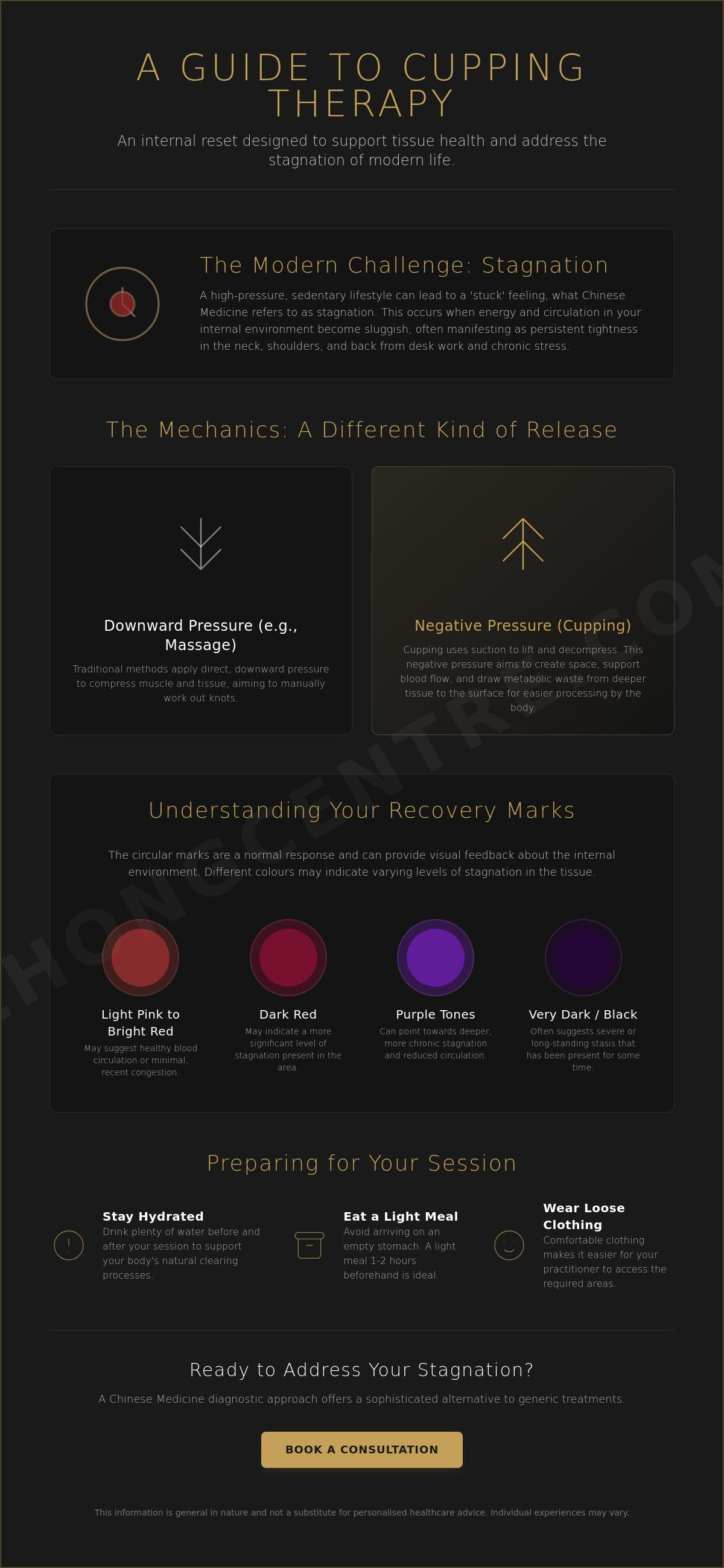
Most people are used to being pushed. We're pushed at work, pushed in the gym, and traditional massage pushes into our muscles. Cupping therapy balaclava offers the opposite. It provides space. By creating a vacuum, it encourages the tissues to expand rather than contract. This concept of negative pressure is what sets the technique apart from downward pressure modalities. Instead of compressing the tissue further, we lift it. This decompression aims to support blood flow to areas that have become "islands" of chronic tightness, bringing fresh nutrients to tissues that have been starved of circulation due to sedentary habits.
Suction is a powerful tool for internal maintenance. It acts like a vacuum for your system. By lifting the skin and superficial muscle layers, it is designed to assist the body's natural recovery processes. This action aims to draw metabolic waste from deep muscle tissue toward the surface. Once these by-products are moved into the superficial layers, the lymphatic system can process and clear them more efficiently. It’s about clearing the decks so your system can function without the physiological "junk" slowing it down. If you're ready to experience this decompression first-hand, you can check our schedule to see what fits your week.
Decompressing the Tissue: A Different Kind of Release
Think of your fascia as a tight wetsuit. When it’s restricted, movement feels laboured. Cupping lifts this connective tissue, which may reduce or improve the appearance of tension. Unlike the "pushing" method of remedial massage, this "pulling" technique offers a unique decompression. This may help with musculoskeletal discomfort, particularly in the lower back where structural pressure is often highest. By creating this physical space, we allow the body to exit its state of constant contraction.
The Chinese Medicine Perspective: Moving the Stagnation
In this traditional healing art, we focus on movement as the foundation of health. Chinese Medicine identifies "Blood Stasis" as a state where blood isn't circulating optimally, leading to persistent discomfort. We use cupping to "vent" excess heat and move Qi. We always capitalise Chinese Medicine as a mark of clinical respect. It is a complete medical system, not just a spa treatment. By moving what is stuck, we aim to restore the internal flow required for systemic health and modern Melbourne vitality.
This information is general in nature and not a substitute for personalised healthcare advice. Individual experiences may vary.
Addressing the Bruise Factor: Understanding the Marks of Recovery
Those iconic circular marks are often the first thing people notice about cupping, but they're also the most misunderstood. Let's be clear: these are not bruises in the traditional sense of trauma. A bruise usually happens when a blunt force ruptures capillaries and damages tissue. In contrast, the marks left after a session of cupping therapy balaclava are the result of therapeutic suction. This negative pressure aims to draw stagnant blood and cellular debris from deep within the muscle to the surface. It is a controlled, intentional process designed to assist your lymphatic system in clearing out the "junk."
You shouldn't expect a painful ordeal. When performed correctly, the sensation is often described as a tight, deep "hug" for your muscles. It’s a rhythmic, grounding experience that aims to soothe the nervous system while physically decompressing the tissue. The marks themselves are a visual report card of your internal environment. They typically fade within three to seven days, depending on your systemic efficiency and how well you support your recovery after leaving the centre.
Deciphering the Colour Palette of Your Back
In Chinese Medicine, the colour of a cupping mark is a diagnostic gift. It tells us exactly what is happening beneath the skin. Light pink or bright red marks generally indicate healthy circulation with only minor surface tension. It's a sign that things are moving well. On the other end of the spectrum, dark purple or even "black" marks may suggest deeper, long-standing stagnation or a significant lack of flow in that specific area. These visual cues are invaluable. They allow your practitioner to tailor future sessions, focusing on the zones that require the most support to restore movement.
Post-Session Care: Protecting Your "Open" Channels
After your session, your body is in a state of active transition. We often describe the pores and channels as being "open," which means they're more sensitive to the environment. In the often-chilly Melbourne climate, it’s vital to keep the area covered and warm for at least 24 hours. Avoid cold showers or sudden drafts. Hydration is also a non-negotiable. Drinking plenty of water assists your body in processing the metabolic waste that the suction has brought to the surface. For those wanting to support their skin health at home, applying The Night Oil can assist with maintaining a supple, hydrated surface while your body continues its internal reset.
This information is general in nature and not a substitute for personalised healthcare advice. Individual experiences may vary.
Choosing the Right Practitioners: Why a TCM Approach Matters
Anyone can buy a set of silicone cups online, but applying cupping therapy balaclava with clinical precision requires years of diagnostic training. There is a massive difference between cupping as a mindless "add-on" at a massage chain and cupping as a strategic Chinese Medicine tool. When you visit us, the placement of each cup isn't random. It is based on a sophisticated understanding of your internal landscape. We look at your tongue, feel your pulse, and map out where your system is struggling to maintain flow. This diagnostic depth ensures that the suction is working for you, not just sitting on you.
Our team, led by Dr Abbie, operates with a "Rebel Expert" mentality. We are highly qualified professionals who have traded sterile, corporate health standards for a more grounded, authentic approach to healing. We are conveniently located for those living in Balaclava, Ripponlea, and St Kilda East, offering a sanctuary for people who want results without the clinical coldness. We don't aim to "fix" you in a single session; we aim to support your body's inherent ability to recalibrate and find its own balance.
Registered Expertise vs. Weekend Courses
In Australia, Chinese Medicine practitioners are regulated by AHPRA, the same body that oversees doctors and nurses. This means we've undergone rigorous university training and must meet strict national standards for safety and ethics. Understanding the "why" behind the cup placement is far more important than the suction itself. A weekend course can't teach the nuances of Qi stasis or the subtle art of "venting" heat. Our commitment to a non-absolute voice means we focus on how we can assist with your specific concerns, whether that's persistent back tightness or feeling systemically sluggish.
A Bespoke Experience in the Heart of St Kilda
The Zhong Centre isn't your average sterile clinic. We’ve created a calming, edgy atmosphere that reflects our disruptive approach to wellness. We often integrate our cupping services with other modalities like Cosmetic Acupuncture to provide a truly holistic experience. By focusing on your "internal weather" as much as your external symptoms, we help you navigate the high-pressure Melbourne lifestyle with more resilience. It’s about systemic restoration that feels as good as it looks. If you are ready to move beyond generic care, you can secure your consultation online today.
This information is general in nature and not a substitute for personalised healthcare advice. Individual experiences may vary.
Preparing for Your First Cupping Session in Balaclava
Preparing for cupping therapy balaclava is about more than just finding the centre. It’s a deliberate transition from the noise of Carlisle Street into a space designed for recalibration. We don't believe in the "just show up" mentality common in generic directories. Your experience begins with a thorough initial consultation. This is where we discuss your health history, lifestyle factors, and specific goals. It’s a vital step. It allows us to map your "internal weather" and ensure the technique is tailored to your systemic needs rather than applied as a one-size-fits-all solution.
Once the cups are in place, they typically remain for 15 to 30 minutes. This isn't just waiting time. It is a meditative pause. You may feel a deep, pulling sensation as the negative pressure works to assist with circulation and support tissue decompression. It is a period of stillness that encourages your nervous system to downshift from "fight or flight" into a state of recovery. Integrating this into your broader wellness routine helps maintain that sense of flow, making you more resilient to the stressors of modern Melbourne life.
The Pre-Cup Checklist
Success in the treatment room starts an hour before you arrive. We suggest avoiding heavy meals or high doses of caffeine. These can interfere with your body's ability to settle into a relaxed state. Wear loose-fitting clothing that allows easy access to your back or the target area. Most importantly, be prepared to discuss any specific concerns or physical sensations with Dr Matt or your practitioner. Honest communication ensures your session is as effective and comfortable as possible. We want you to feel understood before the first cup even touches your skin.
Frequency and Consistency: How Often Should You Cup?
While a single session often provides a sense of immediate lightness, consistency is where the real transformation happens. Cupping therapy is designed for cumulative benefits. We typically suggest intervals of every two to four weeks. This depends on your individual needs and how your body responds to the initial reset. Regular maintenance aims to prevent stagnation from becoming "stuck" in the long term. It’s about staying ahead of the tension rather than constantly playing catch-up. For more logistical details on what to expect during your visit, feel free to check our FAQ page. When you're ready to commit to your recovery, you can book your session online.
This information is general in nature and not a substitute for personalised healthcare advice. Individual experiences may vary.
Ready for a Systemic Reset?
You've navigated the mechanics of suction and decoded the visual language of recovery marks. You now understand that moving internal stagnation is a deliberate choice for your systemic health. We reject the surface-level fixes of the beauty industry. Instead, we offer a grounded alternative that prioritises your long-term well-being. Our AHPRA Registered Practitioners have been specialists in Traditional Chinese Medicine since 2014, providing a level of diagnostic precision that ensures your session is tailored to your unique internal landscape.
Whether you're looking to address persistent desk-work tension or seeking to assist with sluggish energy, cupping therapy balaclava offers a physical decompression that manual pressure simply cannot replicate. It is time to stop accepting "stuck" as your physiological default. We are here to support your body's natural recovery processes with clinical expertise and a refreshingly down-to-earth approach. Your path to a lighter, more fluid version of yourself starts with a single, purposeful reset.
Book your Cupping Therapy session at Zhong Centre today
This information is general in nature and not a substitute for personalised healthcare advice. Individual experiences may vary.
Frequently Asked Questions
Does cupping therapy hurt?
Most people find the sensation surprisingly grounding; it feels like a deep, firm hug for your muscles rather than a sharp or painful experience. While the suction is intense, it aims to be a therapeutic release that downshifts your nervous system. You might feel a slight pinching or heat as the blood moves to the surface, but this should never reach the level of genuine pain.
How long do the cupping marks last?
These marks typically fade within three to seven days, depending on your body’s unique ability to process the stagnation we’ve brought to the surface. Factors like hydration, rest, and your systemic circulation speed will influence how quickly the colour disappears. As we discussed earlier, these are not traumatic bruises; they are a visual indicator of your internal recovery process.
Is cupping therapy safe for everyone?
While generally safe, we always perform a thorough assessment because certain conditions require a different approach. We may advise against cupping if you have specific skin conditions, are on certain blood-thinning medications, or have a high fever. Our AHPRA registered practitioners ensure the technique is appropriate for your current "internal weather" before the first cup is applied.
Can I exercise after a cupping session?
We advise resting for at least 24 hours after your appointment to allow your body to process the session. Your pores are effectively "open" and your tissues are in an active state of recalibration. Intense gym sessions or swimming in cold water can shock the system and interfere with the circulation we’ve worked to support.
What is the difference between dry and wet cupping?
Dry cupping uses pure suction to move blood and Qi, whereas wet cupping involves controlled medicinal bleeding. At our centre, we focus on dry cupping techniques to support tissue health and assist with circulation. This method is non-invasive and prioritises the decompression of the fascia without the need for skin incisions.
Will cupping therapy help with my stress and anxiety?
Our treatments are designed to support your wellbeing by addressing the physical manifestations of a high-pressure lifestyle. By physically releasing the "tech neck" and shoulder tension associated with stress, we aim to assist the body in exiting a state of constant alert. It is a holistic way to support your mental health through physical restoration.
Do I need a referral to see a Chinese Medicine practitioner in Balaclava?
You don't need a GP referral to access cupping therapy balaclava at our centre. Most private health funds in Australia cover Chinese Medicine services, provided you have the appropriate level of extras cover. You can book directly through our online system and we will provide the necessary receipts for your claim.
How much does a cupping session cost at Zhong Centre?
We offer various session lengths and integrated treatments to suit different health goals. Because our approach is bespoke, we recommend checking our live booking page for the most accurate and up-to-date information on our service options. This ensures you can select the consultation or treatment combination that best supports your individual recovery needs.
This information is general in nature and not a substitute for personalised healthcare advice. Individual experiences may vary.