

Basal Body Temperature and Ovulation: The TCM Guide to Tracking Your Cycle in Melbourne
What if those jagged, mountain-range lines on your morning chart aren't a sign of a broken cycle, but a sophisticated map of your internal landscape? Many people stare at their thermometer in the dim light of a Melbourne morning, feeling a surge of anxiety that they've missed their chance. You're likely frustrated by generic apps that don't seem to account for your specific irregularities. It's common to feel overwhelmed by the data when you're just trying to understand the link between basal body temperature and ovulation.
At Zhong Centre, we view these thermal shifts as more than just data points. They are a real-time reflection of the dance between Yin and Yang in your body. This guide aims to assist you in mastering the art of cycle tracking through the lens of Chinese Medicine, providing a framework designed to support your hormonal health. You'll discover how to better understand your body's unique thermal patterns and find clarity in identifying your fertile window. We're moving beyond the clinical, one-size-fits-all approach to help you develop a deeper, holistic connection with your reproductive rhythm.
Key Takeaways
- Learn how tracking your basal body temperature and ovulation acts as a confirmatory map of your cycle, revealing the specific thermal rise triggered by progesterone.
- Discover how to interpret your chart through the lens of Chinese Medicine, identifying the 'Yin' and 'Yang' phases to better understand your internal landscape.
- Understand the difference between the predictive nature of Ovulation Predictor Kits and the confirmatory data of BBT to help address confusion over missing your window.
- Master the practicalities of accurate tracking, including why a specific basal thermometer is essential for capturing your body's subtle metabolic shifts.
- Explore how your temperature data serves as a collaborative diagnostic tool designed to support your fertility and hormonal health during a consultation.
What is Basal Body Temperature and Why Does It Matter for Ovulation?
Your body has a baseline. It is the metabolic hum that exists when everything else is quiet. This is your Basal Body Temperature (BBT). It is measured the moment you wake up, before the first stretch, the first sip of water, or the reach for your phone. Unlike the temperature you check when you feel a fever coming on, BBT is about detecting microscopic, systemic shifts. These tiny fluctuations are the primary evidence of your hormonal dance. They act as a daily record of your internal metabolic activity, providing a level of detail that a standard thermometer reading simply cannot capture.
The biological link between basal body temperature and ovulation is driven entirely by your hormones. Before you release an egg, your body operates at a slightly cooler baseline. Once ovulation occurs, the empty follicle transforms into the corpus luteum. This temporary gland pumps out progesterone, which we often call the 'warming' hormone. Progesterone is thermogenic. It literally turns up your internal thermostat to prepare the body for a potential pregnancy. By tracking this shift, you are creating a thermal map that reveals exactly when this hormonal surge happens.
The Science of the Shift
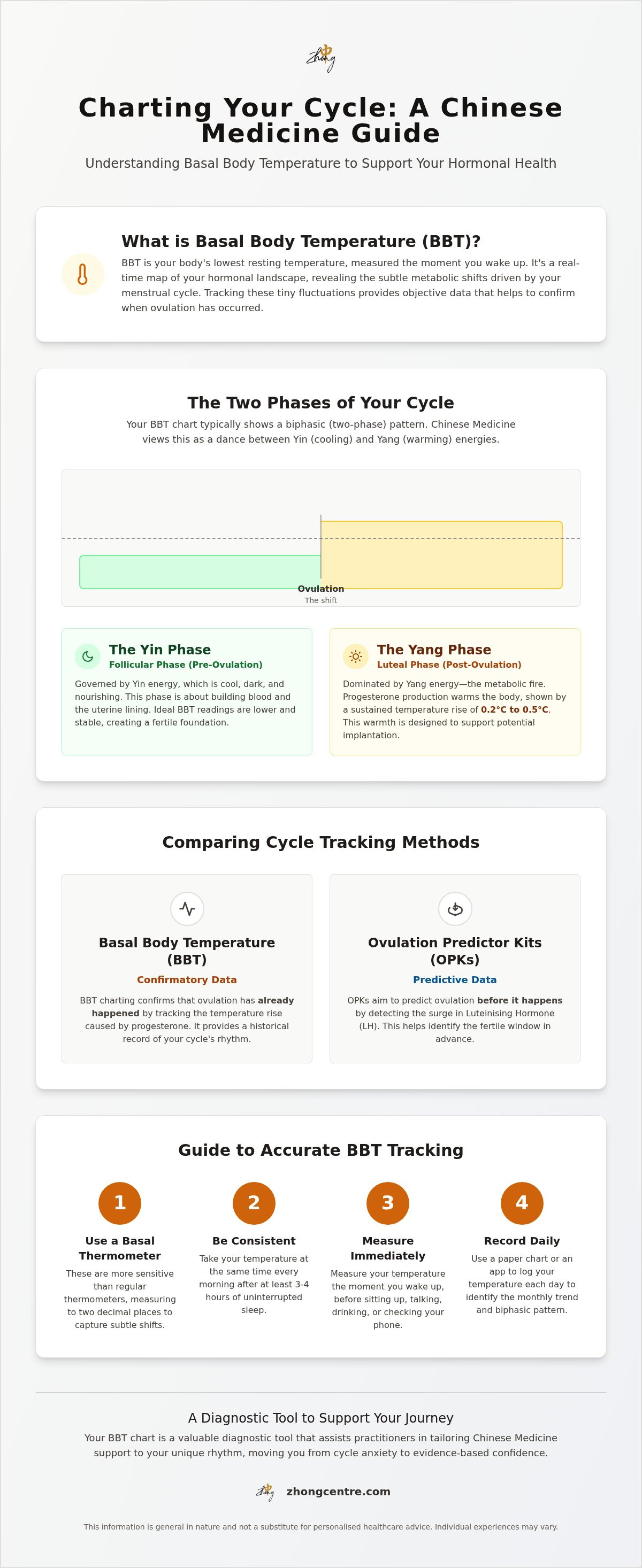
A healthy, ovulatory cycle usually follows a biphasic pattern. This means your chart will show a sea of lower numbers in the first half of your cycle, followed by a distinct jump. This rise is typically between 0.2 and 0.5 degrees Celsius. It serves as a retrospective confirmation that the 'ovulatory jump' has taken place. It proves your body did the work. A single high reading doesn't mean much on its own; we look for the sustained monthly trend. This consistent heat indicates that progesterone is active and your cycle is moving through its necessary phases.
Why Tracking Beats Guessing
Many generic fertility apps rely on 'period math'. They assume every person ovulates exactly on day 14. If your cycle is irregular, long, or influenced by stress, that math is often wrong. Tracking your basal body temperature and ovulation provides objective, raw data that cuts through the noise of synthetic predictions. At Zhong Centre, our practitioners, including Dr Abbie, use your BBT chart as a clinical diagnostic tool. It allows us to see how your system transitions between Yin and Yang energies. This information assists us in tailoring your Traditional Chinese Medicine support to your specific rhythm, moving you from cycle anxiety to evidence-based confidence.
The TCM Lens: Mapping Your Cycle Phases Through Temperature
While most apps focus purely on the chemical rise and fall of estrogen and progesterone, we take a more disruptive approach. We view your chart as a living conversation between Yin and Yang energies. It is a logic-based map that tells us exactly how your system is managing its resources. Understanding the relationship between basal body temperature and ovulation through this lens allows us to see beyond the data points and into the actual vitality of your cycle. Your chart reveals the energetic quality of your internal landscape, showing us where your body is thriving and where it may need a little more assistance.
The Yin Phase: Building the Foundation
The first half of your cycle, the follicular phase, is governed by Yin. In Chinese Medicine, Yin is cool, dark, and nourishing. It is responsible for building the blood and the endometrial lining, creating a lush, fluid-rich environment for a potential embryo. During this time, we look for steady, lower temperatures. If your chart shows erratic or slightly elevated temperatures before you ovulate, it may suggest a 'Yin deficiency'. This is a sign that your body might be struggling to build the necessary foundation required for a healthy ovulatory event. Steady Yin is the essential precursor to a strong Yang shift.
The Yang Phase: Sustaining the Spark
Once ovulation occurs, the energy shifts from Yin to Yang. This is the luteal phase, the time of metabolic fire and activity. Progesterone takes the lead, and your temperature should make a clear, decisive jump. This 'Yang' rise is the heat required to support implantation and maintain the early stages of a pregnancy. If your temperatures rise too slowly or the high-temperature phase is too short, your system may benefit from 'Yang support'. Fertility Acupuncture is specifically designed to assist this thermal transition, aiming to support the body's natural ability to maintain that vital metabolic heat.
Learning how to track your basal body temperature correctly is the first step in providing us with the raw data we need. By documenting these patterns, you are giving your practitioner a clear window into your internal landscape. If you're ready to move beyond generic advice and want a plan tailored to your unique thermal map, you can book a consultation with our team in St Kilda. We use these patterns to help identify where your system needs the most care, ensuring your treatment is as individual as your cycle.
This information is general in nature and not a substitute for personalised healthcare advice. Individual experiences may vary.
BBT vs. Ovulation Predictor Kits: Which Method Suits Your Journey?
Walking down the fertility aisle in a Melbourne chemist can feel like a high-stakes guessing game. Most people reach for Ovulation Predictor Kits (OPKs) because they offer immediate, predictive feedback. They measure the surge of Luteinising Hormone (LH) in your urine, signalling that your body is preparing to release an egg. However, there is a distinct difference between a signal and a result. While OPKs are predictive, tracking basal body temperature and ovulation is confirmatory. One tells you the body is trying; the other proves it actually happened.
Relying solely on kits can be misleading for many. In some cases, the body may surge LH but fail to release an egg, a phenomenon often seen in hormonal imbalances or high-stress cycles. This is why we advocate for a multi-sign approach. By combining BBT with observations of cervical mucus, you create a comprehensive data set that leaves little room for guesswork. It is a cost-effective way to confirm your fertile window without relying on synthetic predictors that only capture a moment in time.
The Pros and Cons of OPKs
OPKs offer the convenience of a quick daily test, but the costs add up quickly over several months. For those with irregular cycles, the 'false peak' is a common frustration. You might see a positive result, but without the subsequent temperature rise, there is no evidence that ovulation occurred. Beyond the expense, these kits are silent on the health of your Luteal phase. They cannot tell you if your 'Yang' energy is strong enough to support the second half of your cycle, leaving a significant gap in your hormonal story.
Why BBT is the 'Gold Standard' for Holistic Analysis
BBT is considered the gold standard because it tracks the actual outcome of your hormones. When you measure the Physiology of Ovulation and BBT, you are witnessing the thermogenic effect of progesterone in real-time. This provides a full 30-day picture of your systemic health rather than a narrow 48-hour window. For the Melbourne Rebel, this isn't just about timing; it's about autonomy. Knowing the 'why' behind your cycle irregularities allows us to provide more targeted support during your consultations at Zhong Centre.
This information is general in nature and not a substitute for personalised healthcare advice. Individual experiences may vary.
Your Step-by-Step Guide to Accurate BBT Tracking in St Kilda
Precision is the difference between a chart that makes sense and one that looks like a random scatter plot. To master the link between basal body temperature and ovulation, you need to capture your body at its most quiet. This requires a specific protocol that respects your physiology. Moving too much or scrolling through your feed before reaching for the thermometer can spike your readings, rendering the data less reliable. Follow these steps to turn your morning routine into a diagnostic tool:
- Step 1: Get the right kit. You need a dedicated Basal Thermometer. A standard chemist fever thermometer isn't sensitive enough; it must show two decimal places, for example, 36.55°C. High-quality tools from specialised suppliers like CT&T Medical GmbH can provide the precision needed for accurate monitoring.
- Step 2: Proximity is power. Keep your thermometer on your bedside table. It should be closer than your mobile phone.
- Step 3: The 'No Movement' rule. Take your temperature the second you wake up. Do not sit up, do not speak, and definitely do not check your notifications. Even the act of reaching for a water bottle can spike your metabolic heat.
- Step 4: Respect the clock. Aim for a consistent time each morning. For the data to be valid, you ideally need at least 4 hours of restorative, uninterrupted sleep.
- Step 5: Map the big picture. Record your data in an app or on a paper chart. We aren't looking at a single day; we are looking for the overall monthly curve.
The Golden Rules of Consistency
Life in Melbourne is vibrant, and your chart will reflect that. A late-night dinner in Prahran or a restless night during a Bayside heatwave can spike your morning reading. These are 'disturbed' temperatures. When this happens, mark it on your chart rather than letting it skew your analysis. Don't obsess over a single 'weird' number. The goal is to see the trend of basal body temperature and ovulation over weeks, not hours. If you're struggling to make sense of your data, you can book a consultation with our St Kilda team to review your chart together. Consistency is about the trend, not perfection.
Reading Your Cervical Mucus Alongside BBT
Temperature tells you that ovulation has happened, but your cervical mucus tells you it is coming. Clear, stretchy 'egg white' mucus is the precursor to the thermal rise. In Traditional Chinese Medicine, we refer to this arrival of reproductive essence as 'Tian Gui'. When you track both signs, you create a high-confidence map of your fertile window. This dual-tracking approach is designed to support your understanding of how your Yin builds fluid before your Yang provides the heat. It turns a mystery into a manageable, logic-based process. This integration of data points allows you to feel more in tune with your cycle's natural shifts.
This information is general in nature and not a substitute for personalised healthcare advice. Individual experiences may vary.
Optimising Your Fertility: Integrating BBT Data with Chinese Medicine
Your morning chart is more than a personal record. It is a clinical blueprint. When you bring your data to a TCM Consultation, you are handing us a map of your metabolic health that no blood test can replicate in real-time. Dr Abbie or Dr Matt look beyond the binary question of whether you ovulated. We analyse the quality, speed, and stability of your hormonal shifts. Understanding the nuances of basal body temperature and ovulation allows us to identify exactly where your system requires the most support, moving from guesswork to a logic-based strategy.
What Your Practitioner Looks For
Our method is disruptively honest. We don't just look at your ovaries; we look at your life. Acupuncture is specifically designed to support the 'ovulatory jump', aiming to assist the body during the high-energy transition between phases. We focus on the 'climate' of your uterus, working to ensure it is warm, nourished, and receptive. This 'Whole Person' focus means we address your sleep quality and stress levels as non-negotiable parts of your reproductive health. We don't believe in synthetic, one-size-fits-all fixes that ignore the underlying systemic balance.
Our libido-supporting teas and clinical treatments are designed to assist these natural biological processes. We invite Bayside locals to book a session at our St Kilda clinic to 'decode' their specific patterns. Whether your chart is a mountain range or a gentle hill, we provide a sanctuary for those tired of the clinical wellness vibe. We are here to help you understand your body's thermal language and provide a clear, holistic path forward.
This information is general in nature and not a substitute for personalised healthcare advice. Individual experiences may vary.
Master Your Cycle with Logic and Intuition
Tracking your basal body temperature and ovulation isn't about obsessing over a thermometer; it's about claiming autonomy over your reproductive health. You've moved beyond the guesswork of generic apps to understand your body's specific Yin and Yang phases. This data is the most honest conversation your body has with you each day, revealing the metabolic story that synthetic tests often miss. It is about building a foundation of knowledge that empowers your future choices.
If you're ready for expert interpretation of your BBT charts, our AHPRA-registered Chinese Medicine practitioners provide holistic, logic-based fertility support in the heart of Melbourne. We use your unique thermal patterns to assist your hormonal health and provide a sanctuary for those seeking a deeper connection to their wellbeing. Book your Fertility Support Consultation at our St Kilda centre to review your data with Dr Abbie and the team. Your cycle is a map, and we're here to help you navigate it with confidence and clarity.
This information is general in nature and not a substitute for personalised healthcare advice. Individual experiences may vary.
Frequently Asked Questions
Can I track my basal body temperature if I have PCOS?
Yes, you can track your basal body temperature and ovulation if you have PCOS, though your chart may look different. PCOS often involves longer cycles or multiple attempts at ovulation. Tracking provides objective data on whether your body is successfully transitioning into the Yang phase. This information assists our practitioners at Zhong Centre in tailoring your Traditional Chinese Medicine support to address specific hormonal imbalances and metabolic stagnation.
What should I do if my BBT chart is very jagged and inconsistent?
A saw-toothed or erratic chart often points to an unsettled nervous system or Heart energy in Traditional Chinese Medicine. It may reflect high cortisol levels or poor sleep quality. If your readings are inconsistent, we suggest focusing on a strict waking routine and marking disturbed nights. This data helps us design acupuncture sessions aimed at calming the system and supporting a more stable thermal rhythm.
How much does basal body temperature rise after ovulation in Celsius?
You should look for a sustained rise of approximately 0.2 to 0.5 degrees Celsius. This shift happens within 24 hours of the egg being released and stays elevated until your next period begins. It's the physiological result of progesterone warming your system. At our St Kilda clinic, we use this specific data to confirm that your ovulatory jump is strong enough to support your reproductive goals.
Is BBT tracking an effective method of natural contraception?
BBT is a core component of many natural family planning methods, but it is primarily confirmatory. It tells you that ovulation has already occurred, rather than predicting it in advance. For those in Melbourne seeking a non-synthetic alternative to hormonal birth control, we recommend combining temperature data with cervical mucus observations. This multi-sign approach is designed to provide a more comprehensive understanding of your fertile window.
Does stress or alcohol affect my basal body temperature readings?
Both stress and alcohol can significantly skew your readings by increasing your systemic metabolic heat. A glass of wine in Windsor or a deadline-induced restless night will often cause a temporary temperature spike the following morning. We advise marking these instances on your chart as disturbed temps. This prevents a single outlier from confusing your overall monthly trend and ensures your data remains clinically useful.
How many months should I track my BBT before I see a pattern?
We typically recommend tracking for at least three consecutive cycles to identify a clear pattern. One month provides a snapshot, but three months reveal your body's unique baseline and seasonal variations. This timeframe allows our team to see how your system responds to Traditional Chinese Medicine treatments. It turns a collection of daily numbers into a meaningful map of your long-term hormonal and reproductive health.
Can I use a normal fever thermometer for BBT tracking?
No, a standard fever thermometer is not sensitive enough for this process. You must use a specific digital basal thermometer that displays two decimal places, such as 36.55°C. The shifts in basal body temperature and ovulation are incredibly subtle, sometimes moving by only a fraction of a degree. A regular thermometer will miss these metabolic nuances, leaving you with a chart that lacks the necessary detail for clinical analysis.
What does it mean if my temperature stays high for more than 18 days?
If your temperature remains elevated for 18 days or more after your ovulatory rise, it is often a strong indicator of pregnancy. This sustained heat reflects the continued production of progesterone required to support an early pregnancy. If you notice this pattern on your chart, we suggest performing a home pregnancy test or booking a consultation to discuss the next steps for your pregnancy support.
This information is general in nature and not a substitute for personalised healthcare advice. Individual experiences may vary.