

Acupuncture for Mental Clarity Melbourne: Cutting Through the Modern Fog
What if sharper focus starts with more than another coffee? If brain fog, scattered attention or poor sleep are making Melbourne’s busy pace feel even heavier, it may be worth looking beyond the next caffeine hit. Acupuncture for mental clarity Melbourne readers explore through Chinese Medicine takes a whole-person view of factors that may affect how clear and resilient you feel.
It’s understandable to want your concentration back without adding another demanding routine to an already packed day. Chinese Medicine doesn’t treat mental clarity as simply a matter of “calming down”. It considers how patterns such as stress, sleep disruption and daily habits may relate to your overall wellbeing. Acupuncture is one approach that may support this broader process, though individual experiences vary.
In this article, discover how Chinese Medicine approaches focus and mental resilience, what an acupuncture consultation may involve, and why sleep and stress belong in the conversation. We’ll also look at Zhong Centre’s integrative approach in St Kilda, and practical questions to consider when exploring care in Melbourne. There’s no quick fix or one-size-fits-all answer.
Key Takeaways
- Brain fog describes difficulties with focus or memory; it isn’t a diagnosis by itself. Stress, sleep and daily demands may be relevant, but persistent symptoms can have different causes.
- Acupuncture for mental clarity melbourne may fit within a whole-person Chinese Medicine approach. Traditional explanations should not be mistaken for proven effects on concentration or nervous system function.
- Caffeine may temporarily increase alertness, but it doesn’t explain or address every possible contributor to mental fatigue. Sleep, routines and wider wellbeing are also worth considering.
- A TCM consultation may include discussion of your health history, lifestyle and sleep, as well as tongue and pulse assessment within a traditional framework.
- Zhong Centre offers TCM consultations and acupuncture in St Kilda. A practitioner can discuss your needs and expectations, including whether cosmetic acupuncture is relevant to your goals.
What is Brain Fog? Understanding the Melbourne Mental Struggle
Brain fog isn’t a diagnosis. It’s a common way to describe experiences such as difficulty concentrating, forgetfulness or feeling mentally sluggish. These symptoms can have different contributors, including disrupted sleep, stress and other health concerns. If they persist, worsen or affect daily life, talk with a health professional rather than assuming you know the cause.
Melbourne’s CBD can reward a fast pace: back-to-back meetings, constant notifications and little breathing room between tasks. That always-on rhythm may leave you feeling cognitively drained, especially when rest and recovery keep slipping down the list. If you’re rereading emails, losing track of tasks or finding decisions harder than usual, pushing through may not be the most useful response. Take note of when the fog occurs and what else is happening around it.
The Cost of Cognitive Fatigue
When your attention feels scattered, everyday work can take more effort. You might reread the same email, struggle to prioritise tasks or second-guess a decision you’d usually make with ease. Reaching for another coffee may feel like the obvious move. Caffeine can temporarily increase alertness, but its effects vary and it doesn’t address every possible contributor to fatigue. For some people, later caffeine use may also interfere with sleep. A broader view asks what’s affecting your energy instead of relying on stimulation alone.
Chinese Medicine and the Mind-Body Link
Chinese Medicine offers a traditional framework for understanding the relationship between mental state and physical wellbeing. In this framework, Shen refers to the mind or spirit and is associated with the heart, while its steadiness is understood in relation to the wider system. Qi describes vital activity and movement within this traditional model. These are Chinese Medicine concepts, not direct explanations of brain anatomy.
Digestive function also features in this whole-person perspective. A practitioner may use the term dampness to describe a pattern associated in Chinese Medicine with heaviness or mental cloudiness. It isn’t literal moisture around the brain or a biomedical diagnosis. An assessment considers the person’s broader presentation rather than assigning a traditional pattern based on one symptom.
That means looking beyond the fog to consider its context, including sleep, stress, daily habits and general wellbeing. If you’re exploring acupuncture for mental clarity melbourne, it helps to understand the approach and its limits. Acupuncture has a long history within Traditional Chinese Medicine and is also used in modern healthcare settings. This overview is general background, not evidence of a particular outcome.
The Logic of the Needle: How Acupuncture Aims to Support Focus
Acupuncture doesn’t work like a switch for concentration. In Chinese Medicine, a practitioner selects points according to an individual assessment and traditional ideas about the movement of Qi. Terms such as “clear the head” describe this framework. They aren’t established explanations of brain function or evidence that acupuncture will improve focus.
It’s useful to separate traditional theory from scientific evidence. This article doesn’t claim that acupuncture improves blood flow, regulates the nervous system or changes cognitive performance. Those statements would need suitable research references. Instead, the focus here is on how Chinese Medicine describes an individual approach and what you can ask a practitioner.
If you’re exploring acupuncture for mental clarity melbourne, a consultation can help you discuss whether acupuncture may be appropriate for your circumstances. It isn’t a substitute for medical assessment or other healthcare you may need.
Regulating the Vagus Nerve
The vagus nerve is part of the autonomic nervous system. Acupuncture is sometimes discussed in relation to nervous system activity, but without specific verified studies to cite here, it would be misleading to claim a session directly changes vagal function or shifts the body out of “fight or flight”. A practitioner can explain the Chinese Medicine perspective and discuss your health history without presenting a particular physiological response as certain.
Feeling settled may make it easier to give a task your attention, but that possibility shouldn’t be mistaken for a proven effect of acupuncture on higher-order thinking.
Addressing ‘Dampness’ and Mental Clouding
In Chinese Medicine, dampness is a traditional pattern description, not literal metabolic waste or a biomedical explanation for brain fog. A practitioner may consider it alongside your energy, digestion and wider health picture. The Spleen and Stomach refer to functional systems in Chinese Medicine associated with transforming food and fluids into usable energy; they aren’t direct equivalents of the anatomical organs alone.
Points may be selected within this traditional framework to support the movement of Qi. Phrases such as “descend excess upward energy” describe Chinese Medicine concepts, not a measurable process or guaranteed outcome. If mental cloudiness persists or affects daily life, discuss it with a GP or another qualified health professional.
A useful consultation makes room for questions about why particular points are being considered, what the session involves and how your experience will be reviewed. To explore whether an individual consultation may suit your needs, view booking options for a consultation.
Acupuncture vs. Short-Term Approaches: Why Systemic Balance Wins
A double espresso can feel like a practical response to a foggy afternoon. But reaching for coffee doesn’t tell you why you’re feeling mentally tired. If you notice a pattern between caffeine, restlessness or sleep, make a note of it and consider discussing your habits and symptoms with a health professional. Responses to caffeine vary, so don’t assume the same approach suits everyone.
Chinese Medicine offers a different framework. Rather than promising a quick cognitive “reset”, it considers your wider health picture, which may include stress, sleep, digestion and daily routines. Acupuncture is one option within this approach, not a substitute for medical assessment or prescribed care. The intention is to explore your circumstances, not to promise sustained high performance.
Breaking the Caffeine Cycle
In a busy Melbourne workplace, coffee can become part of the routine before you’ve paused to check what you need. There’s no single caffeine response, and acupuncture can’t be claimed to reduce jitters or restore natural energy. A practitioner may discuss your routines as part of a broader consultation. You could note when you have caffeine and whether you notice a connection with your rest or how you feel, then raise that information with a health professional.
The Problem with ‘Powering Through’
Continuing through mental fatigue can make it harder to notice patterns in your wellbeing. Tension headaches or skin concerns may occur alongside stress or poor sleep, but that doesn’t establish that brain fog causes them. Chinese Medicine takes an interconnected view and may consider these concerns within your broader health context, rather than assuming one symptom explains another.
At Zhong Centre, the “Zhong” philosophy places whole-person health ahead of chasing a temporary cognitive or cosmetic ideal. Acupuncture sessions can offer time to pause and discuss your wellbeing, but they can’t be presented as a guaranteed reset or a substitute for sleep, lifestyle changes or appropriate healthcare. If symptoms persist, are new or worsen, seek advice from a qualified health professional.
If you’re considering acupuncture for mental clarity melbourne, a Chinese Medicine consultation can give you an opportunity to discuss your concerns and whether an individual approach may suit you.
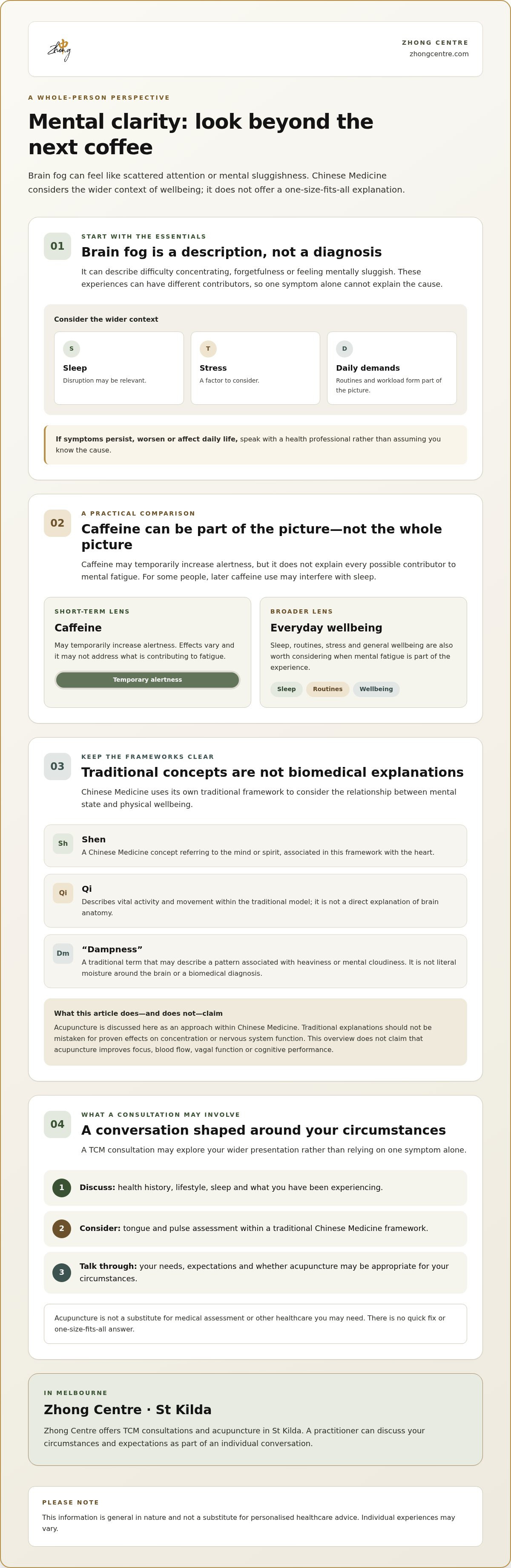
What to Expect: Your Melbourne Acupuncture Session for Clarity
A session begins with a conversation, not a one-size-fits-all plan. A TCM consultation may cover what you’ve noticed about your concentration, sleep, stress, digestion and daily routine. The practitioner may also observe your tongue and feel your pulse as part of a traditional Chinese Medicine assessment. These methods inform a Chinese Medicine perspective; they don’t replace medical assessment or establish a biomedical diagnosis.
For acupuncture for mental clarity melbourne, the aim is to understand your individual context rather than assume every foggy day has the same cause. You can also ask what the practitioner’s assessment involves and how your concerns will guide the discussion.
Personalised Diagnostic Methods
A practitioner may describe patterns using Chinese Medicine terms such as “deficiency” or “stagnation”. These refer to different traditional pattern interpretations, not confirmed explanations for your symptoms. One person might discuss low energy and poor sleep; another may describe feeling tense or mentally stuck. At Zhong Centre, the conversation and assessment respond to the individual rather than a preset recipe.
The Treatment Experience
Needles are fine, and sensations vary. Some people notice a brief prick, pressure, tingling or a dull ache; others feel little as a needle is placed. In Chinese Medicine, De Qi describes a needling sensation sometimes sought by practitioners. It isn’t proof that the session is having a particular effect, and you can tell your practitioner if a sensation feels uncomfortable.
An “acupuncture nap” is best understood as a possible experience of resting quietly during a session, not a guaranteed result. Stillness may feel welcome in a packed week, but there’s no basis to claim that a set period of rest rewires focus. Zhong Centre is in St Kilda and takes a modern, whole-person approach, but neither the setting nor the treatment promises a particular atmosphere or response.
For practical preparation, choose comfortable clothing that allows access to the areas your practitioner plans to work on. Follow any guidance provided when arranging your appointment, and mention relevant health concerns, medicines or sensitivities during your consultation. There’s no special post-session routine that guarantees clarity. Make room for your usual needs, such as food, hydration, sleep and a manageable schedule.
If you’d like to discuss whether acupuncture may suit your circumstances, book a TCM consultation with Zhong Centre.
The Zhong Centre Difference: Modern TCM for Mind and Face
At Zhong Centre, whole-person health comes before chasing a cosmetic or cognitive ideal. The idea of a “Zhong Glow” reflects that philosophy, not a promise that mental clarity will change your appearance. Stress, sleep and wellbeing can be part of a wider health conversation, while skin and facial concerns deserve consideration in their own right. There’s no single look that proves how someone feels inside.
For people interested in facial care, Cosmetic Acupuncture is one of the clinic’s offerings. A practitioner can discuss whether it may suit your needs and explain what it involves. You can raise facial tension or habitual frowning during that conversation, but acupuncture shouldn’t be presented as a guaranteed way to change facial lines or resolve stress. The approach is about informed, individual care, not synthetic standards or dramatic claims.
Beyond the Needle: Integrative Support
Chinese Medicine may include discussion of a Herbal Medicine Prescription where appropriate. Whether it’s suitable depends on your circumstances, health history and other medicines or supplements you use. Share those details with your practitioner, and check with your doctor or pharmacist before starting herbal products, particularly if you’re pregnant, managing a health condition or taking prescribed medicine.
Skincare can be part of your personal routine, but it isn’t a substitute for acupuncture or healthcare advice. Zhong Centre offers skincare products including The Glow masque serum and The Night Oil. These are distinct from acupuncture services; no particular combination can be assumed to support mental clarity. For common questions about care and combining services, explore the clinic’s frequently asked questions.
That means thoughtful, individual wellbeing support rather than a one-size-fits-all promise. Internal wellbeing and appearance can both matter, without claiming one determines the other. For persistent cognitive concerns, seek personalised advice from an appropriate health professional.
Booking Your Path to Clarity
If you’re considering acupuncture for mental clarity melbourne, start with a conversation about what you’re experiencing and what you hope to explore. A consultation can help establish whether Chinese Medicine or acupuncture may be appropriate for your individual needs. It isn’t a promise of sharper focus, and it doesn’t replace other healthcare you may need.
Melbourne moves quickly, but your care doesn’t need to follow a cookie-cutter script. Zhong Centre is based in St Kilda, with local relevance for people in Elwood, Bayside, Armadale, Toorak, Windsor, Prahran, St Kilda East, Melbourne East, Elsternwick, Port Melbourne, Albert Park, Caulfield, Malvern, Chadstone, Balaclava and Ripponlea. You can view booking options for a consultation and decide whether the clinic’s approach feels right for you. Keep the goal grounded: a considered next step, not an overnight transformation.
This information is general in nature and not a substitute for personalised healthcare advice. Individual experiences may vary.
Make Space for a More Considered Approach
Brain fog can have many possible contributors, so persistent changes in concentration deserve more than guesswork or another quick pick-me-up. Chinese Medicine offers a whole-person framework that considers factors such as sleep, stress and daily habits. Acupuncture may be one option to discuss, but it can’t promise sharper focus or replace personalised healthcare advice.
At Zhong Centre in St Kilda, Dr Abbie Cloherty leads an integrative approach that brings Chinese Medicine into conversation with modern Melbourne life. If you’re exploring acupuncture for mental clarity melbourne, a consultation can help you discuss your concerns and whether this approach may suit your circumstances.
Explore booking options for a St Kilda consultation. Start with a thoughtful conversation about what your mind and body may need.
This information is general in nature and not a substitute for personalised healthcare advice. Individual experiences may vary.
Frequently Asked Questions
Can acupuncture assist with brain fog and concentration?
Acupuncture may be considered as part of a broader approach to wellbeing, but it can’t be relied on to improve concentration or resolve brain fog. Brain fog describes symptoms such as difficulty focusing or remembering, and it can have different possible contributors. A Chinese Medicine consultation can explore your health picture and whether acupuncture may be appropriate. Persistent, new or worsening changes in concentration are worth discussing with a GP or another qualified health professional.
How many sessions will I need to notice an improvement in mental clarity?
There’s no set number of sessions that can predict whether or when you’ll notice a change in mental clarity. People’s circumstances and experiences differ, and acupuncture can’t guarantee an improvement. A practitioner can discuss your goals, health history and options during a consultation, then review how you’re responding. Ask how progress will be discussed and whether the approach should be adjusted. Don’t delay medical advice if cognitive changes are persistent or concerning.
Is acupuncture for mental health safe to use alongside my current therapy?
Acupuncture may be considered alongside other care, but suitability depends on your health and circumstances. Tell the acupuncturist about your current therapy, medicines, supplements and relevant health conditions, and let your GP or mental health professional know you’re considering acupuncture. Don’t stop or change prescribed medicines or therapy without speaking with the clinician responsible for that care. If you’re unsure about interactions or risks, ask your healthcare team before proceeding.
What does an acupuncture session for focus actually feel like?
People experience acupuncture differently. Needle placement may feel like a brief prick, pressure, tingling or a dull ache, while some people notice little sensation. You can tell the practitioner if you feel uncomfortable and ask them to explain each step. A session may include time resting quietly, but feeling calm or focused afterwards isn’t guaranteed. Before your appointment, mention any concerns about needles, relevant health conditions or sensitivities.
Are there specific points used for mental clarity?
There isn’t one set of acupuncture points used for everyone seeking support with mental clarity. In Chinese Medicine, point selection is informed by an individual consultation and the practitioner’s assessment. Traditional descriptions such as “clearing the head” refer to this framework, not a guaranteed cognitive effect. Ask the practitioner why particular points are being considered and what sensations you might notice. Acupuncture shouldn’t replace assessment of ongoing or unexplained cognitive symptoms.
Can Chinese Medicine help with work-related burnout in Melbourne?
Chinese Medicine may offer a framework for discussing stress and wellbeing, but it can’t guarantee relief from burnout or replace appropriate mental healthcare. A consultation may consider how work demands relate to sleep, energy and daily habits, alongside your wider health picture. Zhong Centre is based in St Kilda and supports people seeking Chinese Medicine and acupuncture. If work stress is affecting your health or functioning, consider speaking with your GP as well.
What should I do after my session to maintain focus?
There’s no post-session routine proven to maintain focus for everyone. Follow any personalised guidance from your practitioner, and keep attending to everyday foundations such as adequate sleep, regular meals and breaks from demanding tasks. Notice how you feel without assuming a change is due to acupuncture. If symptoms persist or affect your daily life, seek advice from a GP or another qualified health professional rather than relying on self-care alone.
Do I need a GP referral to see an acupuncturist in Melbourne?
Referral requirements can depend on your circumstances and the reason for seeking care, so check directly with the clinic before booking. Zhong Centre is based in St Kilda, with local relevance for people in Elwood, Bayside, Armadale, Toorak, Windsor, Prahran, St Kilda East, Melbourne East, Elsternwick, Port Melbourne, Albert Park, Caulfield, Malvern, Chadstone, Balaclava and Ripponlea. In Australia, Chinese Medicine practitioners, including acupuncturists, must be registered with the Chinese Medicine Board of Australia.
This information is general in nature and not a substitute for personalised healthcare advice. Individual experiences may vary.