
Pain and Injury Acupuncture in St Kilda: A Modern Rebel’s Guide to Recovery
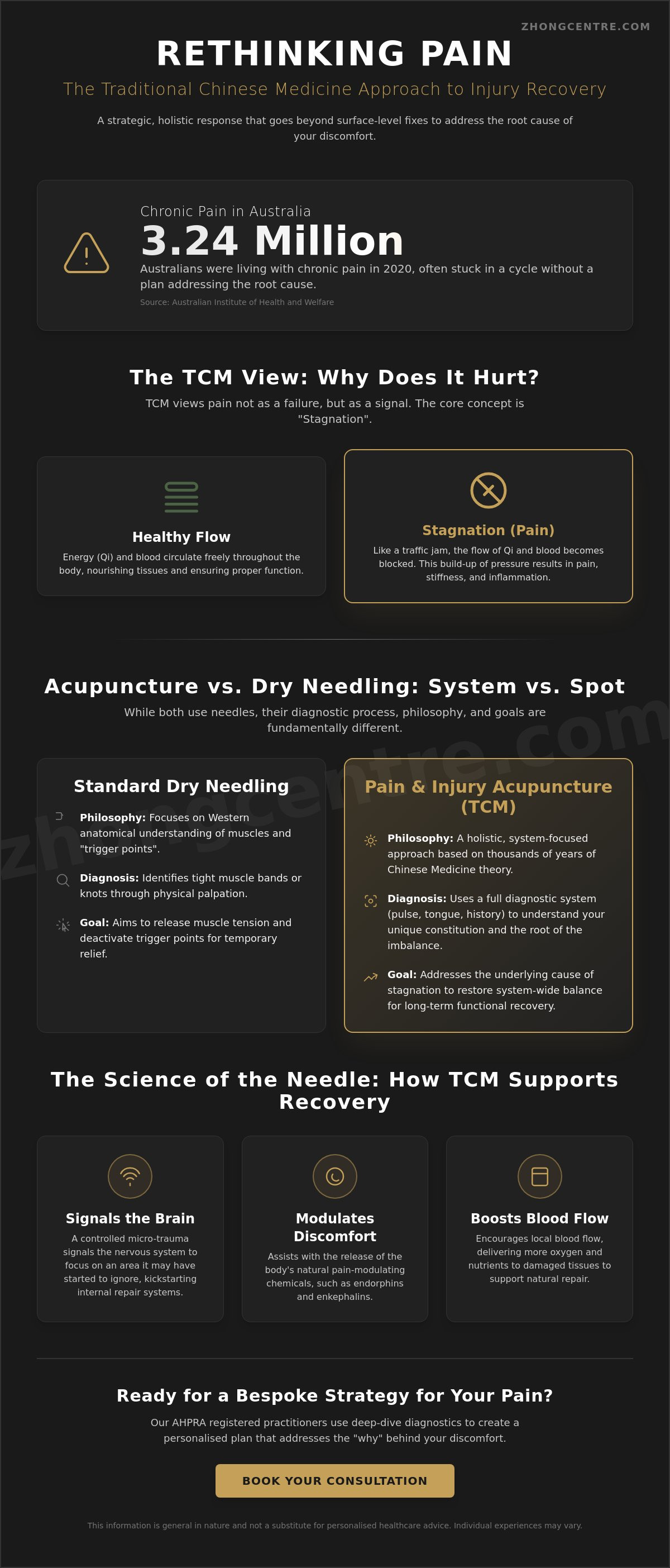
What if your nagging lower back ache isn't a sign that your body is failing, but a loud, persistent signal that your internal energy is simply stagnant? You've likely spent months cycling through ice packs and anti-inflammatories, only to find that you need more than a temporary band-aid. Seeking pain and injury acupuncture at our St Kilda centre is about looking for a strategic, holistic response rather than a surface-level approach. Statistics from the Australian Institute of Health and Welfare show that 3.24 million Australians lived with chronic pain in 2020, yet many remain stuck in a cycle of frustration without a plan that addresses the root cause of their discomfort.
This guide explores how Traditional Chinese Medicine aims to support your body’s natural recovery journey through clinical logic and diagnostic precision. You'll discover the functional difference between TCM and basic dry needling, and how our practitioners assist with restoring the mobility required for Melbourne’s active lifestyle. We're breaking down the "why" behind your physical discomfort to provide an integrated health strategy and acupuncture that finally makes sense.
This information is general in nature and not a substitute for personalised healthcare advice. Individual experiences may vary.
Key Takeaways
- Understand the concept of "stagnation" and how a diagnostic approach aims to assist with physical discomfort by addressing the root cause.
- Discover how the needle aims to support your nervous system and signal the body to prioritise its natural recovery journey.
- Learn why pain and injury acupuncture offers a more comprehensive, system-focused alternative to standard dry needling for long-term health.
- Explore how TCM diagnostics like pulse and tongue analysis are used to create a bespoke plan for chronic back and neck tension.
- Prepare for your first session at our St Kilda centre by understanding our clinical, "Rebel Expert" approach to holistic healing.
What is Pain and Injury Acupuncture? More Than Just Needles
In our St Kilda clinic, we don't view physical discomfort as a random occurrence. We see it as a diagnostic roadmap. Traditional Chinese Medicine (TCM) defines pain and injury acupuncture as a sophisticated method of physical support that looks beyond the immediate ache. It’s a clinical strategy designed to address the underlying mechanisms of why your body isn't bouncing back. While some approaches focus purely on the muscle that hurts, we look at the entire system. This isn't a "quick fix" designed to mask symptoms; it’s a real strategy aimed at restoring functional movement and long-term vitality.
The core philosophy here revolves around the concept of "stagnation." In TCM, pain is often the result of energy or blood flow becoming "stuck" in a specific area. Think of it like a traffic jam on the Nepean Highway; when the flow stops, pressure builds up. By using Acupuncture, we aim to signal the nervous system to initiate a local tissue response. This process encourages the body to prioritse blood flow to the area, assisting with the reduction of inflammation and supporting the natural repair of damaged fibres. It’s about working with your biology, not against it.
The St Kilda Approach to Physical Recovery
Melbourne’s active lifestyle is unique. Whether you’re training for the Melbourne Marathon or spending your weekends cycling along the Bayside trails, your body takes on a specific set of stresses. Our "face to feet" philosophy means we understand that a tight jaw can be linked to pelvic instability, and a shoulder injury often has roots in your postural habits at the office. We've designed our recovery plans to match this nuanced reality. We focus on getting you back to your best version, ensuring your mobility matches the energetic vibe of our local community.
AHPRA Compliance and Professional Standards
When you walk into Zhong Centre, you're meeting with AHPRA registered practitioners. This isn't just a title; it’s a standard of care that ensures your health is managed with clinical integrity. As of June 2023, there are over 4,800 registered Chinese Medicine practitioners in Australia, all held to rigorous evidence-based standards. We don't offer "cures" or "guarantees" because every body is different. Instead, we provide:
- Deep-dive diagnostic consultations: We look at your history, pulse, and tongue to understand your unique constitution.
- Evidence-based support: Our techniques are designed to assist with injury recovery based on established TCM protocols.
- Personalised care: We avoid generic "needling" and instead focus on a bespoke plan that addresses why your body felt the need to seize up in the first place.
This information is general in nature and not a substitute for personalised healthcare advice. Individual experiences may vary.
The Science of the Needle: How TCM Supports Injury Recovery
When a needle is inserted during a session of pain and injury acupuncture, it isn't just about finding a "sore spot." It’s about creating a controlled micro-trauma. This tiny, precise stimulus signals your brain to pay immediate attention to an area it may have started to ignore or over-protect. This response aims to kickstart the body’s internal repair systems, moving resources to where they are needed most. It’s a sophisticated biological nudge that encourages the body to stop "guarding" and start recovering.
This process involves a complex interaction with your nervous system. Research into acupuncture for pain control suggests that needling assists with the release of endorphins and enkephalins, which are the body's natural chemicals designed to modulate discomfort. Beyond just a chemical release, this practice addresses the appearance of swelling by encouraging local blood flow. More blood means more oxygen and nutrients delivered to damaged tissues, which supports the natural drainage of metabolic waste. We also look at neuroplasticity, aiming to retrain how your brain perceives chronic signals so you don't stay stuck in an old loop of discomfort.
Addressing Chronic Stagnation and Inflammation
In the TCM framework, we often view inflammation through the lens of "Heat" or "Dampness." If a joint feels hot, red, and angry, we address the Heat. If it feels heavy, swollen, and sluggish, we focus on the Dampness. Acupuncture aims to assist the body’s natural cooling and drainage mechanisms, moving the blood to support joint health. By addressing these internal imbalances, we provide a structured environment for your body to manage its own inflammatory response more efficiently.
The Role of Cupping in Injury Support
While needles work from the inside out, cupping therapy works from the outside in. We often describe it as a "reverse massage." Instead of pushing tension into the body, the suction pulls it out, creating space within the myofascial layers. This technique is designed to assist with myofascial release, supporting the work of acupuncture by physically decompressing tight tissues. If you're ready to see how these methods work together, consider booking your initial diagnostic to get a plan tailored to your specific needs.
This information is general in nature and not a substitute for personalised healthcare advice. Individual experiences may vary.
Acupuncture vs. Dry Needling: Which is Right for Your Body?
Many people think dry needling and acupuncture are the same thing because they both use thin needles. They aren't. Dry needling is typically a symptom-focused tool used to "reset" a trigger point in a muscle. In contrast, pain and injury acupuncture is a comprehensive diagnostic system. We don't just look at the knot in your calf; we look at why your body decided to create that knot in the first place. It’s the difference between turning off a car's "check engine" light and actually looking under the bonnet to see why the light came on. It’s a clinical strategy, not a guessing game.
Leading medical institutions like Weill Cornell Medicine recognise acupuncture as an effective treatment for various physical conditions, noting its ability to influence the central nervous system. As Rebel Experts, we choose the deeper path. We understand that a repetitive strain injury isn't just a local tissue problem. It’s often a sign of systemic stagnation or an imbalance in how your body distributes resources. By assessing your whole-body health, we aim to provide a more sustainable recovery strategy that addresses the root cause of your discomfort.
The Diagnostic Difference
Before a single needle is used, we perform a deep-dive diagnostic. This includes TCM pulse and tongue analysis. Your tongue can reveal signs of systemic inflammation or "dampness" that a local physical exam might miss. Just hitting a trigger point might offer temporary relief, but if the underlying stagnation remains, the muscle will likely seize up again. Our bespoke pain and injury acupuncture plans in St Kilda are designed to address these root causes, ensuring your recovery is built on a solid foundation rather than a temporary patch.
Beyond the Muscle: Supporting the Soul
An injury doesn't just affect your body; it affects your head too. Being sidelined from your Melbourne run club or missing out on Bayside yoga sessions is frustrating. This stress can actually slow down your recovery by keeping your nervous system in a "fight or flight" state. We treat the person, not just the knee. By addressing the stress and mental fatigue that comes with chronic discomfort, we support your "whole" self. We want you back on your feet, but we also want you to feel empowered and understood throughout the process.
This information is general in nature and not a substitute for personalised healthcare advice. Individual experiences may vary.
Common Injuries We Address in our St Kilda Centre
Living in St Kilda offers the best of both worlds: beachside vibes and proximity to the city. However, that proximity often comes with the "Melbourne commute" spine. A 2021 report indicated that Melburnians spend an average of 60 minutes a day commuting, often stuck in the same seated position on the 96 tram or crawling along the Nepean Highway. This repetitive postural stress is a primary reason people seek pain and injury acupuncture. We address the resulting lower back discomfort and the chronic neck tension that plagues the modern office warrior. For those managing more complex postural challenges, our scoliosis treatment Melbourne guide provides a deeper look at holistic spinal support.
Our work isn't limited to desk-related strain. We assist a variety of weekend warriors and local athletes with sports-related injuries. This includes supporting the recovery of ankle sprains from a run along the Esplanade or addressing the persistent ache of "tennis elbow" from the St Kilda Tennis Club. We also provide integrative support for internal physical concerns, such as assisting with the discomfort associated with pelvic inflammatory disease treatments. By looking at the body as a whole, we ensure that every injury is addressed within the context of your overall health.
Lower Back and Sciatica Support
In Traditional Chinese Medicine, the lower back is considered the "mansion of the Kidneys." This doesn't refer to the literal organs, but to a functional system called Kidney Qi that governs foundational strength and longevity. When this energy is stagnant or depleted, you might experience that "stuck" feeling or sharp nerve-related signals. Acupuncture aims to assist the body in managing these signals, providing a drug-free way to support your mobility. We often suggest St Kilda locals maintain their spinal health between sessions with gentle, consistent movement, like a daily stroll past Luna Park to keep the blood flowing.
Joint Health and Mobility
Knees and ankles are frequently the first joints to show signs of wear and tear. We focus on supporting the appearance of reduced inflammation and assisting with range of motion through "acupuncture that makes sense." By using precise needling to signal the body to prioritise these areas, we aim to improve joint longevity and flexibility. It’s about ensuring your body can keep up with your lifestyle, whether that’s a morning yoga session or a long walk on the sand. If you're ready to address your discomfort with a clear, clinical strategy, book your diagnostic consultation today.
This information is general in nature and not a substitute for personalised healthcare advice. Individual experiences may vary.
Your First Session at Zhong Centre: What to Expect
Stepping into our St Kilda centre isn't like visiting a sterile hospital ward. We've ditched the fluorescent lights and the clinical boredom for a space that feels like modern, edgy wellness. Your first session of pain and injury acupuncture is about honest health and clinical logic. We're bored with the status quo of the health industry, so we've created an environment where you feel understood on a deeper level than just your physical symptoms. We don't just address the pain; we look at the person.
Your journey starts with a deep-dive diagnostic consultation. This isn't a quick chat. We look at your history, take your pulse, and observe your tongue. These ancient TCM diagnostic tools provide us with real-time data about your internal state, showing us where energy is stagnant or where your body is struggling to prioritise recovery. From there, we develop a bespoke needle strategy. We explain exactly where the needles are going and why, ensuring the plan makes sense to you before we begin. Once the needles are in, you'll likely drift into the "Zhong State." It’s a period of deep, restorative calm where your nervous system can finally shift out of "fight or flight" mode.
How to Prepare for Your Appointment
To get the most out of your session, a little preparation goes a long way. Loose, comfortable clothing is your best friend; it allows us easy access to points on your limbs without you needing to play a game of Twister. We recommend having a light snack beforehand so your body has the energy to process the treatment, but maybe skip that third St Kilda latte. Caffeine can interfere with our ability to get an accurate pulse reading. Most importantly, bring your honesty. We're a judgment-free zone. Whether you've been "kickin' fricken goals" with your rehab or your body simply didn't read the manual this week, we just need the data to support you properly.
Meeting the Team: Dr Abbie, Dr Tahya, and Dr Matt
You'll be in the hands of practitioners who are highly qualified professionals and refreshingly down-to-earth. Whether you are seeing Dr Abbie, Dr Tahya, or Dr Matt, you're getting a mentor who values your soul as much as your skin. Our team is AHPRA registered and committed to a standard of care that prioritises your long-term health. If you're ready for a recovery plan that actually respects your body’s complexity, it’s time to take action. Book your St Kilda recovery session and let’s get your health back on track.
This information is general in nature and not a substitute for personalised healthcare advice. Individual experiences may vary.
Reclaiming Your Physical Freedom in St Kilda
Choosing a path to recovery shouldn't feel like a series of band-aid solutions. By moving beyond surface-level fixes and embracing a diagnostic strategy, you allow for a deeper understanding of your body’s unique patterns of stagnation. Our approach to pain and injury acupuncture prioritises clinical logic and systemic support, moving you closer to the active Melbourne lifestyle you value. With over 10 years of "Rebel Expert" experience in our local community, our AHPRA Registered practitioners provide the clinical authority your body deserves.
We don't do generic protocols. We do bespoke TCM diagnostics that address the root cause of your physical discomfort. It’s about providing acupuncture that makes sense and assisting your nervous system in its natural recovery journey. If you're ready to kick fricken goals, book your St Kilda session here. Your body already has the manual; we're simply here to help you translate the signals and support your "whole" self.
This information is general in nature and not a substitute for personalised healthcare advice. Individual experiences may vary.
Frequently Asked Questions
Does pain and injury acupuncture hurt?
Most people describe the sensation as a heavy, dull ache or a slight tingle rather than sharp pain. The needles we use are incredibly fine, often measuring between 0.16mm and 0.25mm in diameter. This is significantly thinner than the needles used for standard medical blood tests. You might feel a momentary sensation called "De Qi," which signals that the treatment is engaging with your nervous system. It’s a clinical nudge designed to be a comfortable, restorative experience.
How many sessions will I need to notice a difference?
Your recovery timeline depends on your unique constitution, but we generally recommend an initial strategy of 4 to 8 sessions. Acute injuries might show a response more quickly, while chronic issues that have persisted for years require a more patient, diagnostic approach. We perform a clinical review at every session to ensure your bespoke plan still makes sense for your current state of health and mobility goals.
Can I get acupuncture for an injury if I’m also seeing a physio?
Acupuncture is an excellent integrative tool that works alongside other physical therapies. While we don't provide physiotherapy ourselves, our pain and injury acupuncture focuses on the systemic "why" behind your discomfort. By addressing internal stagnation and blood flow, we aim to support the structural work you're doing with other practitioners. It’s about creating an internal environment that is primed for a successful recovery journey.
Is acupuncture for pain covered by private health insurance in Australia?
Yes, acupuncture is typically covered by most Australian private health funds under their "Extras" tables. To be eligible for a rebate, your treatment must be provided by an AHPRA registered practitioner, which includes our entire team at Zhong Centre. We provide HICAPS facilities on-site, allowing you to claim your rebate instantly after your session. The exact amount covered depends on your specific provider and your chosen level of cover.
What is the difference between acupuncture and dry needling for sports injuries?
The primary difference lies in the diagnostic depth; dry needling is a symptom-based tool for trigger points, while acupuncture is a system-based medicine. We look at your pulse, tongue, and overall lifestyle to understand why a muscle is tight. This holistic assessment aims to provide more sustainable support by addressing the underlying imbalances that lead to recurring sports injuries rather than just addressing the local ache in isolation.
Can acupuncture assist with chronic back pain that has lasted for years?
Acupuncture is specifically designed to assist with long-term discomfort by addressing chronic stagnation and modulating the nervous system. Even if your back pain has been a constant companion for 10 years, we focus on retraining how your brain perceives these persistent signals. Our goal is to support your body’s natural ability to manage inflammation and improve your daily mobility through a tailored, evidence-based TCM strategy.
Are there any side effects to pain management acupuncture?
Minor side effects can include slight bruising at the needle site or a temporary feeling of tiredness, often referred to as an "acupuncture hangover." These responses are generally mild and tend to resolve within 24 to 48 hours. Many people report feeling a sense of deep relaxation or entering the "Zhong State" during and after their session. It’s a sign that your body is shifting from a stressed state into a restorative mode.
How soon after a sports injury can I have acupuncture?
You can often begin acupuncture support within 24 to 72 hours of an acute sports injury. In these early stages, our focus is on assisting the body with the appearance of swelling and supporting the natural inflammatory process. By addressing the injury early, we aim to support the tissue repair journey and help you maintain better mobility as you prepare to return to your regular Melbourne training routine.
This information is general in nature and not a substitute for personalised healthcare advice. Individual experiences may vary.